Sitharaman: India Powers 50% of Global Real-Time Digital Transactions
Synopsis
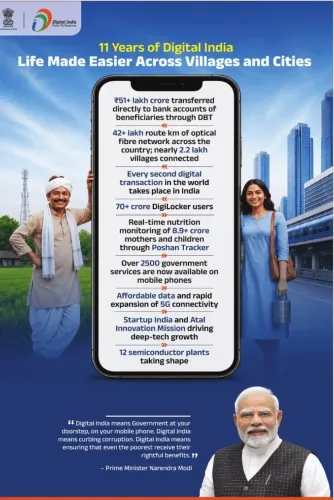
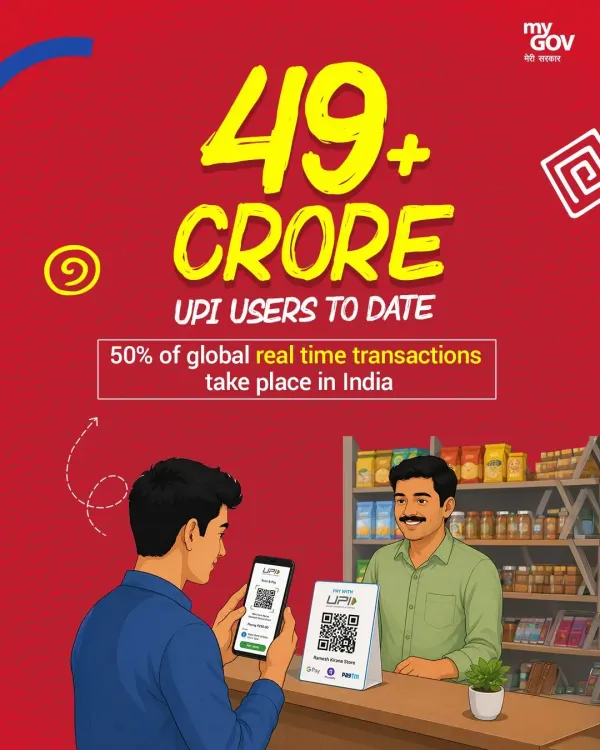
Union Finance Minister Nirmala Sitharaman marked 11 years of Digital India on 1 July 2026, citing over 49 crore UPI users and India's 50% share of all global real-time digital transactions — a milestone that underscores the country's emergence as the world's largest real-time payments ecosystem.
Key Takeaways
Union Finance Minister Nirmala Sitharaman posted on 1 July 2026 to mark 11 years of the Digital India programme .
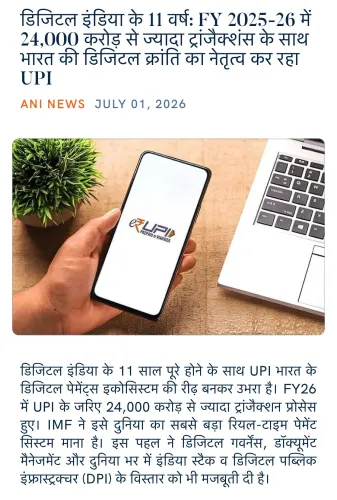
India now has over 49 crore (490 million) UPI users , according to the Finance Minister's post.
India accounts for 50% of all global real-time digital transactions , as cited by Sitharaman.
UPI was launched in August 2016 by NPCI and has since become the world's most widely used real-time payments rail.
The Digital India programme, launched in July 2015 , created the policy and infrastructure foundation for this growth.
India is actively exporting the UPI model internationally through bilateral agreements with multiple countries.
Union Finance Minister Nirmala Sitharaman on Wednesday, 1 July 2026 highlighted India's dominance in real-time digital payments, citing over 49 crore UPI users and the country's share of 50% of all global real-time digital transactions — marking the occasion of 11 years of the Digital India programme.
Context
Sitharaman's post, shared on the anniversary of the Digital India initiative, underscores the scale at which India's payments infrastructure has grown since the programme's launch in July 2015. The hashtag #11YearsOfDigitalIndia [11 years of Digital India] anchors the message to a decade-plus of policy-driven digital transformation. The Finance Minister described the momentum as 'an unstoppable digital revolution.'
The Unified Payments Interface (UPI), the backbone of this growth, was rolled out in August 2016 by the National Payments Corporation of India (NPCI). It enables instant, interoperable bank-to-bank transfers through mobile applications — at near-zero cost to end users.
Policy Backdrop
The Digital India programme was conceived as a whole-of-government initiative to build digital infrastructure, expand e-governance services, and promote digital literacy across the country. UPI emerged as one of its most consequential outputs, riding on the broader India Stack — a set of open, interoperable digital public goods that allow private fintech applications to operate on government-built rails.
The post-2016 demonetisation period gave UPI adoption a significant push, accelerating the shift away from cash. Since then, successive policy nudges — including merchant incentive schemes, zero-charge mandates on person-to-person transfers, and international expansion agreements — have compounded growth. India has signed bilateral agreements to extend UPI acceptance in several countries, positioning the system as a model for digital public infrastructure globally.
Stakeholders and Impact
The figure of 49 crore users — roughly 490 million people — reflects deep penetration across urban and semi-urban India, with ongoing efforts to bring rural and unbanked populations onto the platform. Fintech companies, commercial banks, and small merchants are among the primary stakeholders who have built businesses atop UPI's interoperable architecture.
NPCI, the not-for-profit entity that governs UPI, has also been active in exporting the model: UPI-linked payment systems are now operational in markets including Singapore, the UAE, France, Sri Lanka, and others. The claim of a 50% share of global real-time transactions — if sustained — would cement India's position as the world's largest real-time payments market by volume, ahead of far larger economies.
What's Next
Analysts and policymakers will watch for further bilateral agreements that expand UPI's international footprint, as well as any new regulatory framework around cross-border payments and data protection expected in upcoming parliamentary sessions. The government is also expected to deepen financial inclusion by extending UPI access to feature-phone users through the UPI 123Pay and UPI Lite features. The 11-year milestone is likely to set the tone for the next phase of India's digital public infrastructure ambitions — including potential integration with emerging central bank digital currency frameworks.
Point of View
Timed to the 11th anniversary of Digital India to draw a direct line between a decade of BJP-led policy and India's now-dominant position in global real-time payments. The 50% global transaction share claim, if verified, is a genuinely striking data point that no major economy has previously achieved at this scale — making it a powerful political and diplomatic asset. This fits a broader pattern in which the Finance Ministry uses UPI growth statistics as a proxy indicator for financial inclusion and economic modernisation under the current administration. The next frontier — cross-border UPI expansion and a potential CBDC interface — will test whether India can translate domestic scale into lasting global payments influence.
NationPress
30 Sept 2026
Frequently Asked Questions
What is UPI and why is it important?
UPI, or Unified Payments Interface, is a real-time interbank payment system operated by the National Payments Corporation of India (NPCI) , launched in August 2016 . It allows users to transfer money instantly between bank accounts using a mobile app, at little to no cost, and has become the backbone of India's digital payments ecosystem.
What did Nirmala Sitharaman say about Digital India on 1 July 2026?
Finance Minister Nirmala Sitharaman posted on 1 July 2026 that India has over 49 crore UPI users and accounts for 50% of all global real-time digital transactions , calling it 'an unstoppable digital revolution' on the occasion of 11 years of Digital India .
When was the Digital India programme launched?
The Digital India programme was launched in July 2015 by the Government of India to build digital infrastructure, deliver e-governance services, and promote digital literacy nationwide.
How many countries accept UPI payments?
UPI-linked payment systems are operational in several countries including Singapore, the UAE, France , and Sri Lanka , among others, as India expands its digital payments footprint through bilateral agreements.
What is India's share of global real-time digital transactions?
According to Finance Minister Nirmala Sitharaman , India accounts for 50% of all global real-time digital transactions as of 2026 , driven by the rapid adoption of the UPI platform.