Anand Mahindra on China's K-shaped economy: a mirror for India
Synopsis
Mahindra Group chairman Anand Mahindra invoked journalist James Crabtree's analysis of China's K-shaped economy — dazzling tech, collapsing property — to argue India must scrutinise itself with the same critical eye it trains on rivals, not less.
Key Takeaways
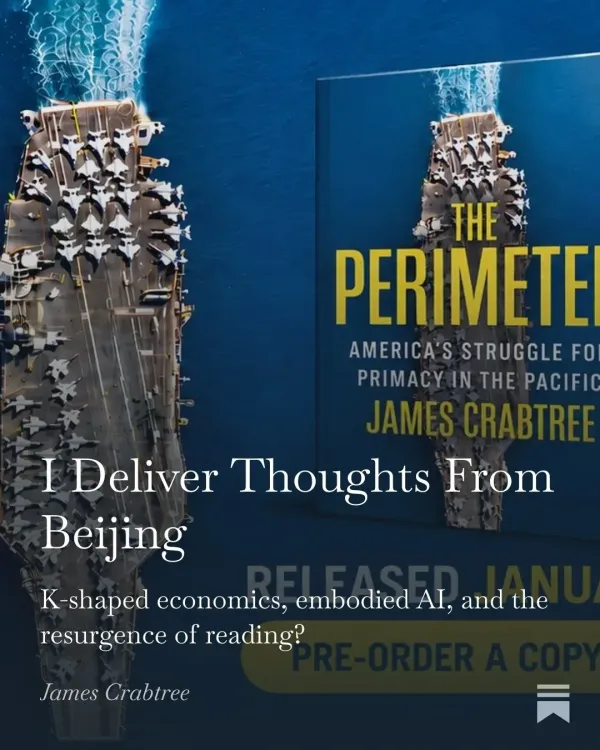
Mahindra Group chairman Anand Mahindra posted his reflection on 4 November 2026 , anchored to a piece by journalist James Crabtree .
Crabtree described being 'blown away' by Shenzhen 's tech ecosystem while documenting falling investment, weak demand, free-falling property, and stalled private spending in China .
China's EV sector was characterised as a 'bloodbath' with over a hundred brands in relentless price wars and razor-thin margins.
Mahindra framed China as a K-shaped economy — remarkable technological progress alongside deep structural stress — not a model to uncritically admire or dismiss.
His core argument: India applies a magnifying glass to other nations' achievements and a microscope to its own flaws — a perceptual imbalance that blocks genuine understanding.
He explicitly rejected Schadenfreude over China's difficulties, calling instead for equal, unsentimental analysis of every economy including India's.
A magnifying glass for others, a microscope for ourselves — that is the perceptual trap Mahindra Group chairman Anand Mahindra says India must escape. In a pointed reflection posted on X on Wednesday, 4 November 2026, Mahindra drew on a recent essay by veteran Asia journalist James Crabtree to hold up China's economy as a study in coexisting brilliance and brittleness — and to ask whether India applies the same rigorous honesty to its own story.
Shenzhen's dazzle and the cracks beneath it
Mahindra quoted Crabtree's first-hand awe at Shenzhen — 'blown away by the power of its tech ecosystem' — before immediately pivoting to the structural rot the same writer documented: 'Investment is falling, demand is weak, property is in free fall, and private business has stopped spending.' The juxtaposition is deliberate. China, the world's second-largest economy, can dazzle and distress in the same breath.
Nowhere is that tension sharper than in electric vehicles. Mahindra cited Crabtree's description of the sector as 'a well-known bloodbath: well over a hundred brands locked in relentless price wars, margins are razor-thin, and almost nobody besides a handful of sector leaders is making money.' That hyper-competition, Mahindra acknowledged, has forged genuinely formidable global players. But it has also destroyed capital on an industrial scale.
The K-shaped economy — and what India should read into it
The phrase Mahindra reaches for is K-shaped: an economy where technological advancement and deep economic stress do not cancel each other out — they coexist, one arm of the K climbing, the other falling. It is a framework increasingly used to describe post-pandemic recoveries globally, and Mahindra applies it here with precision. Remarkable innovation at the top; hollowed-out property markets, weak demand, and stalled private investment at the bottom.
Indian business leaders and policymakers have long studied China's manufacturing scale and technology adoption. That comparison is often flattering to China and sobering for India. Mahindra does not dispute China's achievements — 'there is much to admire and learn,' he writes — but he is equally clear that selective admiration is its own distortion.
Schadenfreude is not the point — balance is
Mahindra reaches for a German word to describe what he is not feeling: Schadenfreude — pleasure derived from another's misfortune. He is explicit that a Chinese economic downturn would not please him. The real provocation in his post is epistemological, not competitive: why do Indians scrutinise their own economy through a microscope 'trained on every flaw' while viewing rivals through a magnifying glass that inflates every win?
It is a question that lands with particular weight for India's corporate class, which often benchmarks manufacturing ambition, EV scale, and digital infrastructure against Chinese benchmarks — sometimes with excessive deference, sometimes with reflexive dismissal. Mahindra's argument is simpler and harder: apply the same critical eye to every economy, including your own. 'Neither excessive admiration nor excessive criticism should get in the way of deeper understanding,' he concludes.
In a business climate where India's EV policy, manufacturing push, and tech-sector ambitions are all live debates, that call for calibrated, unsentimental analysis may be the most useful thing a chairman can say.
Point of View
Where digital and manufacturing growth coexist with agrarian stress and uneven consumption. His rejection of Schadenfreude also signals that Indian industry's interests are entangled with, not insulated from, Chinese economic health — through supply chains, commodity prices, and global investor sentiment. The practical takeaway for Indian executives: build strategy on China's full picture, not its highlight reel.
NationPress
4 Nov 2026
Frequently Asked Questions
What did Anand Mahindra say about China's economy?
Mahindra described China as a K-shaped economy where remarkable technological progress — especially in cities like Shenzhen — coexists with falling investment, a property collapse, weak demand, and stalled private spending, drawing on analysis by journalist James Crabtree.
What is a K-shaped economy?
A K-shaped economy is one where two divergent trajectories operate simultaneously — one segment (often technology or high-income sectors) climbs strongly while another (property, small business, or lower-income groups) declines, with the two arms of the 'K' moving in opposite directions.
What did Anand Mahindra say about China's EV market?
Mahindra quoted James Crabtree's description of China's EV sector as a 'well-known bloodbath' with over a hundred brands in relentless price wars, razor-thin margins, and almost no profitability outside a handful of sector leaders.
What is the meaning of Schadenfreude and why did Mahindra mention it?
Schadenfreude is a German word meaning pleasure derived from someone else's misfortune. Mahindra invoked it specifically to say that was not his sentiment — he has no interest in China's economic difficulties, and his purpose was to call for balanced, critical analysis of all economies, not to celebrate a rival's troubles.
What is Mahindra's message for India in this post?
Mahindra argued that India often views other nations' achievements through a magnifying glass and its own through a microscope focused on flaws. His call: apply the same rigorous, unsentimental critical eye to every economy — including India's — for 'deeper understanding.'