Make in India, Startup India driving manufacturing growth: Industry leaders at Bharat Forward Summit
Synopsis
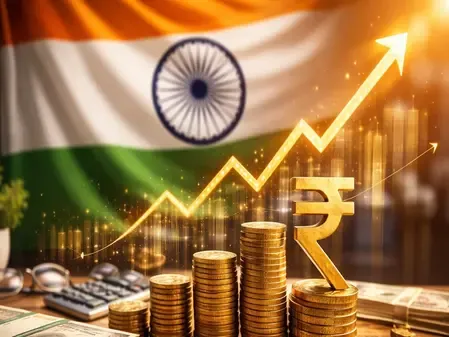
At the Bharat Forward Summit in New Delhi, industry voices and a Union Minister converged on a striking data point: 548 of India's 750 districts are now recording exports. Combined with a rural consumption market estimated at over ₹42 lakh crore, the picture being painted is of an Indian economy whose industrial and consumption story is quietly becoming far more geographically broad-based than the traditional metro-centric narrative suggests.
Key Takeaways
Rohit Sood of Bertelsmann India Investments credited Make in India and Startup India with significant expansion in mobile phone manufacturing and exports.
India's rural consumption is estimated at over ₹42 lakh crore annually, according to Rozana co-founder Adwait Singh .
Consumer goods consumption in Uttar Pradesh alone is estimated between ₹1.5 lakh crore and ₹2 lakh crore .
Union Minister Giriraj Singh said 548 of India's 750 districts have recorded exports, reflecting geographic broadening of economic activity.
Industry leaders flagged advanced manufacturing and speciality chemicals as emerging investment destinations within India's industrial ecosystem.
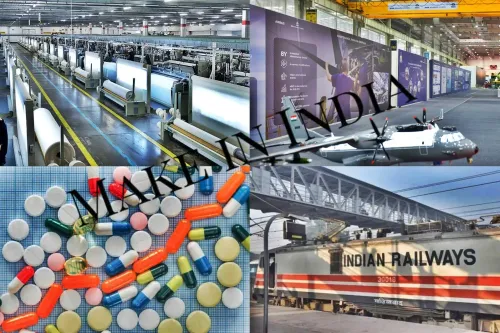
Industry leaders on 17 November 2026 credited Prime Minister Narendra Modi's flagship Make in India and Startup India programmes with significantly accelerating manufacturing activity, drawing investment and deepening India's entrepreneurial ecosystem over the past decade. The assessments were shared at the Bharat Forward Summit in New Delhi.
Industry Voices on a Decade of Progress
Rohit Sood, Partner at Bertelsmann India Investments (BII), said both schemes — launched during Modi's first term — had produced measurable outcomes across multiple sectors. 'Make in India and Startup India have been highly successful initiatives. Mobile phone manufacturing has expanded significantly under Make in India and exports have also increased substantially,' Sood said on the sidelines of the summit.
Sood noted that the policy environment had channelled capital into areas including advanced manufacturing and speciality chemicals. Bertelsmann India Investments has itself backed startups in speciality chemicals and advanced materials, he said, reflecting broader investor confidence in India's industrial ecosystem.
Looking ahead, Sood emphasised that manufacturing would need to contribute more meaningfully to India's growth trajectory, pointing to China, Japan, and Germany as economies that built durable wealth through industrial expansion.
Rural Economy Emerging as a Growth Engine
Adwait Singh, co-founder of Rozana, drew attention to the scale of India's rural consumption, estimating it at over ₹42 lakh crore annually. He said the market for products such as cosmetics, processed foods, and consumer goods in Uttar Pradesh alone was estimated at between ₹1.5 lakh crore and ₹2 lakh crore. The figures, he argued, underscore that rural India is no longer a peripheral footnote in the country's consumption story.
What the Government Said
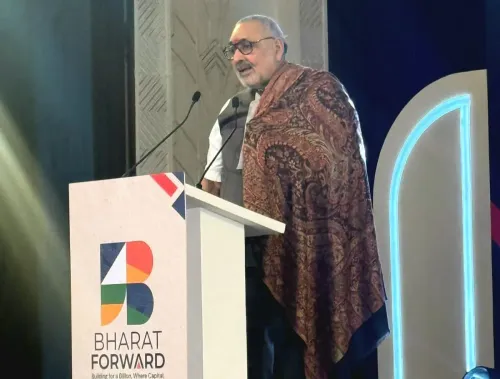
Union Minister Giriraj Singh, addressing the Bharat Forward Summit, said Prime Minister Modi's vision of a Viksit Bharat by 2047 was increasingly visible on the ground. He pointed to export data as evidence of geographic broadening: 548 of India's 750 districts had recorded exports, he said, underscoring that economic participation was no longer confined to traditional industrial centres.
The minister described rising exports, expanding manufacturing activity, and stronger rural economic engagement as markers of India's ongoing structural transformation and its growing integration into the global economy.
Why It Matters
The industry endorsements come at a moment when India is seeking to consolidate its position as a global manufacturing alternative, particularly as supply chains shift away from China. India's mobile phone exports, often cited as Make in India's headline success, have grown from near-zero to billions of dollars over the past decade. However, critics have long noted that India's manufacturing share of GDP has remained stubbornly near 17% against a longstanding target of 25%, raising questions about the depth of the transformation. Notably, the breadth of district-level export participation — if sustained — could signal a more structural shift than earlier cycles of industrial policy.
What to Watch Next
With the 2047 development target as a guiding framework, attention will turn to whether rural consumption can be more systematically linked to domestic manufacturing capacity, closing the gap between demand and local supply. The expansion of speciality chemicals and advanced materials investment, flagged by Bertelsmann India Investments, may offer a leading indicator of where the next wave of industrial activity is headed.
Point of View
Well short of the 25% target, suggesting that headline export wins in mobile phones have not yet translated into a structural industrial shift. The 548-district export figure, if robustly verified, is the more genuinely interesting data point — it suggests the pipeline of participation is widening even if the aggregate share has not moved dramatically. The real policy question is whether rural consumption on the scale Rozana describes can be systematically redirected toward domestically manufactured goods rather than imports, which would be the true multiplier for both Make in India and jobs creation.
NationPress
17 Nov 2026
Frequently Asked Questions
What is the Make in India initiative and what has it achieved?
Make in India is a flagship government scheme launched during Prime Minister Narendra Modi's first term to boost domestic manufacturing and exports. Industry leaders at the Bharat Forward Summit cited significant expansion in mobile phone manufacturing and a substantial rise in exports as among its key outcomes over the past decade.
How large is India's rural consumption market?
According to Rozana co-founder Adwait Singh, India's rural consumption stands at over ₹42 lakh crore annually. He estimated that consumer goods demand in Uttar Pradesh alone — covering cosmetics, processed foods, and other products — is between ₹1.5 lakh crore and ₹2 lakh crore.
How many Indian districts are now recording exports?
Union Minister Giriraj Singh stated at the Bharat Forward Summit that 548 of India's 750 districts have recorded exports. He presented this as evidence that export activity is no longer concentrated in traditional industrial hubs.
What sectors are attracting manufacturing investment in India?
According to Rohit Sood of Bertelsmann India Investments, capital is flowing into advanced manufacturing and speciality chemicals, in addition to mobile phone production. His firm has backed startups in speciality chemicals and advanced materials, reflecting growing investor interest in these segments.
What is the Viksit Bharat 2047 vision?
Viksit Bharat 2047 is the Modi government's long-term goal of making India a developed nation by the centenary of its independence. Union Minister Giriraj Singh said at the Bharat Forward Summit that the vision is increasingly visible on the ground, citing rising exports and broader district-level economic participation as indicators.