Indian Stock Markets Close FY26 Lower Amid Middle East Tensions
Synopsis
As the fiscal year 2026 wraps up, Indian stock markets faced significant declines, primarily driven by escalating tensions in the Middle East. Selling pressure across sectors signals a challenging economic outlook.
Key Takeaways
Indian stock markets ended FY26 on a weak note.
Escalating tensions in the Middle East led to heavy selling.
Nifty and Sensex fell significantly, closing below crucial support levels.
Financial stocks faced the most substantial losses.
Broader market indices also experienced declines.
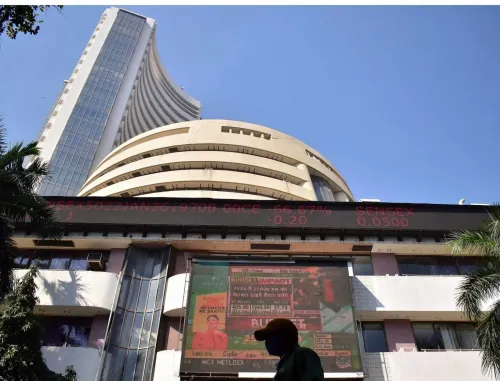
Mumbai, March 30 (NationPress) The Indian stock markets concluded the final trading session of fiscal year 2026 on a subdued note, influenced by escalating global tensions stemming from the ongoing conflict in the Middle East. The extended warfare has heightened worries regarding economic growth and inflation, prompting substantial selling across the equity markets.
The benchmark Nifty experienced a significant decline of 2.14 percent, or 488.20 points, finishing the day at 22,331.40. In a similar trend, the Sensex fell by 2.22 percent, equating to a drop of 1,635.67 points, and closed at 71,947.55.
Experts analyzing the Nifty's technical outlook noted that closing below the vital 22,500 support level is critical and indicates a potential continuation of the overall downtrend.
“On the upside, the 22,500–22,600 range is now regarded as immediate resistance, where the index has encountered persistent selling pressure,” stated an analyst.
Selling pressure was notably pronounced in the financial sector, with Bajaj Finance, Shriram Finance, and State Bank of India leading the losses on the Nifty index.
Within the Sensex constituents, Tech Mahindra and Power Grid were the only two stocks that managed to finish in positive territory.
Conversely, shares such as Bajaj Finance, IndiGo, Bajaj Finserv, Axis Bank, and Kotak Mahindra Bank were among the biggest losers.
The downturn was not confined to large-cap stocks; broader markets also witnessed significant declines, as the Nifty MidCap index fell by 2.68 percent, and the Nifty SmallCap index dropped by 2.66 percent.
From a sectoral perspective, banking and financial stocks were the hardest hit, with indices like Nifty PSU Bank, Nifty Bank, and Nifty Financial Services emerging as the day's worst performers.
In contrast, metal and oil & gas stocks exhibited relatively smaller declines compared to other sectors, providing some support to the market.
Analysts indicated that increasing geopolitical uncertainty and inflation worries continued to undermine investor sentiment, resulting in a sharp correction in equities as the fiscal year drew to a close.
"The escalation of Iranian strikes, the entry of Houthis into the conflict, and a noticeable increase in US troop presence in the region collectively raised fears of escalation, with no viable pathway to alleviate energy prices pushing investors into risk-averse territory," remarked a market expert.
Point of View
It is crucial to stay informed about market trends and broader economic indicators.
NationPress
22 Oct 2026
Frequently Asked Questions
What caused the decline in Indian stock markets?
The decline was primarily driven by rising tensions in the Middle East, which raised concerns about economic growth and inflation.
How much did the Nifty and Sensex drop?
The Nifty fell by 2.14 percent, while the Sensex dropped by 2.22 percent.
Which sectors were most affected?
Banking and financial stocks were among the hardest hit, with significant losses across large-cap stocks.
Is this decline indicative of a longer-term trend?
Closing below key support levels suggests a continuation of the broader downtrend in the market.
What should investors consider moving forward?
Investors should remain vigilant about geopolitical developments and their potential impact on market performance.