How Middle East Conflicts Are Impacting Indian Stock Market This Week
Synopsis
As tensions escalate in the Middle East, the Indian stock market faces significant volatility. Analysts predict continued bearish sentiment, with key sectors under pressure. Stay informed about crucial market movements and potential trading strategies.
Key Takeaways
Geopolitical tensions in the Middle East are impacting Indian stock market sentiments.
Kuwait has halted oil production, raising concerns over supply.
Analysts predict continued bearish trends in the market.
Selective buying opportunities may exist in specific sectors.
Investors should monitor key economic indicators closely.
Mumbai, March 8 (NationPress) This week, the sentiment of the Indian stock markets is poised to be significantly influenced by the ongoing geopolitical strife in the Middle East, leading analysts to predict volatile fluctuations on the bourses.
Kuwait has declared a halt to its oil production and refining activities, citing that tankers cannot navigate the Persian Gulf due to threats from Iran. The Arab nation labeled this output reduction as a precautionary measure, although the specific volume of the cut remains undisclosed.
Global investors are also contending with the potential for commodity-driven inflation, which presents a complex challenge for those in monetary policy, according to an analyst.
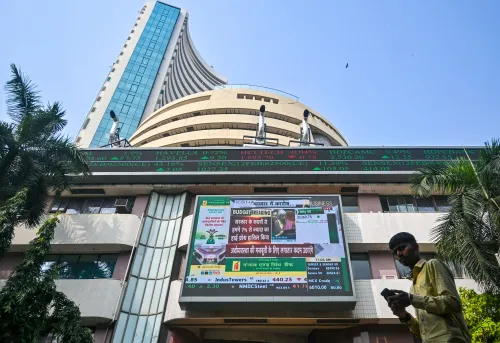
Recently, Indian equity markets have shown considerable volatility, experiencing relentless selling pressure in the past week. The Nifty 50 concluded at 24,450, while the Sensex closed at 78,919, both reflecting a decline of 2.9% on a weekly basis. The Bank Nifty ended near 57,783, marking a 4.5% drop, indicating a marked underperformance compared to the wider market.
“From a technical standpoint, the index is positioned below the previous swing low, signaling ongoing bearish sentiment. In the near term, the index could continue its downward trajectory, potentially approaching 24,000 or less,” stated Rupak De, Senior Technical Analyst at LKP Securities.
“On the upside, resistance is identified at 25,000; unless this threshold is decisively breached, the prevailing trend is likely to favor a sell-on-rise strategy,” the analyst added.
Selective buying opportunities may arise in sectors such as pharmaceuticals, defense, public sector enterprises (PSEs), as well as specific metals and energy stocks, according to Ajit Mishra, SVP of Research at Religare Broking Ltd.
Conversely, stocks in banking, real estate, IT, and select FMCG sectors may continue to experience pressure, he noted.
Investors will be monitoring global developments, crude oil prices, and the Consumer Price Index (CPI) inflation data due on March 12, as these will provide insights into price pressures following the recent surge in crude oil prices.
Furthermore, data on foreign exchange reserves will be scrutinized by investors to evaluate the robustness of India’s external buffers.
Qatar’s energy minister, Saad al-Kaabi, previously warned that if the conflict in the Middle East persists for a few more days, Gulf exporters may declare force majeure, leading to halted deliveries and driving oil prices up to $150 a barrel, with natural gas reaching $40 per MMBtu within weeks.
Point of View
The Indian stock market is navigating through turbulent waters. The volatility observed in recent weeks highlights the interconnectedness of global events and local market dynamics, necessitating a cautious approach from investors.
NationPress
17 Sept 2026
Frequently Asked Questions
What are the expected trends in the Indian stock market this week?
Analysts anticipate significant volatility driven by geopolitical tensions in the Middle East, with a bearish outlook for major indices.
How is Kuwait's oil production halt affecting global markets?
Kuwait's oil production reduction is a precautionary measure due to threats in the Persian Gulf, potentially influencing oil prices and global inflation risks.
Which sectors may present buying opportunities?
Opportunities may arise in pharmaceuticals, defense, public sector enterprises, metals, and energy stocks amid current market conditions.
What indicators should investors watch for?
Investors should keep an eye on crude oil prices, CPI inflation data, and foreign exchange reserves to gauge market direction.
What was the performance of the Nifty and Sensex last week?
Last week, the Nifty 50 closed at 24,450 and the Sensex at 78,919, both down approximately 2.9% on a weekly basis.