MSME rail freight access could unlock major logistics gains: FICCI-KPMG report
Synopsis
A FICCI-KPMG report reveals that MSMEs — contributing over 31% of India's GDP — are being shut out of rail freight by infrastructure and aggregation gaps, despite rail costing nearly half as much per tonne-km as road. Fixing this isn't just good for small businesses; it could fundamentally rebalance how India moves goods.
Key Takeaways
A joint FICCI-KPMG report released on 23 July calls for urgent improvements in rail accessibility for MSMEs .
Rail freight costs average ₹1.96 per tonne-km versus ₹3.78 per tonne-km by road — yet most MSMEs still use roads.
MSMEs contribute over 31% of India's GDP, 35% of manufacturing output, and nearly half of total exports.
Key barriers cited include fragmented consignments, poor terminal access, and first- and last-mile connectivity gaps.
The report recommends freight aggregation platforms, modernised terminals, digital interfaces, and demand-led wagon planning.
Union Minister Nitin Gadkari stated in April that India's logistics costs are on course to fall to 9% of GDP.
Improving rail accessibility for micro, small and medium enterprises (MSMEs) could unlock significant freight growth while lowering logistics costs across India, according to a joint report by FICCI and KPMG in India released on Thursday, 23 July. The report identifies MSMEs as an untapped and strategically vital customer segment for rail services.
The Core Problem: Why MSMEs Still Choose Roads
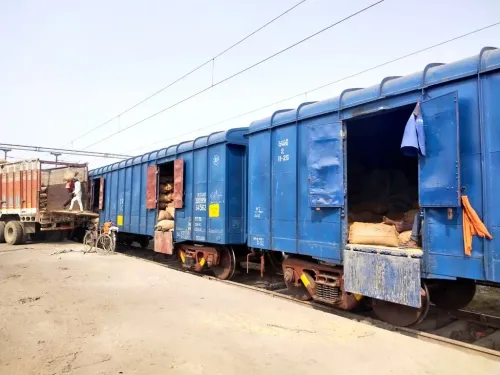
Despite rail's structural cost advantage, most MSMEs continue to rely on road transport. The report attributes this to fragmented consignments, limited cargo aggregation infrastructure, inadequate terminal access, first- and last-mile connectivity gaps, service unpredictability, and difficulty in accessing suitable rolling stock.
The cost differential is stark: average rail freight costs stand at ₹1.96 per tonne-km compared with ₹3.78 per tonne-km by road — a gap of nearly 93%. India's national rail network also operates on a common technical and digital platform, giving it a non-discriminatory reach that road logistics cannot replicate at scale.
Why MSMEs Matter to India's Freight Future
MSMEs are not a peripheral segment. They contribute more than 31% of India's GDP, account for 35% of manufacturing output, and represent nearly half of the country's total exports, according to the report. Bringing this segment into the rail freight ecosystem would, in effect, reshape India's logistics map.
Sameer Bhatnagar, Partner and Lead — Mobility and Logistics at KPMG in India, said: 'Rail operates across the country on a uniform operating system on a non-discriminatory basis and is therefore capable of offering competitive logistics services to them. By addressing accessibility concerns, rail and MSMEs can gain symbiotically and play a pivotal role in India's freight ecosystem and economy.'
Key Recommendations from the Report
The FICCI-KPMG report outlines five priority interventions: strengthening freight aggregation platforms; modernising common-user terminals; improving digital visibility and customer-facing interfaces; enhancing first- and last-mile connectivity; and adopting demand-led wagon planning. Together, these are framed as the structural fixes needed to make rail a practical choice — not just a theoretical one — for smaller businesses.
Government's Parallel Push on Logistics Costs
The report arrives alongside a broader government push to reduce India's overall logistics burden. Union Minister of Road Transport and Highways Nitin Gadkari stated in April that India's logistics cost is on track to fall to 9% of GDP at the current pace of road infrastructure development.
Gadkari cited research by IIT Bangalore, IIT Kanpur, and IIT Chennai — completed approximately six months prior — which reportedly showed that road infrastructure improvements had already reduced logistics costs by 6%, bringing them down to around 10% of GDP. This comes amid a wider national ambition to cut logistics costs from their historically high levels and improve India's global trade competitiveness.
What Comes Next
The convergence of a FICCI-KPMG policy blueprint and active government signalling on logistics reform suggests the MSME-rail freight gap is moving up the policy agenda. Whether the recommendations translate into terminal investments and aggregation infrastructure — rather than remaining a well-researched wishlist — will determine the actual freight shift.
Point of View
It is a structural one. The real question is why, after decades of this advantage existing on paper, MSMEs are still loading trucks. The FICCI-KPMG report correctly identifies infrastructure and aggregation failures as the culprit, but India has seen similar recommendations before without the terminal investments to back them. With MSMEs accounting for nearly half of exports, the stakes of inaction are macroeconomic, not just sectoral. The government's parallel road-infrastructure push, while welcome, risks entrenching road dependency further if rail reforms do not keep pace.
NationPress
22 Oct 2026
Frequently Asked Questions
What does the FICCI-KPMG report say about MSMEs and rail freight?
The report, released on 23 July, finds that improving rail accessibility for MSMEs could unlock significant freight growth and lower logistics costs. Despite rail being nearly half the cost of road transport per tonne-km, most MSMEs continue to rely on roads due to infrastructure and service gaps.
How much cheaper is rail freight compared to road freight in India?
According to the report, average rail freight costs ₹1.96 per tonne-km, compared with ₹3.78 per tonne-km by road — making rail roughly 93% cheaper on a per-unit basis. However, first- and last-mile gaps and aggregation challenges prevent most MSMEs from accessing this advantage.
Why are MSMEs important to India's freight ecosystem?
MSMEs contribute over 31% of India's GDP, 35% of manufacturing output, and nearly half of the country's total exports. Integrating them into the rail freight network would add a large, underserved customer segment and help rebalance India's heavily road-dependent logistics system.
What solutions does the report recommend to improve MSME rail access?
The report recommends five key interventions: strengthening freight aggregation platforms, modernising common-user terminals, improving digital visibility and customer interfaces, enhancing first- and last-mile connectivity, and adopting demand-led wagon planning.
What has the government said about reducing India's logistics costs?
Union Minister Nitin Gadkari stated in April that India's logistics costs are on track to fall to 9% of GDP. He cited IIT research showing road infrastructure improvements had already reduced logistics costs by 6%, bringing them to around 10% of GDP.