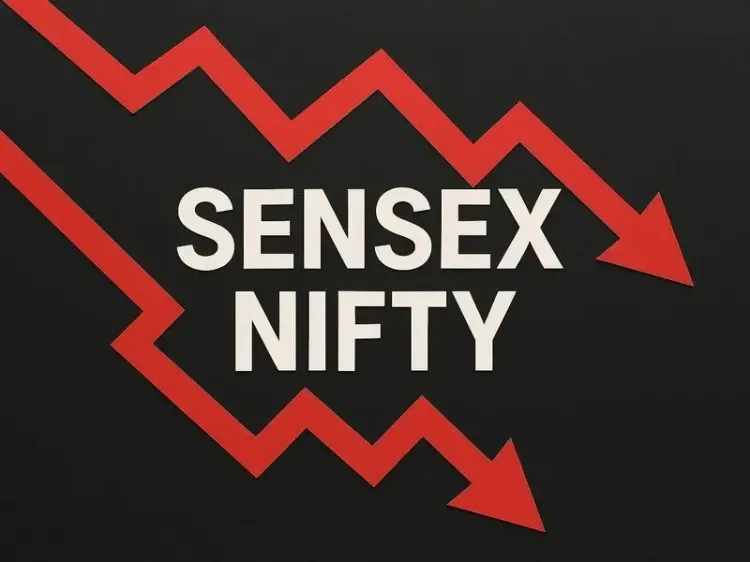
Nifty falls 11% between Navratri 2025 and Navratri 2026 as global headwinds batter markets
Synopsis
A year that began with Navratri optimism ended with the Nifty down 11% — a bruising stretch defined by ₹3.04 lakh crore in FPI outflows, a US-Iran conflict-driven oil spike, and a weakening rupee. While Shriram Finance surged 49% against the tide, heavyweight names like Infosys, TCS, and HDFC Bank shed up to 30%, exposing how sharply global headwinds can override India's domestic growth story.
Key Takeaways
The Nifty50 fell 11 per cent between Navratri 2025 and Navratri 2026 , with 31 of 50 constituents ending in negative territory.
Foreign portfolio investors sold Indian equities worth ₹3.04 lakh crore in 2026 , following ₹1.66 lakh crore in net outflows in 2025 .
ITC , Tata Motors PV , Infosys , Jio Financial Services , and TCS each declined more than 30 per cent .
Shriram Finance was the top Nifty performer, surging nearly 49 per cent during the period.
Analysts expect the market to remain range-bound near term, with crude oil prices and global bond yields as key watchpoints.
The Nifty50 index declined 11 per cent between Navratri 2025 and Navratri 2026, with a majority of its constituents ending deep in the red, as global economic and geopolitical headwinds overpowered India's resilient domestic growth fundamentals. The year-long selloff was driven by a combination of elevated crude oil prices, a weakening rupee, rising global bond yields, and relentless selling by foreign portfolio investors.
The Scale of the Decline
Of the 50 stocks in the Nifty index, 31 delivered negative returns over the period, and around 20 constituents fell by more than 12 per cent. The damage was concentrated in large-cap IT, auto, and consumer names.
ITC, Tata Motors PV, Infosys, Jio Financial Services, and Tata Consultancy Services (TCS) were among the worst performers, each declining more than 30 per cent. HDFC Life Insurance, Maruti Suzuki, HDFC Bank, Hindustan Unilever, Max Healthcare, and Mahindra & Mahindra shed between 22 per cent and 29 per cent during the same stretch.
What Drove the Selling
Market participants attributed the sustained weakness primarily to external factors. Heightened geopolitical tensions — particularly the US-Iran conflict — pushed crude oil prices higher, adding to India's import bill and widening macro risks. A weaker rupee compounded pressure, while rising global bond yields made emerging market equities comparatively less attractive.
Foreign portfolio investors have sold Indian equities worth ₹3.04 lakh crore so far in 2026, following net outflows of ₹1.66 lakh crore in 2025. This two-year exodus has been a significant drag on market sentiment, even as domestic institutional investors (DIIs) continued to provide a partial counterweight.
Bright Spots in a Bruised Index
Not every Nifty constituent succumbed to the broader trend. Shriram Finance emerged as the standout performer, surging nearly 49 per cent during the period — a near-five-decade high in relative outperformance against the benchmark.
Titan Company, Adani Ports, and Hindalco Industries gained between 21 per cent and 27 per cent, while Nestle India, State Bank of India (SBI), and Axis Bank advanced more than 10 per cent each. Analysts note that defensives, financials with strong domestic loan books, and commodity plays with export exposure proved most resilient.
What Analysts Expect Next
Experts broadly expect the market to remain range-bound in the near term, with investors continuing to track crude oil prices and global bond yield trajectories. Second-quarter corporate earnings are anticipated to remain healthy, but analysts caution that persistent macroeconomic concerns — particularly on the external front — could cap any sustained rally. The trajectory of FPI flows in the coming weeks is seen as a key swing factor for the index direction.
Point of View
The market is effectively pricing in a prolonged US slowdown, not a one-quarter blip. The rally in Shriram Finance and SBI suggests the street is rotating toward domestic credit growth stories — a signal worth watching as corporate earnings season unfolds.
NationPress
11 Oct 2026
Frequently Asked Questions
Why did the Nifty fall 11% between Navratri 2025 and Navratri 2026?
The Nifty fell 11% over the period primarily due to sustained foreign portfolio investor outflows, elevated crude oil prices linked to the US-Iran conflict, a weakening rupee, and rising global bond yields. These external headwinds overshadowed India's resilient domestic economic growth during the year.
How much have FPIs sold in Indian equities in 2026?
Foreign portfolio investors have sold Indian equities worth ₹3.04 lakh crore in 2026 alone, following net outflows of ₹1.66 lakh crore in 2025. The two-year selling streak has been a major drag on the Nifty and broader market sentiment.
Which Nifty stocks fell the most between Navratri 2025 and Navratri 2026?
ITC, Tata Motors PV, Infosys, Jio Financial Services, and TCS were the worst performers, each declining more than 30%. HDFC Life Insurance, Maruti Suzuki, HDFC Bank, Hindustan Unilever, Max Healthcare, and Mahindra & Mahindra fell between 22% and 29%.
Which Nifty stocks performed best during this period?
Shriram Finance was the top performer, surging nearly 49%. Titan Company, Adani Ports, and Hindalco Industries gained between 21% and 27%, while Nestle India, State Bank of India, and Axis Bank each advanced more than 10%.
What is the market outlook after Navratri 2026?
Analysts expect the Nifty to remain range-bound in the near term, with crude oil prices and global bond yields as the primary watchpoints. While second-quarter corporate earnings are expected to be healthy, macroeconomic concerns and continued FPI flows are seen as factors that could limit any sustained rally.