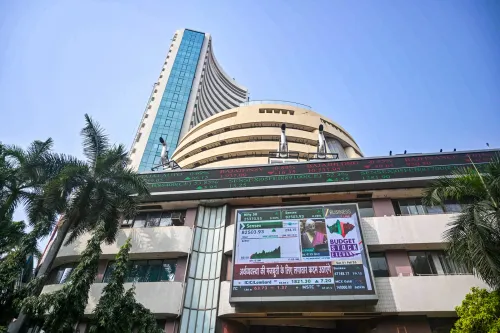
Nifty slips 2.2% during closing auction on expiry day, ends at 22,716

Synopsis
Nifty swung a full 2.2% during Tuesday's Closing Auction Session before snapping back to close barely 0.28% lower — a dramatic illustration of why SEBI is now consulting on whether to suspend or redesign the CAS framework for expiry days. With the regulator weighing a temporary rollback and traders calling for structural fixes, the outcome of SEBI's review will define how Indian markets price derivatives at the close for years to come.
Key Takeaways
Nifty50 hit an intraday low of 22,267 during the Closing Auction Session (CAS) on 29 September 2026 , a drop of 2.2% , before closing at 22,716.20 — down only 0.28% .
BSE Sensex ended 0.33% lower at 72,529.07 ; Bank Nifty closed 0.4% down at 54,259.95 after briefly breaching 53,300 .
The CAS framework was introduced on 3 August to set end-of-day prices for futures and options via a short closing auction.
SEBI has proposed two alternatives to CAS settlement pricing, including a potential suspension of the auction for expiry days for at least a year.
SEBI Chairman Tuhin Kanta Pandey confirmed in September that the methodology is being reworked but said the CAS framework 'is here to stay.'
The Nifty50 briefly plunged 2.2% during the Closing Auction Session (CAS) on Tuesday, 29 September 2026, touching a low of 22,267 as monthly derivatives expiry amplified intraday swings — before recovering sharply to close only 0.28% lower at 22,716.20. The BSE Sensex similarly pared losses to end 0.33% down at 72,529.07, underscoring how much of the day's drama was concentrated in the closing window.
How the Session Played Out
Bank Nifty also came under severe pressure during the CAS, briefly sliding below 53,300, before recovering to close just 0.4% lower at 54,259.95. The pattern — a sharp intraday dip followed by a near-full recovery — was consistent across indices, pointing squarely at expiry-day mechanics rather than a fundamental change in sentiment. Monthly derivatives expiry has repeatedly amplified volatility around the CAS since the framework was introduced on 3 August to set end-of-day prices for futures and options through a short auction at the close of regular trading.
SEBI's Ongoing Review of the CAS Framework
The wild swings have not gone unnoticed by the regulator. The Securities and Exchange Board of India (SEBI) released a consultation paper earlier this month proposing two alternatives for how expiry-day derivative settlement prices should be determined. The first method combines trades from the last 30 minutes of regular trading with the 10-minute closing auction. The second would temporarily revert to using only the last 30 minutes of regular trading — excluding the closing auction entirely — for at least a year.
Additional proposals in the paper include a ban on traders cancelling orders placed more than 1% above or below the reference price, a reduction of the post-auction derivatives trading window from 10 minutes to 5 minutes, and scrapping the practice of publishing an estimated index closing level during the auction itself.
What the SEBI Chairman Said
SEBI Chairman Tuhin Kanta Pandey clarified in September that the regulator is actively reworking the methodology for determining closing prices under the CAS framework. While acknowledging that the rollout had faced 'initial challenges, particularly around liquidity,' Pandey maintained that the CAS framework 'is here to stay.' He noted that liquidity constraints experienced immediately after implementation tend to ease over time as market participants adapt.
Why This Matters for Traders and Markets
The CAS was designed to make closing prices more representative and harder to manipulate — a goal regulators globally have pursued with varying success. However, traders have argued that the mechanism, especially on derivatives expiry days, is producing abrupt index moves that distort settlement prices and create artificial volatility. This is not purely an Indian problem: several international exchanges that introduced similar frameworks reported liquidity gaps in early months. Notably, the concentration of open interest on monthly expiry days makes Indian markets particularly susceptible to last-minute order imbalances during the auction window. SEBI's willingness to entertain a temporary rollback of the CAS for expiry-day settlements signals that the regulator is prioritising market stability over rigid adherence to the new mechanism.
The market will watch closely for SEBI's final circular on CAS reforms, which is expected in the coming weeks, to determine whether expiry-day volatility is structurally tamed or remains a recurring feature of Indian equity markets.
Point of View
But the fact that it is already considering reverting to pre-CAS methodology within three months of launch signals that implementation outran readiness. The deeper issue is that monthly expiry concentrates enormous open interest into a narrow window — a structural feature the CAS does not resolve. Until SEBI mandates longer expiry calendars or staggered settlement, even a redesigned auction will face the same liquidity vacuum on expiry day.
NationPress
29 Sept 2026
Frequently Asked Questions
What is the Closing Auction Session (CAS) and why is it controversial?
The CAS is a short auction introduced by SEBI on 3 August to determine end-of-day prices for futures and options contracts. It has become controversial because traders say it produces abrupt, exaggerated index swings on derivatives expiry days, distorting settlement prices.
How much did Nifty fall on 29 September expiry day?
The Nifty50 briefly fell 2.2% to a low of 22,267 during the Closing Auction Session on 29 September before recovering to close at 22,716.20, a decline of just 0.28% for the day.
What changes is SEBI proposing to the CAS framework?
SEBI's consultation paper proposes two alternatives: combining the last 30 minutes of regular trading with the 10-minute closing auction, or temporarily suspending the auction for expiry days and reverting to the last 30 minutes of regular trading alone for at least a year. Additional proposals include restricting order cancellations and reducing post-auction trading windows.
Will SEBI scrap the CAS framework entirely?
No. SEBI Chairman Tuhin Kanta Pandey has stated that the CAS framework 'is here to stay,' but acknowledged that the methodology for determining closing prices under it is being actively reworked following initial liquidity challenges.
Who is affected by expiry-day CAS volatility?
Retail and institutional traders holding monthly derivatives contracts are most directly affected, as the CAS determines final settlement prices. Sudden index swings during the auction can result in unexpected settlement losses even when the broader market moves are modest.