India's semiconductor push: Modi's I-Day speech targets global chip leadership
Synopsis
Modi's 80th Independence Day speech wasn't a vision statement — it was a status report and a deadline. Three chip plants already exporting, a ₹1,27,000 crore Semicon 2.0 framework in motion, and a target of 5 to 8 new fabs in under a decade: India is placing the biggest industrial bet of the chip era, and industry leaders say the execution has finally begun.
Key Takeaways
PM Modi outlined a plan for 5 to 8 advanced chip fabrication facilities over the next 7 to 8 years in his 80th Independence Day address.
Three operational mega semiconductor plants are already exporting chips to global markets, according to the Prime Minister.
Mobile phone manufacturing has grown 33 times and electronics manufacturing 7 times over the past 12 years .
The Semicon 2.0 framework, backed by ₹1,27,000 crore , covers chip design, fabrication, ATMP/OSAT packaging, R&D, and talent development.
200 GW of clean nuclear energy is being planned to power chip fabs, AI nodes, and data centres.
Industry bodies IESA and ICEA have endorsed the roadmap, calling it a shift from ecosystem creation to global leadership.
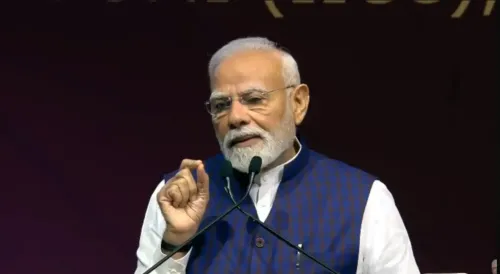
Prime Minister Narendra Modi's 80th Independence Day address on 15 August has drawn strong endorsement from industry leaders, who say India's semiconductor and electronics ambitions have decisively shifted from building a domestic ecosystem to competing for global leadership. The speech outlined a roadmap to establish 5 to 8 advanced chip fabrication facilities over the next 7 to 8 years, signalling the most concrete timeline yet for India's chip manufacturing scale-up.
Key Announcements from the Independence Day Address
Modi highlighted that three operational mega semiconductor plants are already exporting chips to global markets — a milestone that would have seemed ambitious just a few years ago. He also noted that mobile phone manufacturing has expanded 33 times over the past 12 years, while the broader electronics manufacturing sector has grown 7 times, positioning India as an emerging hub for hardware innovation.
Notably, the Prime Minister also spoke of integrating 200 GW of clean nuclear energy to meet the power demands of chip fabrication plants, AI nodes, and data centres — a signal that energy infrastructure is now being treated as a core component of the semiconductor strategy, not an afterthought.
What Industry Leaders Said
Ashok Chandak, President of the India Electronics and Semiconductor Association (IESA) and SEMI India, said the speech reflected a 'massive, unwavering commitment from the government to position our nation as a global powerhouse for chip design and manufacturing, electronics design, and advanced mobile technology.' Chandak described the moment as a transition point: 'India is no longer just dreaming of semiconductors, digital and hardware self-reliance — we are executing it at an unprecedented scale.'
He pointed to the Semicon 2.0 framework, backed by an outlay of ₹1,27,000 crore, as the structural vehicle for this ambition. The framework covers chip design, fabrication, advanced packaging (ATMP/OSAT), machines and materials, research and development, and talent development — a full-stack approach that earlier policy iterations lacked.
Pankaj Mohindroo, Chairman of the India Cellular and Electronics Association (ICEA), linked the semiconductor push to the broader 'Sapta Dhara' manufacturing initiative and the mobilisation of a million-strong AI workforce. 'India's electronics sector is no longer content to be seen as a secondary option; it is setting the standard for trust, resilience and dominance in the world's digital economy,' Mohindroo said.
The Semicon 2.0 Framework and What It Covers
The ₹1,27,000 crore Semicon 2.0 framework is designed to move India up the semiconductor value chain — from assembly and packaging toward design and fabrication. According to Chandak, the policy will drive India from ecosystem creation to what he termed 'global ecosystem leadership.' The framework's emphasis on ATMP and OSAT facilities is particularly significant, as these segments represent the fastest near-term entry point for Indian manufacturers into the global chip supply chain.
This comes amid a global reconfiguration of semiconductor supply chains, with the United States, European Union, and Japan all running parallel chip-incentive programmes. India's window to carve out a differentiated position — particularly in design talent and cost-competitive packaging — is widely seen as narrow but real.
What Comes Next
The target of 5 to 8 new advanced chip facilities within 7 to 8 years will require sustained capital commitment, land acquisition, water and power infrastructure, and a trained technical workforce — challenges that industry bodies have flagged repeatedly. Whether the Semicon 2.0 framework translates into signed investment agreements and operational fabs will be the metric that matters. The next major checkpoint is expected to be the government's sectoral implementation roadmap, details of which have not yet been made public.
Point of View
But the hard test lies ahead. India has announced semiconductor ambitions before — what is different now is the presence of three operational plants and a structured ₹1,27,000 crore framework with defined verticals. Yet the gap between policy architecture and fab construction is where previous industrial pushes have stalled. The 200 GW nuclear energy integration target is particularly ambitious given India's current nuclear capacity trajectory. And with the US, EU, and Japan all running competing chip-incentive regimes, India's window is real but closing. The government's next move — publishing a binding implementation roadmap with verifiable milestones — will determine whether Semicon 2.0 is a turning point or another well-designed plan that runs ahead of execution capacity.
NationPress
15 Aug 2026
Frequently Asked Questions
What did PM Modi announce about semiconductors on Independence Day 2025?
PM Modi announced a roadmap to establish 5 to 8 advanced chip fabrication facilities over the next 7 to 8 years during his 80th Independence Day address. He also confirmed that three mega semiconductor plants are already operational and exporting chips globally.
What is the Semicon 2.0 framework and how much is it worth?
Semicon 2.0 is India's next-generation semiconductor policy framework backed by an outlay of ₹1,27,000 crore. It covers chip design, fabrication, advanced packaging (ATMP/OSAT), machines and materials, R&D, and talent development, aiming to move India from ecosystem creation to global supply chain leadership.
How much has India's electronics manufacturing grown?
According to PM Modi's Independence Day address, mobile phone manufacturing has expanded 33 times over the past 12 years, while the broader electronics manufacturing sector has grown 7 times, turning India into an emerging global hardware hub.
Why is the 200 GW nuclear energy target significant for semiconductors?
Chip fabrication plants, AI data centres, and advanced computing nodes require enormous and uninterrupted power supply. By integrating 200 GW of clean nuclear energy into the grid, India aims to provide the reliable, large-scale power infrastructure that semiconductor fabs demand — a prerequisite that has historically been a bottleneck.
What did industry bodies say about Modi's semiconductor roadmap?
IESA President Ashok Chandak called it a 'massive, unwavering commitment' and said India is now executing at an unprecedented scale. ICEA Chairman Pankaj Mohindroo said India's electronics sector is 'setting the standard for trust, resilience and dominance in the world's digital economy,' linking the push to the Sapta Dhara manufacturing initiative and a million-strong AI workforce target.