Is There Growing Discontent Over the Pakistan Government's Claims on Industrial Growth and Jobs?
Synopsis
A recent report highlights significant concerns regarding the Pakistan government's claims of industrial growth. Rising unemployment rates and the closure of numerous manufacturing units challenge the official narrative, indicating a deeper economic discontent among the public. The analysis sheds light on the discrepancies in reported data and the impact on various sectors.
Key Takeaways
Significant public discontent regarding government claims on industrial growth.
Rising unemployment rates, reaching nearly 8 percent.
Closure of numerous manufacturing units, particularly in textiles and steel.
Concerns over the accuracy of reported economic data.
Inflation rates severely affecting purchasing power.
New Delhi, Jan 20 (NationPress) A recent analysis reveals that the private large-scale manufacturing (LSM) sector, along with rising unemployment and increasing average national wages from 2020-21 to 2024-25, casts doubt on the government's assertions regarding industrial growth in Pakistan. Anjum Ibrahim, writing for Business Recorder, notes that the government's portrayal of the economy remains overly optimistic, yet it occasionally reflects a deep-rooted public unease regarding these claims.
Islamabad maintains that GDP growth is on a positive ascension, projecting a 3.09 percent growth for 2024-25 and an estimated 3.71 percent in the first quarter (July-September) of the current fiscal year.
However, the escalating grievances from the private LSM sector raise genuine questions about the validity of the reported data.
Among these grievances is the issue of electricity cross-subsidization, which increases production costs and undermines export competitiveness, as evidenced by a drop in exports and a rise in smuggling across the country’s extensive borders.
According to the article, the proactive audits of industrial units—often framed as enforcement—are primarily focused on sales tax in specific sectors like sugar, cement, and fertilizers, indirectly burdening consumers, particularly impacting the less affluent more severely.
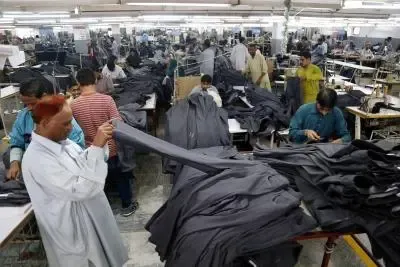
The All Pakistan Textile Mills Association has reported that 150 units have ceased operations in the past 18 months due to these misguided policies.
Additionally, the Pakistan Readymade Garments Manufacturers and Exporters Association disclosed that over 100 spinning units have shut down, leading to yarn and fabric shortages, forcing many large-scale operations that once ran two shifts to now operate on a single shift.
Furthermore, the Pakistan Association of Large Steel Producers is currently functioning at only 30 to 50 percent capacity, producing 3.8 million tonnes annually, compared to an installed capacity of 9 million tonnes, as highlighted in the report.
Moreover, cement dispatches experienced a 3.47 percent decline year-on-year in November 2025, reaching 4.14 million tons, despite a total dispatch increase of 11.54 percent in the first five months of the current year.
The reported number of closures challenges the government's assertion of a 6.01 percent LSM growth from July-November 2025.
Pakistan's unemployment rate has surged to 7.09 percent, nearing 8 percent, up from 6.3 percent in the LFS 2020-21 across all demographics.
This rise is evident for both genders, with male unemployment increasing from 5.5 percent in LFS 2020-21 to 5.9 percent in 2024-25, and female unemployment climbing from 8.9 percent to 9.7 percent.
Notably, the formal sector's contribution to employment remains critically low at 27.5 percent in 2024-25, only slightly down from 27.6 percent in LFS 2020-21.
Moreover, the purchasing power of the Pakistani Rupee is significantly affected by inflation rates: from a modest 8.9 percent in 2020-21, inflation soared to 29.18 percent the following year and stabilized at 23.41 percent in 2023-24.
Point of View
I uphold the responsibility of addressing the concerns of our nation. This report reflects the genuine worries of the public regarding economic stability and employment. It is vital to scrutinize government claims and ensure transparency in reporting economic indicators that affect every citizen's livelihood.
NationPress
25 Sept 2026
Frequently Asked Questions
What does the report say about the unemployment rate in Pakistan?
The report indicates that the unemployment rate in Pakistan has risen to approximately 7.09 percent, nearing 8 percent, which is an increase from 6.3 percent in 2020-21.
How many manufacturing units have closed in Pakistan recently?
The All Pakistan Textile Mills Association reported the closure of 150 manufacturing units in the past year and a half due to unfavorable economic policies.
What are the issues faced by the large-scale manufacturing sector?
The LSM sector faces rising production costs due to electricity cross-subsidy, decreased export competitiveness, and stringent audits primarily focused on certain sectors.
What is the current capacity utilization of the steel industry in Pakistan?
The Pakistan Association of Large Steel Producers reports that the steel industry is currently operating at just 30 to 50 percent of its capacity.
How has inflation impacted the purchasing power in Pakistan?
Inflation rates have drastically impacted purchasing power, rising from 8.9 percent in 2020-21 to 29.18 percent the following year, indicating a significant decrease in consumer purchasing power.