How Far Has India’s Semiconductor Ecosystem Advanced with Qualcomm’s 2nm Chip Design?
Synopsis
Qualcomm's groundbreaking 2nm semiconductor design marks a transformative milestone for India's semiconductor industry. This achievement highlights the growing capabilities of India's tech ecosystem and Qualcomm's commitment to fostering local innovation, setting the stage for further advancements in global technology.
Key Takeaways
Qualcomm announces successful tape-out of 2nm semiconductor design .
This achievement highlights India's growing semiconductor capabilities.
Collaboration with engineering centers in Bengaluru, Chennai, and Hyderabad is crucial.
The milestone emphasizes India's role as a center for semiconductor innovation.
Investment in R&D is vital for sustainable growth in the semiconductor sector.
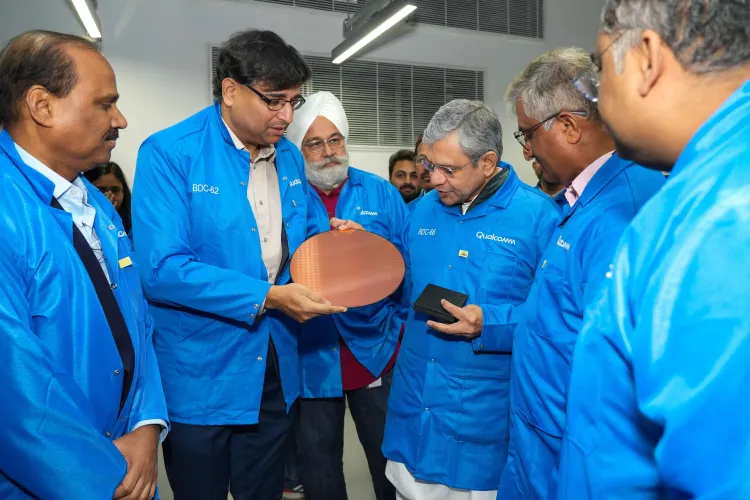
Bengaluru, Feb 7 (NationPress) The renowned US semiconductor manufacturer Qualcomm Technologies announced on Saturday the successful tape-out of its 2nm semiconductor design, representing a pivotal advancement in sophisticated semiconductor technology and reaffirming the company's strong dedication to bolstering India's quickly growing semiconductor ecosystem.
This accomplishment showcases Qualcomm’s robust global engineering expertise in collaboration with development centers located in Bengaluru, Chennai, and Hyderabad.
“India is increasingly becoming a central player in the design of advanced semiconductor technologies for the future,” stated Ashwini Vaishnaw, the Union Minister of Railways, Electronics, and IT.
“Witnessing Qualcomm’s operations here, their engineering prowess, profound design capabilities, and unwavering commitment to India is genuinely remarkable. Achievements like this highlight the significant progress of India’s design ecosystem and are closely aligned with our vision of establishing a globally competitive semiconductor industry,” the minister remarked.
This milestone signifies India's rise as a vital center for innovative semiconductor development and highlights Qualcomm’s long-term commitment to enhancing the nation’s semiconductor framework.
Qualcomm has had a presence in India for over 20 years, during which it has developed one of its most significant engineering operations outside the United States.
With extensive expertise in wireless, compute, AI, and system-level engineering, Qualcomm is continuously reinforcing its enduring commitment to India’s technological advancement and innovation.
Amitesh Kumar Sinha, Additional Secretary, Ministry of Electronics and IT and CEO of the India Semiconductor Mission, remarked, “India’s Semiconductor Mission is gaining strong momentum, backed by a robust design ecosystem and ongoing industry engagement. Investment in advanced engineering and R&D capabilities is crucial for establishing sustainable semiconductor capacity in the nation.”
“This achievement stands as a proof of the strength and depth of our engineering teams in India,” added Srini Maddali, Senior Vice President of Engineering at Qualcomm India Private Limited.
The Qualcomm campus in Bengaluru functions as a crucial engineering hub for the advancement of next-generation wireless, AI, compute, and system-level technologies.
“Today, India plays a vital role in how we facilitate the design, development, and delivery of next-generation technologies globally. The innovations emerging from here are shaping the future of connectivity, computation, and intelligent systems worldwide,” commented Savi Soin, President of Qualcomm India.
Point of View
Qualcomm's announcement is a testament to India's evolving role in the global semiconductor sector and highlights the importance of fostering local innovation. The collaboration between international companies and Indian engineering centers is pivotal for positioning India as a competitive player in the tech landscape. Such achievements should be recognized and supported to ensure sustainable growth in this critical industry.
NationPress
16 Sept 2026
Frequently Asked Questions
What does Qualcomm's 2nm chip design mean for India?
Qualcomm's 2nm chip design signifies a significant advancement in India's semiconductor capabilities, showcasing the country's growing role in global tech innovation.
How long has Qualcomm been in India?
Qualcomm has been operating in India for over 20 years, developing extensive engineering operations and capabilities.
What is the India Semiconductor Mission?
The India Semiconductor Mission aims to foster a robust semiconductor ecosystem in India by encouraging investment in advanced engineering and research capabilities.