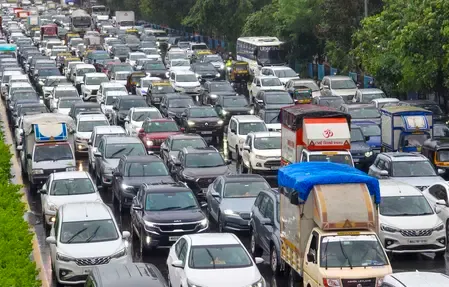
Indian Auto Industry Sets Record with 3 Crore Units Projected for FY26
Synopsis
The Indian automotive sector has reached unprecedented heights, achieving nearly 3 crore units in FY26. This milestone reflects significant growth across various vehicle categories, driven by increased affordability and diverse powertrain options. Discover the insights from FADA's report detailing this remarkable transformation.
Key Takeaways
Record sales: The Indian auto industry achieved nearly 3 crore units in FY26.
Structural growth: Growth was supported by better affordability and diverse powertrains.
Two-wheelers rebounded: Sold over 2.14 crore units, recovering pre-COVID levels.
Passenger vehicles surged: Exceeded 47 lakh units for the first time.
Rural demand exceeded urban: Highlighting a shift in consumer behavior.
New Delhi, April 6 (NationPress) The Indian automotive retail sector achieved a record-breaking total of 2,96,71,064 units sold in FY26, marking a robust 13.30 percent year-on-year growth. This impressive performance saw five out of six vehicle categories break previous annual records, according to data from the Federation of Automobile Dealers Associations (FADA).
This achievement signifies that the domestic automobile market is on the verge of reaching the 3 crore mark within a financial year — a goal that seemed far-fetched just two years ago.
FADA President C.S. Vigneshwar remarked, “What makes this year particularly significant is that the growth was structurally sound, driven by enhanced affordability, increased mobility demand across urban and rural sectors, and a diversifying range of powertrains.”
In terms of categories, two-wheelers regained their pre-COVID heights, selling over 2.14 crore units with a growth rate of 13.40 percent. This long-anticipated recovery was fueled by a combination of GST-driven affordability, improved rural income, and an expanding product range that appeals to both entry-level and aspirational consumers.
Passenger vehicles surpassed the 47-lakh sales milestone for the first time, achieving a 13 percent growth, aided by a strong pipeline of new models, ongoing urbanization, and a continued shift towards SUVs and alternative powertrains, as revealed by the FADA data.
Tractors emerged as a standout category, reaching over 10 lakh retail units for the first time, with a staggering growth of 18.95 percent. This success is attributed to favorable monsoon conditions, robust rabi sowing, and improving agricultural economics.
Commercial vehicles also posted record figures, exceeding 10 lakh units for the first time, with an 11.74 percent growth, driven by demand from infrastructure projects and a particularly strong medium and heavy commercial vehicles (MCV) segment. Meanwhile, three-wheelers achieved their third consecutive annual record with an 11.68 percent growth, with the transition to electric vehicles now making up over 60 percent of this segment's sales.
The only category to experience a decline was construction equipment, which fell by 11.70 percent, impacted by project delays and a high base effect.
According to Vigneshwar, “The turning point came in September with the rollout of GST 2.0. The tax rate adjustments significantly lowered the effective tax burden on mass-market two-wheelers, small cars, three-wheelers, and select commercial vehicles, boosting real affordability just when consumers were ready to respond.”
On the demand front, rural areas continued to catch up with urban markets. For FY26, rural retail grew by 13.05 percent, slightly behind urban growth of 13.62 percent. Notably, within the passenger vehicle category, rural demand notably outpaced urban demand, achieving 17.12 percent growth compared to 10.43 percent in urban areas.
As we look ahead to April, the immediate demand landscape remains largely positive, although it is entering a phase of measured adjustment following a strong year-end. FADA's survey indicates that 50.56 percent of dealers expect growth in April, while 40.15 percent anticipate stable performance — a sign of natural recalibration after a record-setting March.
Point of View
The Indian automotive sector's growth reflects a strategic response to changing consumer dynamics and market needs. This robust performance, driven by improved affordability and diversification, showcases the sector's resilience and adaptability. The upcoming months will be crucial as the market recalibrates after a record-setting fiscal year.
NationPress
19 Sept 2026
Frequently Asked Questions
What was the total auto sales in FY26?
The total auto sales in FY26 reached 2,96,71,064 units.
Which vehicle categories saw growth?
Five out of six vehicle categories set new records, including two-wheelers, passenger vehicles, tractors, and commercial vehicles.
What factors contributed to the growth in the auto industry?
Growth was driven by improved affordability, increased demand for mobility, and diversifying powertrain technologies.
How did rural demand compare to urban demand?
Rural demand outpaced urban demand in the passenger vehicle segment, with growth rates of 17.12 percent compared to 10.43 percent.
What impact did GST 2.0 have on the auto industry?
GST 2.0 significantly reduced tax burdens, enhancing affordability and enabling a stronger consumer response.