Did S. Korea's Exports Surge 8.4% to $61 Billion in November?
Click to start listening
Synopsis
In November, South Korea's exports surged by a remarkable 8.4% year-on-year, reaching over $61 billion, primarily fueled by the booming semiconductor sector. This marks the sixth month of growth, with expectations rising for record annual exports this year. Discover what sectors are driving this impressive growth and the implications for the South Korean economy.
Key Takeaways
- South Korea's exports rose by 8.4% in November.
- Total exports reached over $61 billion.
- Semiconductors significantly contributed to this growth.
- Trade surplus for November was $9.73 billion.
- Automobile exports showed a strong recovery.
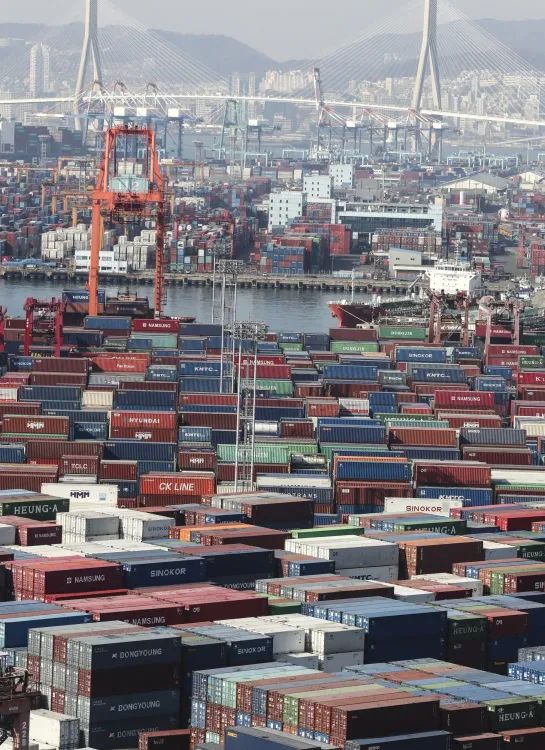
Seoul, Dec 1 (NationPress) South Korea has witnessed a remarkable 8.4% increase in its exports compared to the previous year, totaling over $61 billion in November. This marks the sixth consecutive month of growth, driven primarily by robust demand for semiconductors, according to data released by the government on Monday.
The outbound shipments amounted to $61.04 billion last month, setting a record for any November, as per the figures compiled by the Ministry of Trade, Industry and Resources, as reported by Yonhap news agency.
Imports rose by 1.2% year-on-year to $51.3 billion, leading to a trade surplus of $9.73 billion.
For the January-November period, total exports reached $640.2 billion, achieving a new record for this timeframe and raising hopes that the annual total will exceed $700 billion for the first time in history this year.
Semiconductor exports soared by 38.6% year-on-year to an unprecedented monthly high of $17.26 billion last month, driven by increasing memory chip prices due to high demand for premium products in data centres.
This marks the ninth consecutive month that chip exports have seen an annual increase.
Automobile exports also saw a notable 13.7% increase to $6.41 billion, thanks to the strong performance of traditional combustion vehicles and hybrid models, recovering from a 10.5% drop in October.
In the first eleven months of the year, semiconductor and automobile exports reached record highs of $152.6 billion and $66.04 billion, respectively.
Shipments of wireless communication devices grew by 1.6% to $1.73 billion, while secondary battery shipments rose by 2.2% to $670 million, ending a six-month decline.
Exports of electrical equipment, agricultural and fishery products, and cosmetics increased by 5.2%, 3.3%, and 4.3% respectively, reaching $1.27 billion, $1.04 billion, and $950 million.
However, exports of petroleum products fell by 10.3% to $3.28 billion, and petrochemical products dropped 14.1% to $3.06 billion due to a global oversupply.
Steel exports decreased by 16% to $2.3 billion as new orders were limited by the heavy tariff measures imposed by the U.S. government and a slowdown in global demand.
Regionally, exports to the United States dipped 0.2% year-on-year to $10.35 billion in November.
Specifically, semiconductor and auto exports to the U.S. rose by 39% and 11% to $1.1 billion and $2.2 billion, respectively, in the first 25 days of the month. Conversely, shipments of steel products to the U.S. plummeted by 24% year-on-year to $200 million, while machinery exports contracted by 18% to $800 million.
Exports to China increased by 6.9% to $12.07 billion, driven by strong demand for semiconductors, petroleum, and machinery products.
Shipments to the Association of Southeast Asian Nations (ASEAN) rose by 6.3% to $10.42 billion, led by semiconductors, while exports to the Middle East surged by 33.1% to $2.18 billion.
On the other hand, shipments to the European Union fell by 1.9% to $5.34 billion due to weaker demand for steel and ships.
Industry Minister Kim Jung-kwan stated that Korea's exports are on an upward trajectory, attributed to the strong performances in the semiconductor, automobile, and bio-health sectors, along with a diversification of export goods. He emphasized the commitment to maintaining this growth trend despite global trade uncertainties.
With the recent introduction of a special bill concerning Seoul's $350 billion investment commitment to the U.S. under a bilateral tariff agreement, conditions have been set for the U.S. administration to lower tariffs on Korean vehicles and auto parts, he added.
Point of View
The consistent growth in South Korea's exports, particularly in semiconductors and automobiles, underscores the resilience of the nation’s economy. Despite global uncertainties, the diversification of export products and strategic trade agreements present significant opportunities for sustained growth.
NationPress
01/12/2025
Frequently Asked Questions
What is the percentage increase in South Korea's exports for November?
South Korea's exports increased by 8.4% in November compared to the previous year.
What were the total exports in November?
Total exports in November amounted to over $61 billion.
Which sector drove the export growth?
The semiconductor sector was the main driver of export growth.
What is the trade surplus reported for November?
The trade surplus for November was reported at $9.73 billion.
How much did semiconductor exports increase?
Semiconductor exports soared by 38.6% year-on-year to $17.26 billion.