How Can Stockbrokers Build Investor Trust Through Transparency?
Synopsis
In a thought-provoking address, SEBI Chairman Tuhin Kanta Pandey highlights the critical role of transparency and compliance in fostering investor trust among stockbrokers. He urges financial intermediaries to prioritize integrity and resilience to adapt to evolving market demands and challenges.
Key Takeaways
Transparency is vital for earning investor trust.
Compliance should be viewed as a foundation, not a limitation.
Financial intermediaries must prioritize data protection .
Timely grievance redressal is essential for maintaining market integrity.
Cybersecurity concerns are escalating with digital advancements.
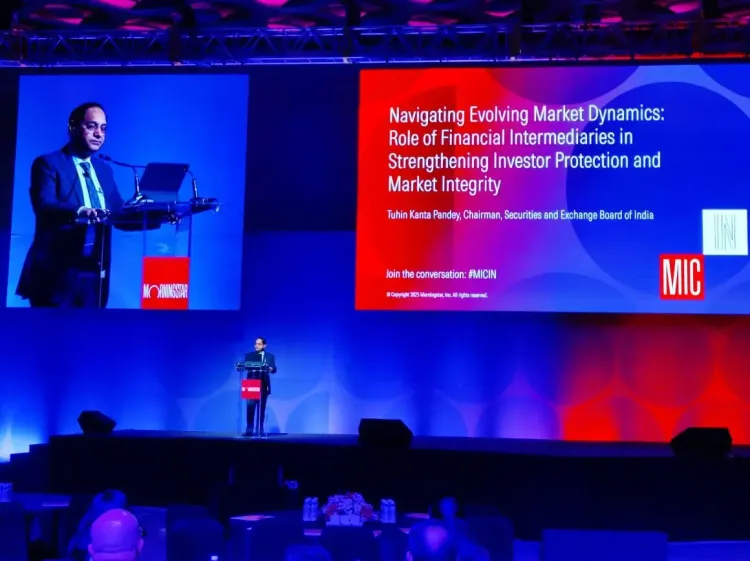
Mumbai, Nov 4 (NationPress) The Chairman of the Securities and Exchange Board of India (SEBI), Tuhin Kanta Pandey, emphasized on Tuesday that financial intermediaries, such as stockbrokers, must maintain clean, auditable records and foster a culture of transparency to gain investors' trust.
During his speech at the 'Morningstar Investment Conference India 2025', the SEBI chief stated, "Today's investors demand not only access to the market but also fair terms that emphasize transparency in transactions, execution, and payouts."
He remarked, "The most reputable firms will be those that consider compliance as a foundation rather than a limitation. This should be complemented by a culture of integrity, resilience, and transparency that consistently earns investor trust."
Pandey further highlighted the necessity for enhanced compliance, effective risk identification, data protection, and prompt grievance resolution, mentioning that SEBI is currently reviewing the Stock Brokers Regulations, 1992 with these aspects in mind.
"Firms should acknowledge that the true measure of success lies in the experience and confidence of investors, particularly in how well issues are resolved, the accuracy of settlements, and the transparency of disclosures," he noted.
He pointed out that financial intermediaries must ensure that investor protection and market integrity are reflected in real-world practices, as any decline in investor trust could lead to decreased market liquidity.
Pandey also addressed the recent MCX glitch, stating that an analysis of the root cause is currently underway. "Such incidents must be prevented," he said.
The Multi-Commodity Exchange (MCX) encountered operational challenges last week due to a technical problem, causing over a four-hour delay in trading and requiring a transition to its Disaster Recovery (DR) site. This disruption affected trading in significant commodity contracts, including gold, silver, crude oil, and base metals like copper, zinc, and aluminum.
Additionally, Pandey stressed that cybersecurity remains a critical concern amidst the rapid digital transformation and global market integration. "Companies need to protect sensitive client data and vital infrastructure from advanced threats. As reliance on technology vendors and service providers increases, risks associated with third-party outsourcing have grown, necessitating more robust oversight and due diligence," he explained.
He added that while algorithmic and high-frequency trading introduce efficiencies into the markets, they also create new vulnerabilities. "Intermediaries must ensure operational resilience and maintain business continuity amidst market fluctuations," the SEBI chief concluded.
Point of View
The emphasis on transparency and compliance from SEBI reflects a growing recognition of the importance of investor trust in maintaining market integrity. As the financial landscape evolves, stockbrokers must adapt to ensure that their practices align with investor expectations. This approach not only secures the confidence of clients but also fortifies the overall stability of the market.
NationPress
21 Sept 2026
Frequently Asked Questions
What did SEBI Chairman Tuhin Kanta Pandey emphasize for stockbrokers?
He emphasized the importance of maintaining clean, auditable books and fostering a culture of transparency to earn investors' trust.
What recent issue did SEBI address regarding MCX?
SEBI is investigating a recent technical glitch at the Multi-Commodity Exchange that caused significant trading delays.
Why is cybersecurity a concern for financial intermediaries?
With increasing digital integration, firms must protect sensitive data and infrastructure from sophisticated cyber threats.