SEMICON India 2026: 25 deals sealed across semiconductor value chain on Day 2
Synopsis
SEMICON India 2026's second day delivered 25 concrete deals — not just intent. With Tata Electronics and L&T Semiconductor tying up with Japanese, Singaporean, and Indian partners across materials, fab infrastructure, packaging, and power electronics, and the India Deep Tech Alliance logging $263 million in deep-tech investments, India's semiconductor push is visibly shifting from policy announcements to commercial commitments.
Key Takeaways
SEMICON India 2026 recorded 25 key deals and collaborations on Day 2, 18 September 2026 , spanning the full semiconductor value chain.
Tata Electronics signed partnerships with INOX Air Products , Sumitomo Chemical , Kelington Engineering , and Enomoto Co. for supply chain localisation, materials, and packaging.
L&T Semiconductor Technologies inked deals covering Silicon Carbide Power Modules, solar and AI data centre applications, and IGBT development for renewables.
The India Semiconductor Mission signed an MoU with Nippon Express for logistics and supply-chain support.
India Deep Tech Alliance reported $263 million in investments across 56 Indian deep-tech companies .
The event drew nearly 12,000 visitors on Day 1 with 600+ exhibitors , including ~300 international from countries including Japan, Singapore, South Korea, Belgium, Netherlands, and Sweden.
SEMICON India 2026 recorded 25 key announcements and collaborations on its second day, 18 September 2026, spanning semiconductor manufacturing, chip design, advanced packaging, power electronics, materials, logistics, and workforce development, according to a statement from the Ministry of Electronics and Information Technology (MeitY). The deals, involving Indian giants Tata Electronics and L&T Semiconductor Technologies alongside several international partners, mark a significant push to deepen India's domestic semiconductor ecosystem.
Key Partnerships and MoUs Signed
Tata Electronics led a wave of agreements on the day. The company signed a collaboration with INOX Air Products Ltd to strengthen the local supply chain for high-purity gases critical to semiconductor manufacturing. A separate partnership with Sumitomo Chemical Ltd targets the localisation of high-purity wet chemicals and advanced materials for front-end semiconductor manufacturing.
Tata Electronics also tied up with Kelington Engineering Pte Ltd to accelerate fab readiness through gas distribution systems, high-purity piping, and process tool hook-up, with a built-in component for training local partners in specialised manufacturing skills. Additionally, a partnership with Enomoto Co. Ltd was announced for joint R&D and localisation of lead-frame manufacturing to bolster advanced semiconductor packaging capabilities.
L&T Semiconductor Technologies Ltd signed agreements with Virtual Forest Pvt Ltd for co-development of power electronics solutions for air conditioning and solar-powered systems, and with Newen Systems Pvt Ltd for Silicon Carbide Power Modules targeting next-generation renewable energy systems and AI data centres. A further agreement with Fimer India Pvt Ltd covers development of Insulated Gate Bipolar Transistors for renewable energy systems.
C-MET, Pune and Hindalco Industries Limited signed an MoU to scale up critical raw materials essential to the semiconductor supply chain, strengthening indigenous material capabilities and supply chain resilience.
Government-Led Collaborations
MeitY, the Ministry of Power, and POWERGRID announced a collaboration to support indigenisation of Silicon Carbide Power Modules for Voltage Source Converter (VSC)-based HVDC transmission systems. The initiative is to be piloted at POWERGRID's 1,000 MW Pusauli project in Bihar. Separately, the India Semiconductor Mission inked an MoU with Nippon Express, under which the Japanese logistics firm will provide expertise in logistics, warehousing, customs, and related supply-chain services as India's semiconductor sector scales up.
Deep-Tech Investment and Industry Response
The India Deep Tech Alliance reported investments of $263 million across 56 Indian deep-tech companies, signalling growing private capital commitment to the sector. The event drew nearly 12,000 visitors on Day 1, with more than 600 exhibitors — including around 300 international exhibitors — in attendance.
Notably, country roundtables saw strong engagement, with more than 30 companies each from Japan and Singapore participating in their respective pavilions. Delegations from South Korea, Belgium, the Netherlands, and Sweden also participated, reflecting broad global interest in India's semiconductor buildout.
What the Minister Said
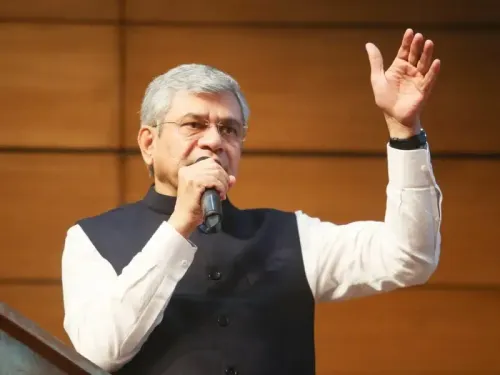
Minister of Electronics and IT Ashwini Vaishnaw told reporters that participation was even higher on the second day, with strong business-to-business engagement and several agreements concluded during bilateral meetings. He said the growing participation reflected increasing global interest in expanding semiconductor-related activities in India, with industry leaders indicating willingness to scale up investment based on execution ability.
Vaishnaw also emphasised that Indian semiconductor companies must compete globally on cost and quality, taking into account manufacturability, product life cycle, and power consumption. On the sustainability front, he highlighted the use of water recycling in semiconductor fabs and closed-loop cooling systems in data centres as resource-efficient practices essential to scaling these sectors responsibly.
Why This Matters
India's semiconductor ambitions have been building since the launch of the India Semiconductor Mission, with the government targeting a sizeable share of global chip supply chain realignment driven by US-China tensions and post-pandemic supply disruptions. The volume of deals at SEMICON India 2026 — spanning upstream materials, fab infrastructure, packaging, power electronics, and logistics — suggests the ecosystem is maturing beyond policy intent into commercial execution. How quickly these MoUs translate into operational capacity will be the critical next test for India's semiconductor roadmap.
Point of View
Not just policy momentum. Yet MoUs are not fabs: the gap between signing and commissioning in semiconductors can span several years and billions of dollars. The real indicator to watch is how many of these agreements convert into capital expenditure commitments within the next 18 months. India's window to capture supply-chain diversification flows is real but time-bound — China's own upgrades and Southeast Asian competition won't wait.
NationPress
18 Sept 2026
Frequently Asked Questions
What happened at SEMICON India 2026 on Day 2?
Day 2 of SEMICON India 2026, held on 18 September 2026 in New Delhi, saw 25 key deals and collaborations signed across semiconductor manufacturing, materials, logistics, chip design, advanced packaging, power electronics, and workforce development. Major participants included Tata Electronics, L&T Semiconductor Technologies, MeitY, Ministry of Power, and POWERGRID.
What deals did Tata Electronics sign at SEMICON India 2026?
Tata Electronics signed partnerships with INOX Air Products for high-purity gas supply chain localisation, Sumitomo Chemical for high-purity wet chemicals, Kelington Engineering for fab readiness and gas distribution, and Enomoto Co. for advanced packaging and lead-frame manufacturing localisation.
What is the India Deep Tech Alliance investment announced at SEMICON India 2026?
The India Deep Tech Alliance reported investments of $263 million across 56 Indian deep-tech companies at the event, indicating growing private capital commitment to India's technology and semiconductor sectors.
What did Minister Ashwini Vaishnaw say at SEMICON India 2026?
Minister of Electronics and IT Ashwini Vaishnaw said participation on Day 2 was higher than Day 1, with strong business-to-business engagement and several agreements concluded in bilateral meetings. He emphasised that Indian semiconductor companies must compete globally on cost, quality, manufacturability, and power efficiency, and highlighted sustainable practices in fabs and data centres.
What is the POWERGRID Silicon Carbide project announced at SEMICON India 2026?
MeitY, the Ministry of Power, and POWERGRID announced a collaboration to indigenise Silicon Carbide Power Modules for Voltage Source Converter-based HVDC transmission systems. The initiative will be piloted at POWERGRID's 1,000 MW Pusauli project in Bihar.