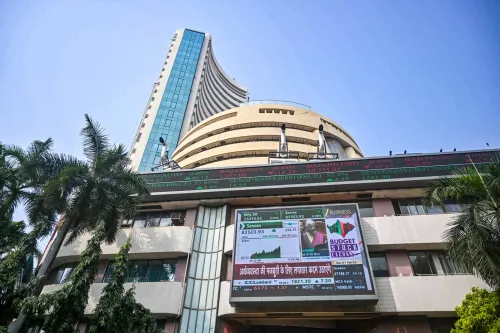
Sensex rises 363 points, Nifty at 24,176 as IT and auto stocks lead gains

Synopsis
Indian markets bucked a global sell-off on 17 July, with Sensex adding 363 points and Nifty IT surging nearly 2% — even as Japan's Nikkei crashed more than 4% and US futures stayed weak. The divergence points to resilient domestic institutional buying, but analysts warn the range-bound trend holds until private bank earnings deliver a decisive catalyst.
Key Takeaways
BSE Sensex rose 363 points to 77,550 and Nifty50 gained 100 points to 24,176 in early trade on 17 July .
Nifty IT surged nearly 2% , leading all sectoral gainers; Nifty Auto rose 0.83% .
Nifty Pharma and Nifty Healthcare each declined around 1% , emerging as the session's biggest laggards.
Japan's Nikkei fell more than 4% and Nasdaq dropped 1.47% overnight, highlighting India's divergence from global weakness.
Analysts flag FII selling , a weakening rupee , and June-quarter bank earnings as key factors for near-term market direction.
Strong support seen in the 24,000–24,100 Nifty zone; a buy-on-dips approach recommended until a clear breakout emerges.
Indian equity markets opened firmly in the green on Friday, 17 July, with the BSE Sensex climbing 363 points or 0.47% to 77,550 and the Nifty50 advancing 100 points or 0.43% to 24,176 in early trade, defying weak global cues on the back of strong buying in IT and auto stocks.
Sectoral Drivers
The Nifty IT index led sectoral gains, surging nearly 2% and providing the sharpest upward thrust to both benchmarks. The Nifty Auto index followed with a rise of 0.83%, while Nifty Private Bank added 0.42%. The Nifty Oil & Gas and Nifty PSU Bank indices also edged marginally higher.
On the downside, pharma and healthcare emerged as the session's biggest laggards. The Nifty Pharma index declined more than 1%, with the Nifty Healthcare Index also slipping around 1%. Among the top losers on the Nifty were Wipro, Hindalco Industries, Cipla, Eternal, Nestle India, Max Healthcare, Sun Pharma, ITC, Dr Reddy's Laboratories, and Tata Consumer Products.
What Analysts Are Watching
Market analysts cautioned that the broader trend is likely to remain range-bound. A weakening rupee, persistent foreign institutional investor (FII) selling, and subdued global sentiment continue to cap upside potential, they noted. However, resilient technical indicators, steady domestic institutional investor (DII) buying, and firm support in the 24,000–24,100 zone are expected to limit the downside.
Analysts added that investors will closely track June-quarter earnings from major private banks for fresh directional cues, recommending a stock-specific and buy-on-dips strategy until a decisive breakout materialises.
Global and Commodity Cues
The domestic resilience came despite a broadly negative global backdrop. Asian markets traded sharply lower, with Japan's Nikkei falling more than 4%, Hong Kong's Hang Seng declining around 2%, and China's Shanghai Composite shedding over 1%. Overnight, US markets also ended in the red — the S&P 500 slipped 0.51% and the Nasdaq fell 1.47%.
On the commodities front, Brent crude rose 1.48% in early trade to $85.48 per barrel, while US WTI crude climbed 1.60% to $80 per barrel, adding an inflationary undertone to the macro picture.
Broader Market Outlook
The domestic outperformance against a weak global backdrop underscores the defensive role that DII buying has played in cushioning Indian markets from external shocks in recent sessions. Notably, this divergence — Indian indices rising while Asian peers fall sharply — is consistent with a pattern seen across multiple risk-off episodes this quarter. With private bank earnings and global macro data lined up, the next few sessions are likely to test the durability of this resilience.
Point of View
It is fragile. Private bank results this week will be the real test. A disappointment there could unwind the range-bound comfort zone analysts are pointing to, and the 24,000 support level would face its stiffest challenge yet.
NationPress
15 Oct 2026
Frequently Asked Questions
Why did Indian markets rise despite weak global cues on 17 July?
Domestic equity markets rose on 17 July primarily due to strong buying in IT and auto stocks, which offset negative global signals. Steady domestic institutional investor buying also helped cushion the benchmarks from the broader global sell-off.
Which sectors gained and which fell in early trade on 17 July?
The Nifty IT index surged nearly 2%, Nifty Auto rose 0.83%, and Nifty Private Bank gained 0.42%. On the downside, Nifty Pharma and the Nifty Healthcare Index each declined around 1%, making them the session's biggest laggards.
What is the near-term outlook for Indian markets?
Analysts expect markets to remain range-bound, with FII selling, a weakening rupee, and weak global cues acting as headwinds. However, strong domestic institutional buying and technical support near the 24,000–24,100 zone are expected to limit the downside.
What should investors watch for the next market direction?
Investors are closely tracking June-quarter earnings from major private banks, which are expected to provide fresh directional cues. Analysts recommend a stock-specific, buy-on-dips strategy until a decisive breakout above the current range emerges.
How did Asian and US markets perform overnight?
Asian markets traded sharply lower on 17 July, with Japan's Nikkei falling more than 4%, Hong Kong's Hang Seng declining around 2%, and China's Shanghai Composite shedding over 1%. US markets also ended in the red overnight, with the S&P 500 down 0.51% and the Nasdaq falling 1.47%.