SMRs can power India's defence manufacturing, data centres: Experts
Synopsis
India's defence production push and its data centre boom are colliding on one bottleneck — reliable baseload power. Experts at a Delhi policy dialogue argued small modular reactors could be the answer, framing the 100 GW nuclear target not as ambition but as strategic necessity for Viksit Bharat 2047.
Key Takeaways
Experts said SMRs can deliver precision-oriented power for defence manufacturing and data centres in India.
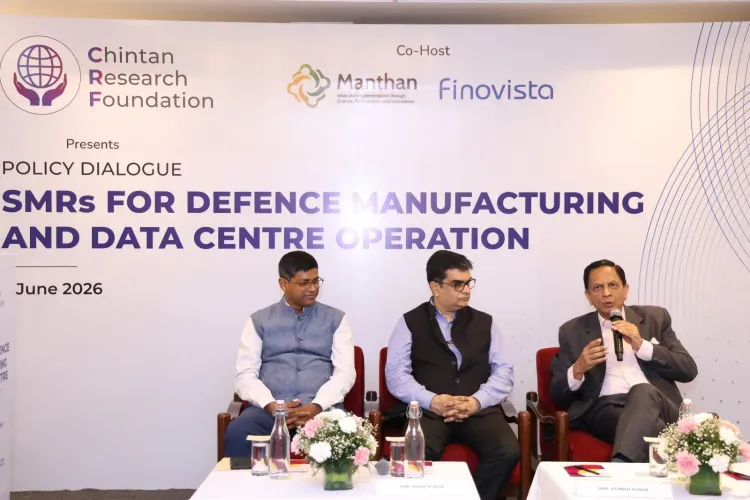
The dialogue was held in New Delhi on 2 June , jointly organised by CRF and Finovista with Manthan .
Srikanth of NIAS said energy transition is not possible without nuclear.
Prasenjit Pal , former CEO of NTPC Parmanu Urja Nigam , called India's 100 GW nuclear target a strategic requirement.
NeGD COO Rajnish Kumar said reliability, resilience and sovereignty are emerging needs for e-governance infrastructure.
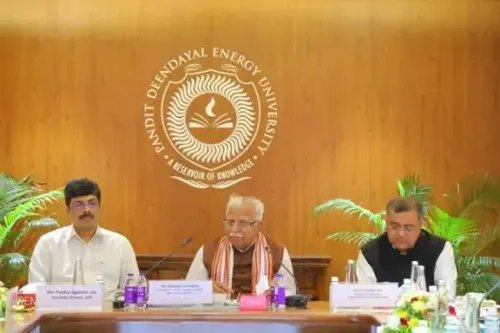
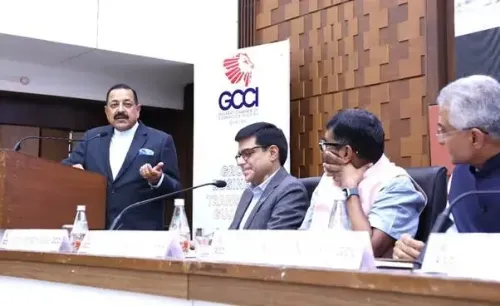
Small modular reactors (SMRs) can deliver the reliable, precision-oriented power supply that India's defence manufacturing and data centre ambitions demand, with their deployment in emerging defence corridors potentially proving transformative for mission-critical operations, experts said at a policy dialogue in New Delhi on Tuesday, 2 June. The convergence of these two high-growth sectors on a single constraint — dependable baseload power — has placed nuclear energy at the centre of India's strategic energy conversation.
Why nuclear is back in focus
‘We cannot have energy transition without nuclear,' said Professor R. Srikanth, Dean of the School of Natural Sciences and Engineering at the National Institute of Advanced Studies (NIAS), addressing the dialogue titled ‘Small Modular Reactors for Defence Manufacturing and Data Centre Operation'. The event was jointly organised by the Chintan Research Foundation (CRF) and Finovista, in association with Manthan, an initiative led by the Office of the Principal Scientific Advisor.
Panellists discussed the complementary role of nuclear and renewable energy in addressing rising power demand and intermittency challenges, with nuclear positioned as a stabiliser for an increasingly variable grid.
Viksit Bharat 2047 and the 100 GW vision
Shishir Priyadarshi, President of CRF, highlighted India's growing future energy requirements, noting that nuclear energy would play an important role in meeting rising industrial and strategic demand. He flagged the need to address questions of cost, fuel security, regulation, deployment, waste management and safety to enable scalable SMR adoption.
Prasenjit Pal, former CEO of NTPC Parmanu Urja Nigam Ltd, underscored that India's 100 GW nuclear vision should now be treated as a strategic requirement rather than an aspiration, citing nuclear energy's lower carbon footprint and long-term importance for energy security.
Defence corridors and digital sovereignty
Vimal Kumar, Co-Founder of Finovista, highlighted the potential of SMRs to support reliable and precision-oriented power supply for defence manufacturing, particularly in emerging defence corridors where uninterrupted power is mission-critical.
Rajnish Kumar, Chief Operating Officer of the National e-Governance Division (NeGD) under MeitY, said reliability, resilience and sovereignty are emerging requirements for e-governance systems. He emphasised that reliable and diversified power sources are essential to ensuring secure and uninterrupted digital governance, with SMRs offering a credible option for critical digital infrastructure.
What's next
The panel, chaired by Dr Debajit Palit, Centre Head of the Centre for Climate Change and Energy Transition at CRF, convened experts from nuclear energy, defence manufacturing, digital infrastructure, finance and public policy. The discussions are expected to feed into broader policy thinking on SMR deployment timelines, financing frameworks and regulatory pathways as India moves towards its Viksit Bharat 2047 energy goals.
Point of View
And the grid's coal dependence is a sovereignty risk as much as a carbon one. The 100 GW target is credible only if regulation, fuel cycle policy and private SMR participation move in lockstep, which they currently do not. Without that alignment, SMRs risk becoming another headline technology stuck in pilot purgatory.
NationPress
16 Oct 2026
Frequently Asked Questions
What are small modular reactors (SMRs) and why are they relevant for India?
SMRs are compact nuclear reactors that can be deployed in a modular fashion to deliver reliable baseload power at smaller scales than conventional plants. Experts say they are well suited to India's defence manufacturing corridors and data centres, where uninterrupted, high-quality power is mission-critical.
Why is nuclear energy central to India's Viksit Bharat 2047 plans?
India's future energy basket is expected to lean heavily on non-fossil sources, and experts argue nuclear is essential to balance the intermittency of renewables. The 100 GW nuclear vision is now being framed as a strategic requirement rather than an aspirational target.
How can SMRs support defence manufacturing in India?
SMRs can provide precision-oriented, reliable power supply for defence production units in emerging defence corridors, where outages or voltage fluctuations can disrupt mission-critical operations. Their modular design also allows deployment closer to industrial clusters.
What are the main challenges to scaling SMR adoption in India?
Experts flagged cost, fuel security, regulation, deployment timelines, waste management and safety as the key issues that need to be resolved. Without a clear regulatory and financing framework, scalable SMR deployment will remain difficult.
Who organised the policy dialogue on SMRs?
The dialogue was jointly organised by the Chintan Research Foundation (CRF) and Finovista, in association with Manthan, an initiative led by the Office of the Principal Scientific Advisor. It was held in New Delhi on 2 June.