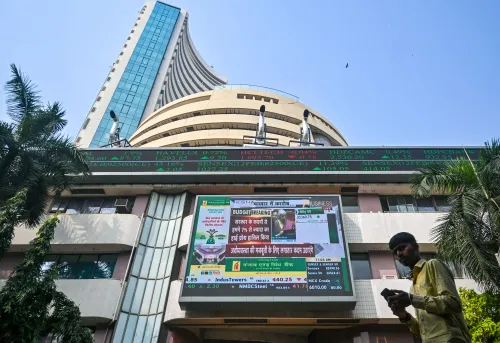
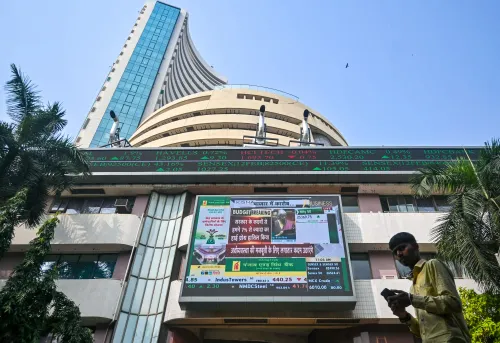
Indian Stock Market Plummets Nearly 1,700 Points Amid Middle East Tensions

Synopsis
On March 27, the Indian stock market fell sharply, influenced by geopolitical tensions involving the U.S., Israel, and Iran. This decline halted a two-day winning streak, signaling caution among investors. Market analysts predict potential resistance ahead and suggest a sell-on-rise strategy in the current climate.
Key Takeaways
The Indian stock market saw a significant decline of nearly 1,700 points.
Ongoing geopolitical tensions are impacting investor confidence.
Experts recommend a 'sell-on-rise' strategy amid uncertainty.
PSU banks and auto sectors faced the most significant losses.
Only a few stocks, including TCS and Bharti Airtel, ended the day positively.
Mumbai, March 27 (NationPress) The Indian stock market closed significantly lower on Friday, ending a two-day upward trend, as the uncertainty surrounding negotiations between the United States, Israel, and Iran unsettled investor confidence.
The primary indices experienced substantial selling pressure throughout the day. The Nifty index dipped by 2.09 percent, or 486.85 points, finishing at 22,819.60. Likewise, the Sensex fell by 2.25 percent, or 1,690.25 points, concluding at 73,583.22.
Regarding the Nifty forecast, analysts indicated that any recovery towards 23,500 may encounter selling pressure, as this threshold is expected to act as immediate resistance.
“If the index breaks below 22,800, it could lead to increased market weakness,” an analyst remarked.
“In light of the current market uncertainties, adopting a sell-on-rise strategy may be prudent in the near future,” a market expert noted.
Among the biggest losers on the Sensex, Reliance Industries suffered the most, declining by 4.55 percent. Other notable losers included Bajaj Finance, IndiGo, Eternal, and HDFC Bank.
Conversely, only a handful of stocks—TCS, Bharti Airtel, and Power Grid—managed to finish in the green.
The broader markets also closed lower, although they demonstrated somewhat better resilience compared to the primary indices.
The Nifty MidCap index dropped by 2.24 percent, while the SmallCap index fell by 1.88 percent by the session's end.
PSU banks faced the most significant pressure among sectoral indices and emerged as the top losers.
Real estate and auto stocks also experienced notable declines, negatively impacting overall market sentiment.
In contrast, the IT sector managed to limit losses, emerging as the best-performing segment of the day, providing some support to the market amid the broader downturn.
The sharp decline reflects an increasing level of caution among investors as global uncertainties continue to affect market sentiment.
“Indian markets experienced a sharp and turbulent session, with major energy stocks driving the decline due to a complex mix of policy changes, rising crude prices, and ongoing geopolitical uncertainty,” a market analyst added.
Point of View
I present a balanced perspective on the recent market movements. The sharp decline in the Indian stock market reflects broader global uncertainties that investors must navigate. While the immediate outlook appears challenging, strategic approaches could mitigate risks during this turbulent period.
NationPress
26 Sept 2026
Frequently Asked Questions
What caused the recent decline in the Indian stock market?
The recent drop was primarily driven by uncertainties surrounding ongoing negotiations between the United States, Israel, and Iran, which unsettled investor sentiment.
How much did the Sensex and Nifty indices fall?
The Sensex fell by 1,690.25 points, or 2.25%, while the Nifty dropped by 486.85 points, or 2.09%.
What strategies should investors consider in this market?
Market experts suggest adopting a 'sell-on-rise' approach, particularly as resistance levels emerge around 23,500 for the Nifty.
Which sectors were most affected by the market decline?
PSU banks faced the most pressure, while real estate and auto stocks also saw significant declines.
Did any stocks perform well despite the market downturn?
Yes, TCS, Bharti Airtel, and Power Grid were among the few stocks that managed to close in the green.