STPI Tech Summit 2026: India's digital economy push backed by AI, semiconductor missions
Synopsis
At STPI's 35th anniversary summit, the government signalled a clear pivot: India's digital economy ambitions now hinge on AI and semiconductors, with STPI's 73-centre network tasked with carrying innovation beyond metros into Tier-II and Tier-III cities — and turning 1,700-plus startups into a global tech export force.
Key Takeaways
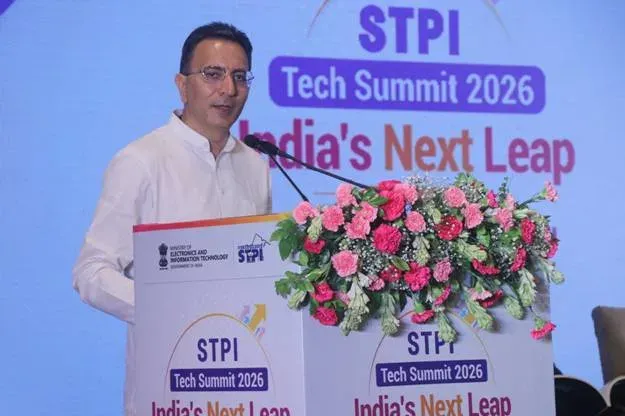
Minister of State Jitin Prasada addressed the STPI Tech Summit 2026 in New Delhi on 6 June 2026 , reaffirming India's digital economy ambitions.
The India Semiconductor Mission and IndiaAI Mission were highlighted as central to innovation-led growth.
STPI has supported more than 1,700 startups and operates 73 centres across India over 35 years .
Krishnan stressed expanding STPI's reach to emerging regions, from the North-East to Tier-II and Tier-III cities.
Artificial intelligence and high-quality employment were identified as the primary focus areas for STPI's next phase.
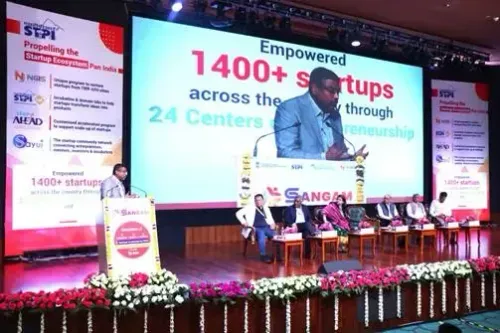
Minister of State for Electronics and Information Technology Jitin Prasada on 6 June 2026 said India is building a future-ready digital economy anchored in innovation, entrepreneurship, and technological self-reliance, as the government doubles down on flagship programmes including the India Semiconductor Mission and the IndiaAI Mission. The remarks came at the STPI Tech Summit 2026: India's Next Leap, organised by the Software Technology Parks of India (STPI) in New Delhi.
Key Announcements at the Summit
Prasada underlined the government's commitment to an enabling ecosystem, citing progressive policies, ease of doing business, and expanded access to technology as the three levers of growth. 'The Government remains committed to fostering an enabling ecosystem through progressive policies, ease of doing business and enhanced access to technology,' he said. He added that institutions such as STPI will be critical in nurturing innovation, strengthening emerging technology ecosystems, and enabling world-class solutions for global markets.
MeitY Secretary on STPI's 35-Year Legacy
S. Krishnan, Secretary of the Ministry of Electronics and Information Technology (MeitY), marking 35 years of STPI, called on the organisation to leverage its legacy to drive growth in emerging regions. 'We must identify the opportunities that lie ahead and leverage its strong legacy to drive growth in emerging regions,' he said. Krishnan highlighted STPI's convening power — its ability to bring together entrepreneurs, mentors, venture capitalists, and industry stakeholders to create a critical mass for innovation. He noted that STPI has successfully built linkages from the North-East to established technology hubs such as Bengaluru, Hyderabad, and Chennai, enabling the flow of mentorship, expertise, and capital to emerging centres.
STPI's Footprint: 73 Centres, 1,700+ Startups
Arvind Kumar, Director General of STPI, said the organisation has emerged as a key pillar of India's digital economy over the past 35 years. 'With 73 centres across the country, support extended to more than 1,700 startups and a significant contribution towards India's IT exports, STPI has enabled technology-led growth beyond metropolitan cities,' he said. Kumar pointed to STPI's role in creating opportunities across Tier-II and Tier-III regions as a distinguishing feature of its mandate.
AI and Employment at the Centre of the Agenda
Krishnan specifically flagged artificial intelligence as the primary domain where STPI can make a meaningful difference — supporting startups, attracting technology investments, and creating high-quality employment opportunities for India's youth. This comes amid a broader government push to position India as a global AI and semiconductor hub, with the IndiaAI Mission and the India Semiconductor Mission both receiving significant policy and financial backing in recent budgets.
What Comes Next
The summit brought together senior government officials, venture capitalists, and ecosystem enablers to map India's technology trajectory. With STPI now operating 73 centres nationally and the government deepening its focus on deep-tech and AI, the emphasis is expected to shift further toward Tier-II and Tier-III cities as the next frontier for startup growth and IT export diversification.
Point of View
But the 35th edition carries a sharper edge: the government is now explicitly tying STPI's mandate to AI and semiconductors — two sectors where India is still catching up with China, Taiwan, and South Korea. The 1,700-startup figure is creditable, but the real test is whether STPI's Tier-II and Tier-III push produces export-quality companies or merely incubation statistics. India's IT export story has long been dominated by a handful of metros and a handful of large firms; decentralising that is a decade-old aspiration. What's different now is the policy stack — semiconductor incentives, the IndiaAI Mission, and PLI for electronics — but execution timelines remain vague. Without measurable targets tied to funding tranches, the summit risks being a well-attended conversation rather than a turning point.
NationPress
20 Sept 2026
Frequently Asked Questions
What is the STPI Tech Summit 2026?
The STPI Tech Summit 2026, themed 'India's Next Leap', is an annual conclave organised by the Software Technology Parks of India (STPI) under the Ministry of Electronics and Information Technology (MeitY). The 2026 edition, held in New Delhi on 6 June, marked STPI's 35th anniversary and brought together government officials, venture capitalists, and ecosystem enablers to chart India's digital economy roadmap.
What is the India Semiconductor Mission and why does it matter?
The India Semiconductor Mission is a government programme aimed at building a domestic semiconductor design and manufacturing ecosystem. It was highlighted at the summit as one of the flagship initiatives opening new avenues for research and manufacturing-led growth in India's technology sector.
How many startups has STPI supported and where does it operate?
STPI has supported more than 1,700 startups across its 73 centres nationwide over 35 years. Its network spans from North-East India to major technology hubs including Bengaluru, Hyderabad, and Chennai, with a stated focus on expanding into Tier-II and Tier-III cities.
What role will AI play in STPI's next phase?
MeitY Secretary S. Krishnan specifically identified artificial intelligence as the primary domain for STPI's next phase, with the organisation expected to support AI-focused startups, attract technology investments, and create high-quality employment opportunities for India's youth in emerging regions.
Who spoke at the STPI Tech Summit 2026?
Key speakers included Minister of State for Electronics and IT Jitin Prasada, MeitY Secretary S. Krishnan, and STPI Director General Arvind Kumar, along with senior government officials, venture capitalists, and industry stakeholders.