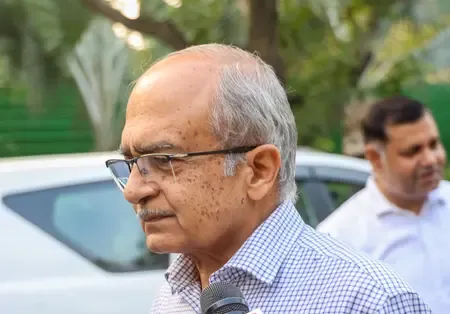
Delhi Police file FIR against Prashant Bhushan over doctored Lavrov video
Synopsis
Delhi Police have booked senior Supreme Court advocate Prashant Bhushan under the BNS and IT Act for allegedly sharing a doctored video of Russian FM Sergey Lavrov making anti-India remarks — a clip both the MEA and Russian Embassy have confirmed as entirely fabricated. The case underscores how AI-driven disinformation is increasingly drawing criminal scrutiny in India.
Key Takeaways
Delhi Police registered FIR No.
263/26 against advocate Prashant Bhushan at the Special Cell police station on 3 November 2026 .
The FIR alleges Bhushan shared a doctored video of Russian Foreign Minister Sergey Lavrov containing remarks hostile to India .
Charges have been filed under Sections 336(4), 353(1)(c), 356 and 340(2) of the BNS , and Section 66C of the IT Act .
The Ministry of External Affairs (MEA) fact-check unit and the Russian Embassy both confirmed the video was entirely fabricated.
No arrest has been reported; Bhushan had not issued a public response as of the filing of this report.
Delhi Police have registered a First Information Report (FIR) against senior Supreme Court advocate Prashant Bhushan for allegedly sharing a digitally manipulated video of Russian Foreign Minister Sergey Lavrov that purportedly contained remarks hostile to India. The FIR, numbered 263/26, was filed at the Special Cell police station in New Delhi after the matter surfaced during routine cyber patrolling on 3 November 2026.
How the Case Came to Light
According to Delhi Police, officers conducting cyber patrolling on Tuesday, 3 November 2026, came across a post on X (formerly Twitter) from the handle @thequotesnews alleging that a doctored video of the Russian Foreign Minister had been shared from Bhushan's verified handle @pbhushan1. In an official post on X, Delhi Police stated: 'On 03.11.2026, during cyber patrolling, it came to notice that the social media handle @thequotesnews has claimed that a purported doctored video of the Russian Foreign Minister, hostile to India, was shared from Prashant Bhushan's handle @pbhushan1.'
Police further stated that 'through the said video, there is an allegation of disseminating misleading, defamatory, and inflammatory content to incite public disturbance and spread rumours.'
Charges Filed Under BNS and IT Act
The FIR has been registered under Sections 336(4), 353(1)(c), 356 and 340(2) of the Bharatiya Nyaya Sanhita (BNS), as well as Section 66C of the Information Technology Act. The charges relate to the alleged spread of misleading, defamatory, and inflammatory content with potential to incite public unrest.
MEA and Russian Embassy Debunked the Video
The case follows an official debunking by multiple authorities. The Ministry of External Affairs (MEA) fact-check unit confirmed that the video was entirely fabricated — a digitally manipulated clip falsely depicting Lavrov criticising India over its internal affairs and oil purchases. The Russian Embassy in New Delhi also denied the authenticity of the video. The MEA's Official FactCheck account posted on X: 'Fake Alert!!! The video of the Russian Foreign Minister being used in this post is fake!'
Broader Context: AI Disinformation and India-Russia Relations
Both Indian and Russian authorities have flagged the growing challenge of AI-generated misinformation and deepfake content, particularly its potential to damage bilateral relations. This case highlights a broader concern about the weaponisation of digitally altered media to distort foreign policy narratives. Notably, India and Russia share a close strategic partnership — including significant energy trade — making disinformation targeting that relationship diplomatically sensitive.
As of the filing of this report, Prashant Bhushan had not issued a public response to the FIR. The investigation is at an early stage, and no arrest has been reported.
Point of View
Digital disinformation, and foreign policy sensitivity. What makes this case unusual is the speed of institutional convergence — the MEA fact-check unit, the Russian Embassy, and Delhi Police all acted within a tight window, suggesting coordinated official concern rather than routine enforcement. Critics will argue that criminalising a share — rather than the creation — of a deepfake raises due-process questions about intent and knowledge. The broader signal, however, is unambiguous: Indian authorities are increasingly treating AI-manipulated content targeting bilateral relations as a law-and-order matter, not merely a platform-moderation one.
NationPress
4 Nov 2026
Frequently Asked Questions
Why has Delhi Police filed an FIR against Prashant Bhushan?
Delhi Police filed FIR No. 263/26 against senior Supreme Court advocate Prashant Bhushan for allegedly sharing a doctored video of Russian Foreign Minister Sergey Lavrov that purportedly showed him making remarks hostile to India. The FIR was registered at the Special Cell police station after the matter came to light during cyber patrolling on 3 November 2026.
What charges have been levelled against Prashant Bhushan?
Bhushan has been booked under Sections 336(4), 353(1)(c), 356, and 340(2) of the Bharatiya Nyaya Sanhita (BNS), along with Section 66C of the Information Technology Act. The charges relate to the alleged dissemination of misleading, defamatory, and inflammatory content intended to incite public disturbance and spread rumours.
Was the Lavrov video actually fake?
Yes. Both the Ministry of External Affairs (MEA) fact-check unit and the Russian Embassy in New Delhi confirmed that the video was entirely fabricated. The MEA's Official FactCheck account labelled it 'fake' and issued an alert on X, confirming the clip had been digitally manipulated.
Has Prashant Bhushan been arrested?
No arrest has been reported as of 4 November 2026. The investigation is at an early stage, and Bhushan had not issued a public response to the FIR at the time of this report.
What is the broader significance of this case?
The case highlights growing official concern in India over AI-generated deepfakes and digital disinformation, particularly when they target sensitive bilateral relationships. It also raises legal questions about criminal liability for sharing — rather than creating — manipulated content on social media.