SUVs grab two-thirds of India's car market in FY26; CV sales jump 12.5%
Synopsis
Two in every three cars sold in India in FY26 were SUVs — a structural shift that would have seemed improbable a decade ago. Combine that with a 12.5% CV surge, a record export run, and a government target of becoming the world's No. 1 auto manufacturer in five years, and India's automotive story looks compelling. The one dissenting voice in the report belongs to the analyst warning that supply chains three tiers deep may not be built for this speed.
Key Takeaways
SUVs accounted for 65 per cent of all passenger vehicle sales in FY2026 — two in every three cars sold.
Commercial vehicle sales grew approximately 12.5 per cent year-on-year in FY2026 , recovering sharply after a moderation in FY2025 .
India became the third-largest automobile market globally in 2025 and is targeting the No.
1 manufacturing position within five years.
PV production rose at a 13 per cent CAGR to 5.54 million units in FY2026 ; domestic PV sales reached 4.64 million units .
PV exports hit a record 0.77 million units in FY2025 , growing at a 17 per cent CAGR .
Under the Automotive Mission Plan 2047 , total vehicle production is projected to reach 200 million units by 2047 , up from 34.71 million units in FY2026 .
India's passenger vehicle market posted a strong recovery in FY2026, with SUVs capturing 65 per cent of all passenger vehicle sales — meaning two in every three cars sold were SUVs — while commercial vehicle (CV) sales surged 12.5 per cent year-on-year, according to a report by Rubix Data Sciences. The findings underscore a structural shift in consumer preference and signal accelerating momentum across India's automotive sector.
SUV Dominance and Market Scale
The Rubix Data Sciences report noted that SUV penetration in the passenger vehicle (PV) segment has reached an inflection point, rising to 65 per cent of total PV sales in FY26. Domestic PV sales climbed at an 11 per cent CAGR from FY2021 to FY2026, reaching 4.64 million units, while PV production expanded at a 13 per cent CAGR from 3.06 million units in FY2021 to 5.54 million units in FY2026.
After both PV and CV segments saw sales moderate in FY2025, momentum returned sharply in FY2026, with PV sales growing approximately 8 per cent and CV sales rising approximately 12.5 per cent year-on-year.
India's Rising Global Automotive Rank
India emerged as the third-largest automobile market globally in 2025 and is now targeting the global No. 1 spot in automobile manufacturing within five years, the report said. The country already holds strong global rankings: second in production of buses and coaches, third in production of passenger cars, fourth in production of commercial vehicles, and third in sales of both passenger cars and commercial vehicles.
Policy Tailwinds Behind the Recovery
The report attributed the FY26 rebound to two key policy catalysts: the rollout of GST 2.0, which lowered the tax burden on vehicles, and easing Reserve Bank of India (RBI) repo rates, which reduced financing costs for buyers. These measures together restored consumer demand that had softened through much of FY25.
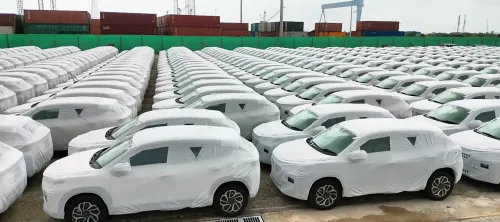
On exports, PV exports grew at a 17 per cent CAGR to reach a record 0.77 million units in FY2025, led by compact cars and utility vehicles from original equipment manufacturers (OEMs).
Automotive Mission Plan 2047: The Long View
Under the Automotive Mission Plan 2047, total production across two-wheelers, three-wheelers, PVs, CVs, and quadricycles is projected to rise from approximately 34.71 million units in FY2026 to 50 million units by 2030 and further to 200 million units by 2047.
Supply Chain Risk: The Warning Beneath the Headlines
Tushar Bhaskar, President of Rubix Data Sciences, cautioned that rapid growth carries systemic risk deeper in the value chain. 'Every record export number and capacity announcement from an OEM sits on top of a much longer chain of component makers, dealers and logistics partners whose balance sheets weren't built for this pace of change,' he said.
Bhaskar added: 'The winners over the next decade will be the companies that can grow while seeing the risk of building three tiers down their supply chain before it reaches them.' The caution is notable at a moment when headline numbers are uniformly positive — the stress, he implies, is invisible until it isn't.
Point of View
But the 65 per cent share figure masks a concentration risk: the entire growth narrative now rests on a single body style, leaving OEMs and their supply chains exposed if consumer sentiment or fuel economics shift. The CV rebound is more structurally encouraging — it tracks infrastructure spend and freight demand, both of which are policy-supported. The more underreported story, however, is the one Rubix's own president flagged: tier-2 and tier-3 suppliers scaling at a pace their balance sheets may not support. India has been here before — rapid auto-sector expansion followed by a credit-driven correction in 2018-19. The question is whether the industry has built the financial resilience to avoid a repeat at a much larger scale.
NationPress
7 Aug 2026
Frequently Asked Questions
What share of India's car sales did SUVs account for in FY26?
SUVs accounted for 65 per cent of all passenger vehicle sales in FY2026 , meaning two in every three cars sold in India were SUVs, according to a report by Rubix Data Sciences.
How much did commercial vehicle sales grow in FY2026?
Commercial vehicle sales grew approximately 12.5 per cent year-on-year in FY2026 , recovering sharply after a period of moderation in FY2025. The rebound was attributed to GST 2.0 and lower RBI repo rates reducing financing costs.
What is India's current rank in the global automobile market?
India became the third-largest automobile market globally in 2025 . The country also ranks second in bus and coach production, third in passenger car production, and fourth in commercial vehicle production.
What does the Automotive Mission Plan 2047 target?
The Automotive Mission Plan 2047 projects total vehicle production — spanning two-wheelers, three-wheelers, PVs, CVs, and quadricycles — to rise from 34.71 million units in FY2026 to 50 million units by 2030 and 200 million units by 2047.
What risk did Rubix Data Sciences flag despite the strong growth numbers?
Rubix Data Sciences President Tushar Bhaskar warned that rapid growth creates systemic risk in the supply chain, with component makers, dealers, and logistics partners potentially unprepared for the pace of expansion. He said the winners will be companies that can identify risk three tiers deep in their supply chains before it surfaces.