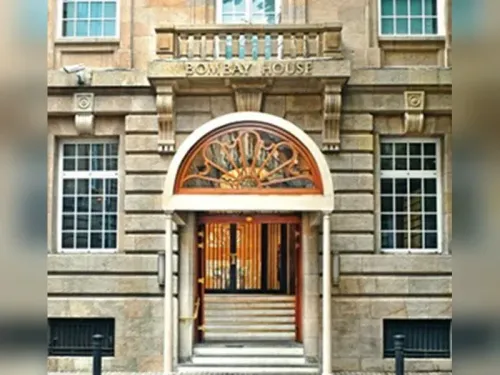
Tata Trusts propose TESS-TCE merger with Tata Sons to avoid mandatory listing
Synopsis
Tata Trusts has unveiled a merger plan that could keep Tata Sons off the stock exchange permanently — by absorbing two operating companies to push its financials outside RBI's NBFC and CIC thresholds. With ₹1,05,043 crore in projected operating revenue, the math is designed to make a listing legally unnecessary. The RBI's response to the no-objection certificate request will be the real verdict.
Key Takeaways
Tata Trusts (holding 66% of Tata Sons ) has proposed merging TESS and TCE into TSPL to exit the RBI's NBFC/CIC regulatory framework.
The merged entity is projected to report operating revenues of ₹1,05,043 crore — 64.3% of total income — as of 31 March 2026 , disqualifying it from NBFC classification.
Investments in group companies would be ₹1,77,120 crore , below the 90% net-asset threshold required for CIC status.
The plan requires a prior no-objection certificate from the RBI under the Voluntary Amalgamation Directions, 2025.
Both Sir Dorabji Tata Trust and Sir Ratan Tata Trust boards unanimously backed the unlisted status goal in July 2025 .
Tata Consultancy Services was a division of TSPL until 2004 , cited as precedent for reabsorbing operating businesses.
Tata Trusts, which holds a 66% stake in Tata Sons Private Limited (TSPL), has formally proposed merging Tata Electronics Systems Solutions Private Ltd (TESS) and Tata Consulting Engineers (TCE) with Tata Sons as part of a strategic reorganisation designed to take the conglomerate's holding company outside the Reserve Bank of India's (RBI) regulatory framework for non-banking financial companies (NBFCs) and core investment companies (CICs) — a classification that currently mandates a public listing. The proposal was communicated through a Tata Trusts statement issued on Monday, 28 September.
The Core Rationale
Tata Trusts contends that the proposed reorganisation is not a novel workaround but a return to a model that defined Tata Sons for much of its existence. According to the statement, TSPL operated with its own revenues and businesses for almost 80 of its 100-plus years, using those revenues to fund newer ventures within the group. As recently as 2004, Tata Consultancy Services (TCS) was a business division of TSPL before being demerged into a separate subsidiary — a precedent the Trusts cite to argue that reabsorbing operating companies is consistent with the group's historical structure.
The Numbers That Matter
The Trusts' statement projects that the amalgamated entity — formed by merging TESS and TCE into TSPL — would, as of 31 March 2026, report operating revenues of ₹1,05,043 crore, far exceeding income from financial assets of ₹40,072 crore. That operating revenue would constitute 64.3% of total income, meaning the merged entity would no longer meet the 'principal business criteria' of an NBFC. Additionally, investments in group companies would stand at ₹1,77,120 crore — representing less than 90% of aggregate net assets of ₹2,00,158 crore — which would also disqualify it from CIC classification under RBI norms.
Regulatory Steps Required
Because TSPL currently holds NBFC status, any amalgamation with operating non-financial companies such as TESS and TCE must comply with the Reserve Bank of India (Non-Banking Financial Companies – Voluntary Amalgamation) Directions, 2025. This includes obtaining a prior 'no-objection certificate' (NOC) from the RBI. Upon completion of the reorganisation, TSPL would also be required to surrender its certificate of registration as a CIC, the statement noted. Tata Trusts has written to the TSPL Board to approve the proposal and initiate the RBI application process. Both entities will engage with the RBI on all aspects of the plan.
Board Backing and Strategic Intent
The proposal is grounded in resolutions passed unanimously by the Boards of Sir Dorabji Tata Trust and Sir Ratan Tata Trust in July 2025, wherein both trusts agreed that every effort should be made to ensure TSPL remains an unlisted private company. The Trusts argue the reorganisation preserves the group's century-old structure, which has historically prioritised long-term strategic initiatives aligned with nation-building and the welfare of disadvantaged communities. Tata Trusts added that the plan is in the best interests of the Tata Group and all its stakeholders, and constitutes a regulatory-compliant form of CIC reorganisation.
The proposal now awaits formal approval from the TSPL Board and, critically, the RBI's no-objection certificate — a regulatory green light that will determine whether Tata Sons can remain outside the public markets.
Point of View
At its core, a regulatory engineering exercise — and a sophisticated one. By reabsorbing operating companies whose revenues dwarf financial asset income, TSPL can mathematically exit the NBFC and CIC categories that trigger mandatory listing. The RBI, however, will scrutinise whether this is a genuine operational reintegration or a structural manoeuvre designed primarily to avoid public-market accountability. The precedent of TCS's 2004 demerger lends historical credibility to the argument, but regulators may weigh the intent as much as the numbers. If the RBI grants the NOC, it sets a significant precedent for how large conglomerates can use internal restructuring to manage their regulatory classification — a question with implications well beyond the Tata Group.
NationPress
29 Sept 2026
Frequently Asked Questions
Why does Tata Sons want to avoid a stock market listing?
Tata Sons, classified as a core investment company (CIC) under RBI norms, is currently required to list on stock exchanges under that regulatory framework. Tata Trusts has consistently sought to preserve TSPL's status as an unlisted private company, arguing that a public listing would alter the group's century-old governance structure and long-term strategic orientation.
What is the proposed merger plan by Tata Trusts?
Tata Trusts has proposed merging Tata Electronics Systems Solutions Private Ltd (TESS) and Tata Consulting Engineers (TCE) with Tata Sons (TSPL). The combined entity's operating revenues would exceed its financial asset income, disqualifying it from NBFC and CIC classification under RBI rules — thereby removing the mandatory listing requirement.
What financial thresholds does the merger aim to cross?
The merged entity is projected to report operating revenues of ₹1,05,043 crore against financial asset income of ₹40,072 crore as of 31 March 2026, making operating income 64.3% of total income. Investments in group companies would also fall below the 90% net-asset threshold required for CIC classification, according to the Tata Trusts statement.
What regulatory approvals are needed for this merger?
The amalgamation must comply with the RBI's Non-Banking Financial Companies – Voluntary Amalgamation Directions, 2025, which requires a prior no-objection certificate (NOC) from the RBI. TSPL would also need to surrender its certificate of registration as a CIC upon completion of the reorganisation.
Has Tata Sons operated as an entity with its own businesses before?
Yes. According to Tata Trusts, TSPL had its own operating businesses and revenues for almost 80 of its 100-plus years of existence. Tata Consultancy Services was itself a business division of TSPL until 2004, when it was demerged into a separate subsidiary — a precedent the Trusts cite to justify the current proposal.