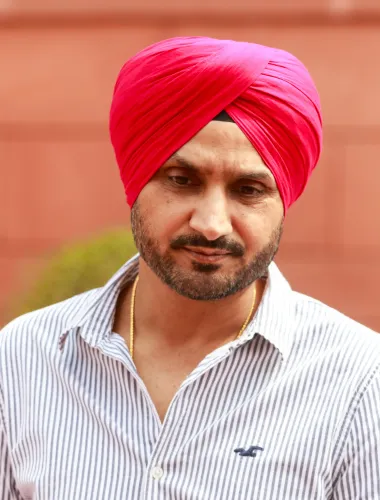
Arjan Bajwa on social media addiction: 'Attention span won't go beyond seconds'

Synopsis
Arjan Bajwa's take on social media cuts deeper than the usual celebrity caution — he frames compulsive scrolling as a dopamine-driven addiction that has hijacked a tool originally meant to inform. With India's smartphone user base among the world's largest, his warning about shrinking attention spans lands with real urgency.
Key Takeaways
Arjan Bajwa called social media scrolling 'a very bad addiction for everybody' in remarks shared on 27 August .
He described compulsive checking as a dopamine rush , comparing it to addictive behaviour rather than information-seeking.
Bajwa acknowledged social media's value as a news source, noting that newspapers and magazines have become less prominent.
His key concern: excessive use shrinks attention spans to 'a few seconds' and wastes time on 'unnecessary or completely random content.' The actor stopped short of rejecting social media outright, calling it 'a big tool' for global information — but warned against uncontrolled use.
Actor Arjan Bajwa, best known for his roles in 'Fashion', 'Rustom', and 'Kabir Singh', has spoken out against the growing culture of compulsive social media use, calling endless scrolling a habit that is quietly eroding attention spans and consuming people's time and energy. The actor shared his concerns in a recent interaction on 27 August.
The Addiction Problem
Bajwa did not mince words when describing the scale of the problem. 'Scrolling through social media has become a very bad addiction for everybody. I don't consider it healthy at all because everyone is on their phones constantly, trying to get information about what's happening in the digital world,' he said.
He went further, drawing a parallel to neurological reward cycles: 'Somehow, now I feel it is like a dopamine rush people get to keep checking social media.' This compulsive checking, he argued, has moved well beyond the original purpose of these platforms.
What Social Media Was Meant to Be
Bajwa acknowledged that digital platforms serve a legitimate informational function — one that has grown more important as print media has receded. 'Social media is supposed to give you information,' he noted, pointing out that with newspapers and magazines becoming less prominent, people are increasingly turning to digital platforms for news and updates. 'It is a big boon that you can watch the news and know what is happening anywhere in the world right on your phone screen,' he said.
However, he drew a clear line between purposeful consumption and mindless scrolling — a distinction he believes most users have lost sight of. 'It has to be informative,' he stressed, noting that habitual checking — 'right after getting out of bed or even before going to sleep' — signals something closer to dependency than information-seeking.
The Attention Span Cost
The actor's sharpest concern was about cognitive impact. 'But then it becomes an addiction, and your attention span also does not go beyond a few seconds,' he warned. He pointed to the volume of low-value content as a key driver: 'There is also a lot of unnecessary or completely random content that takes away your time, energy and attention as you keep scrolling throughout the day.'
Notably, Bajwa's remarks arrive at a time when global regulators and mental health researchers are increasingly scrutinising the design of social media platforms — particularly infinite scroll and notification mechanics — for their role in fostering compulsive behaviour. India, with one of the world's largest and fastest-growing smartphone user bases, sits at the centre of this debate.
The Broader Context
Bajwa is not the first public figure to raise these concerns, but his framing — balancing genuine utility against addictive design — reflects a nuanced position. He stopped short of calling for a boycott, instead urging users to be deliberate about how and when they engage with these platforms. Whether audiences heed that message is another matter entirely.
Point of View
Autoplay, and notification engineering are deliberate retention mechanics, not user failures. India has no federal screen-time regulation and no mandatory design standards for platforms, which means the burden of restraint falls entirely on users already primed to scroll. A Bollywood actor raising the alarm is useful for awareness; it is not a substitute for policy.
NationPress
27 Aug 2026
Frequently Asked Questions
What did Arjan Bajwa say about social media addiction?
Arjan Bajwa said that scrolling through social media has become 'a very bad addiction for everybody,' comparing the compulsive urge to check platforms to a dopamine rush. He warned that excessive use shrinks attention spans and wastes time on irrelevant content.
Does Arjan Bajwa think social media has any value?
Yes. Bajwa acknowledged that social media serves a legitimate purpose as a source of instant global news, especially as print media has declined. He called it 'a big boon' for accessing information, but drew a sharp distinction between purposeful use and addictive scrolling.
Which films is Arjan Bajwa known for?
Arjan Bajwa is known for his roles in 'Fashion' (2008), 'Rustom' (2016), and 'Kabir Singh' (2019), among other Bollywood productions.
Why is social media addiction a concern in India?
India has one of the world's largest and fastest-growing smartphone user bases, making compulsive social media use a significant public health and productivity concern. Researchers and regulators globally are examining platform design features like infinite scroll for their role in fostering dependency.
What specific behaviour did Bajwa flag as most harmful?
Bajwa specifically flagged checking social media immediately after waking up and just before sleeping as signs of dependency rather than deliberate use. He also pointed to the volume of 'unnecessary or completely random content' as a key driver of time and attention loss.