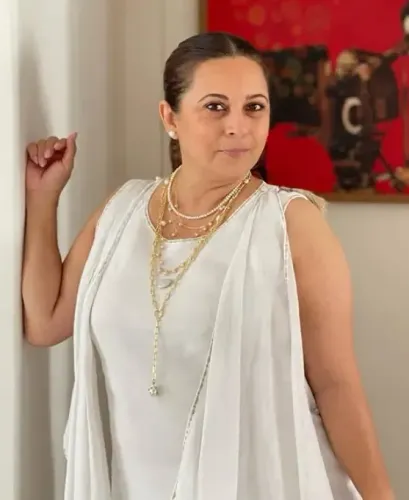
Pallavi Joshi reveals she earned half of Shekhar Suman's fee in 90s TV

Synopsis
Pallavi Joshi has put a number to 90s television’s gender pay gap: she earned half of what Shekhar Suman made, even while both were billed as the highest-paid stars of the era. Her account — specific, named, and unhedged — is one of the clearest first-person testimonies on pay disparity from that generation of Indian television.
Key Takeaways
Pallavi Joshi says she was paid half the fee of Shekhar Suman during their peak years on 1990s Indian television.
Joshi was the highest-paid actress of the era, yet still earned only half of what Suman — the highest-paid male actor — received.
Both stars shared a magazine cover in that period, reflecting their joint status at the top of TV’s pay scale.
Suman was known for shows including Dekh Bhai Dekh , Wah Janaab , and Movers & Shakers ; Joshi for Mriganayani , Talaash , and Aarohan .
Joshi is currently drawing critical praise for her role in the series Margao Files .
Actress and producer Pallavi Joshi has spoken candidly about the gender pay gap she experienced in the Indian television industry during the 1990s, revealing that despite being among the highest-paid actresses of her era, she was paid just half of what her male peer Shekhar Suman earned. The disclosure puts a personal face on a structural inequity that critics argue persisted across the entertainment industry for decades.
What Pallavi Joshi Said
Joshi recalled a telling detail from those years — a magazine cover that featured both her and Suman, a pairing that reflected their shared status at the top of television's pay scale. “I will tell you there was a time when there was a magazine cover page that had Shekhar Suman’s and my photograph. I think because Shekhar Suman and I were the highest-paid actors of television back in those days,” she said.
The disparity, however, was stark. “Shekhar Suman used to get twice the amount that I got. In spite of me being the highest-paid television actress, I was still paid half the price of what he was paid. That says it all,” Joshi added.
Her Career in the 90s Television Era
Joshi was among the most prominent faces on Indian television during the late 1980s and 1990s, earning acclaim for her performances in shows such as Mriganayani, Talaash, and Aarohan. Known for choosing content-driven, character-led roles, she built a reputation as one of the most respected actresses on the small screen — a standing that, by her own account, did not translate into pay parity.
Shekhar Suman's Standing in the Same Period
During the same era, Shekhar Suman was a dominant presence on Indian television, riding popularity through shows including Dekh Bhai Dekh, Wah Janaab, and Movers & Shakers. His double-the-fee status, as Joshi describes it, was not exceptional for the time — male leads routinely commanded significantly higher fees than their female counterparts across the industry.
Why This Matters Now
Joshi’s remarks arrive at a moment when gender pay parity in entertainment remains an active conversation, both in India and globally. Her account is notable precisely because she was at the top of the pay hierarchy for women — meaning the gap for actresses lower on the billing was likely wider still. This is not the first time a senior Indian actress has spoken about pay disparity from that era, but the specificity of the claim — half the fee, despite equivalent billing — gives it unusual weight.
On the professional front, Joshi is currently receiving strong reviews for her performance in the recently released series Margao Files, signalling a continued presence in meaningful, high-profile projects.
Point of View
But because the arithmetic is now on record — highest-paid woman, half the fee of the highest-paid man. The entertainment industry has long deflected pay-parity criticism with vague references to 'market rates' and 'star power'; a named, quantified claim from a peer of the era is harder to dismiss. What’s missing from the conversation is institutional accountability — no channel, producer, or industry body from that era has ever been asked to explain the differential. Joshi’s disclosure deserves a follow-up question: has anything structurally changed, or have the numbers just gotten larger?
NationPress
22 Jun 2026
Frequently Asked Questions
What did Pallavi Joshi reveal about her pay in the 1990s?
Pallavi Joshi revealed that despite being the highest-paid television actress of the 1990s, she earned only half of what Shekhar Suman was paid. She said, ‘Shekhar Suman used to get twice the amount that I got. That says it all.’
Who is Shekhar Suman and why is he relevant here?
Shekhar Suman was one of the most popular actors on Indian television in the 1990s, known for Dekh Bhai Dekh, Wah Janaab, and Movers & Shakers. Joshi cited him as the benchmark male star of the era whose fee was double hers despite their comparable billing.
Why does Pallavi Joshi’s account matter today?
Her account provides a specific, named, and quantified example of the gender pay gap in Indian entertainment — a topic that remains contested. Because she was at the top of the female pay scale, the gap for other actresses was likely even larger.
What is Pallavi Joshi working on currently?
Pallavi Joshi is currently receiving strong critical reviews for her character portrayal in the recently released series Margao Files.
Was the gender pay gap in 90s Indian television widely acknowledged?
The pay disparity between male and female actors in 1990s Indian television was reportedly common across the industry, though rarely quantified publicly. Joshi’s disclosure is among the most direct first-person accounts from a senior actress of that generation.