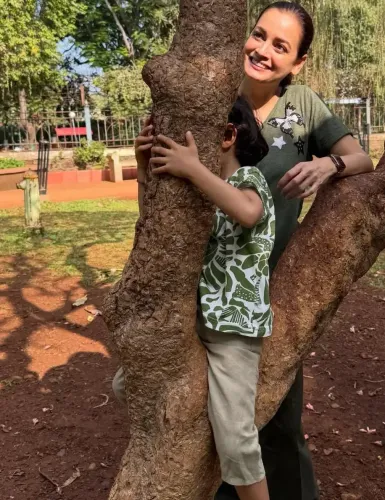
Saiyami Kher on 200-year-old tree felled near Nashik home: 'They couldn't survive us'

Synopsis
Actress Saiyami Kher did not mince words — a 200-year-old tree, just 500 metres from her Nashik home, was felled for development, and she wants those who approved it to sit at a desk on that bare spot in 50°C heat. Her statement cuts through the platitudes of Environment Day to ask why ecological common sense vanishes the moment real infrastructure decisions are made.
Key Takeaways
Actress Saiyami Kher condemned the felling of a 200-year-old tree located 500 metres from her family home in Nashik .
Three large old trees lined the road to her house; at least one has been removed, reportedly for development purposes.
Kher challenged the practice of compensatory plantation, calling it an inadequate substitute for centuries-old ecological value.
She called for 'better planning, better accountability, and a genuine respect for nature,' while clarifying she is not opposed to development.
Her statement, issued on 23 June , called out the normalisation of tree-felling decisions in Indian cities.
Actress Saiyami Kher has spoken out against the felling of a 200-year-old tree located just 500 metres from her family home in Nashik, calling the decision a symbol of how normalised environmental destruction has become in the name of development. Her remarks, issued in a statement, came on 23 June and drew attention to what she described as a fundamental contradiction in how Indian cities approach growth.
What Was Lost
Kher revealed that there were three large, old trees lining the road to her house — trees that had, by her account, provided shade and shelter to countless people over the years. 'So many people have taken shelter under it when it's very hot or when it starts raining,' she said. 'But it's gone. Chopped off for development.'
The tree in question had stood for an estimated two centuries — surviving droughts, monsoons, and generations of change — before being cleared, reportedly to make way for infrastructure work. Kher's pointed observation: 'The trees survived 200 summers. They couldn't survive us.'
Kher's Statement: Sharp and Unsparing
In her statement, Kher drew a direct line between childhood environmental education and adult decision-making — and found the latter wanting. 'Remember when we were kids and our teachers made us write essays on the importance of trees. We celebrate Environment Day. Turns out that wasn't part of the adult syllabus,' she said.
She proposed a pointed hypothetical for those who authorised the felling: 'All the adults who think cutting down 200-year-old trees is a good idea... why don't we set up their offices on the exact spot where these trees were murdered? No cover. No air conditioning. Just a desk and a pleasant 50°C afternoon.'
Kher also challenged the logic of compensatory plantation — the common practice of planting saplings to offset mature tree removal. 'A tree that has stood for two centuries is not just wood and leaves. It carries history, biodiversity, and an ecological value that cannot be replaced by planting a sapling elsewhere and calling it compensation,' she said.
The Broader Critique: Development vs Ecology
What frustrated Kher most, she said, was not a single incident but a pattern. 'What disturbs me even more was how normalised these decisions have become,' she noted, adding that cities continue to 'talk endlessly about climate change, rising temperatures, water shortages, and deteriorating air quality, yet we continue to destroy the very ecosystems that help protect us from these problems.'
She also flagged the seasonal irony: 'Every summer we complain about the heat becoming unbearable, yet we continue removing natural shade and green cover. We celebrate Environment Day, organise plantation drives, and teach children the importance of nature, but those lessons seem to disappear when real decisions need to be made.'
Not Against Development, But Demanding Accountability
Kher was careful to clarify her position. 'I am not against development. I understand that cities need to grow and infrastructure is important. But growth without sensitivity is not progress,' she said. She called for 'better planning, better accountability, and above all, a genuine respect for nature.'
Her closing appeal was directed at the larger conversation she hopes the incident will spark: 'Once a 200-year-old tree is gone, no amount of regret can bring it back. I hope this incident starts a larger conversation about how we value our natural heritage before it's too late.' The sentiment echoes a growing chorus of voices — from urban ecologists to resident welfare groups — who argue that Indian cities routinely undervalue mature tree cover in infrastructure planning.
Point of View
But it points to a structural failure that goes beyond one tree in Nashik. Indian urban planning law requires tree authorities to approve felling and mandates compensatory plantation — yet enforcement is patchy and the replacement ratio rarely accounts for ecological age or canopy value. A sapling planted today will take decades to match the carbon sequestration, biodiversity hosting, and microclimate cooling of a 200-year-old specimen. The real accountability gap is not sentiment but data: most Indian municipalities do not maintain verified urban tree censuses, making it nearly impossible to track net canopy loss. Until that changes, Environment Day pledges and plantation drives will remain performative.
NationPress
21 Sept 2026
Frequently Asked Questions
Why did Saiyami Kher speak out about a tree in Nashik?
Saiyami Kher issued a statement condemning the felling of a 200-year-old tree located just 500 metres from her family home in Nashik, calling it a symbol of how normalised environmentally destructive decisions have become in the name of urban development.
What did Saiyami Kher say about the felled tree?
Kher said the tree had provided shade and shelter to many people over generations and that its ecological value could not be replaced by planting a sapling. She noted it had 'survived 200 summers' but 'couldn't survive us,' and called for those who approved the felling to be held accountable.
Is Saiyami Kher opposed to development?
No. Kher explicitly stated she is not against development and acknowledges that cities need to grow. Her argument is that 'growth without sensitivity is not progress' and that better urban planning can accommodate both infrastructure needs and environmental responsibility.
What is the problem with compensatory plantation, according to Kher?
Kher argued that planting a sapling elsewhere cannot replace a 200-year-old tree, which carries centuries of history, biodiversity, and ecological value. She called compensatory plantation an inadequate and misleading substitute for preserving mature trees.
What broader issue does this incident highlight?
The incident reflects a wider pattern in Indian cities where mature tree cover is routinely cleared for infrastructure projects, often with minimal accountability. Kher's statement drew attention to the contradiction of celebrating Environment Day while continuing to destroy ecosystems that protect against climate change, rising heat, and deteriorating air quality.