Amit Shah Plants Khejri at Rajasthan Border Outpost
Synopsis
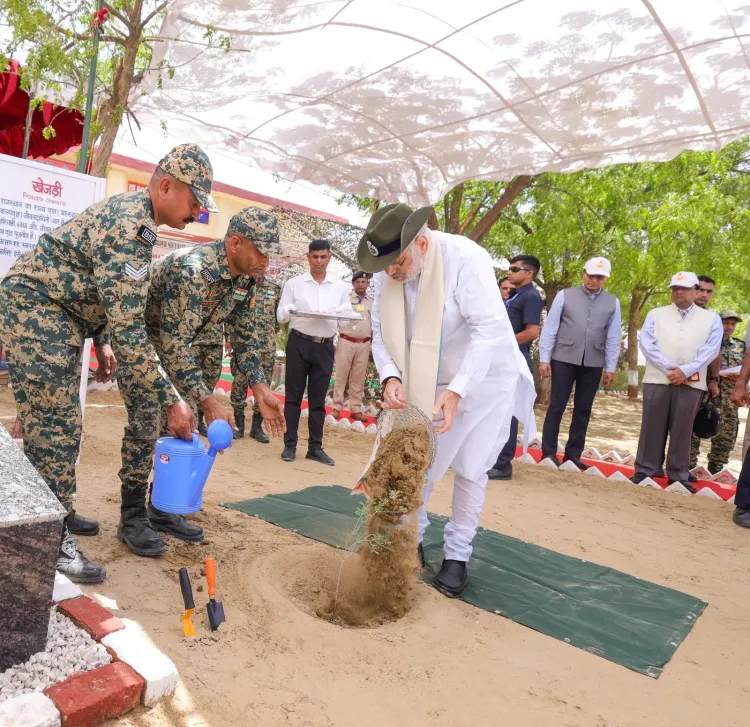
Union Home Minister Amit Shah planted a Khejri sapling at Rajasthan's Sanchu Border Outpost on May 26, 2026, spotlighting the security forces' sustained afforestation efforts along India's western frontier over the past five years.
Key Takeaways
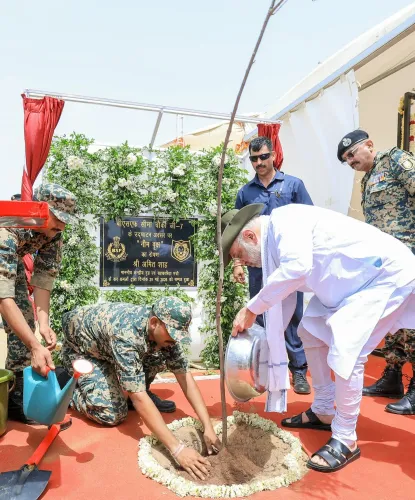
Amit Shah planted a Khejri sapling at the Sanchu Border Outpost in Rajasthan on May 26, 2026 .
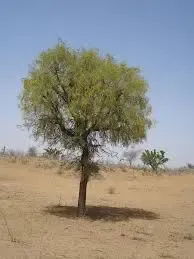
The Khejri tree is Rajasthan's state tree, well-suited to the arid Thar desert environment along the western frontier.
Shah stated that India's security forces have carried out plantation efforts over the past five years as a demonstration of environmental sensitivity.
The BSF and other CAPFs have conducted annual tree-plantation drives along India's borders since at least 2014 under MHA direction.
Such drives align with the National Afforestation Programme and state-level ecological initiatives in Rajasthan .
Afforestation in the border belt aims to combat desertification, stabilise sand dunes, and strengthen ties between security forces and border communities.
Union Home Minister Amit Shah planted a Khejri sapling at the Sanchu Border Outpost in Rajasthan on Tuesday, May 26, 2026, marking his participation in the ongoing afforestation drive conducted by India's security forces along the country's western frontier.
Context
Posting on X, Shah wrote: 'Rajasthan ke Sanchu border outpost par 'Khejri' ka paudharopan kiya' — 'Planted a Khejri sapling at the Sanchu border outpost in Rajasthan.' He added that India's security forces have set an example of environmental sensitivity and responsibility through sustained plantation efforts over the past five years.
The Khejri tree (Prosopis cineraria) holds special significance in Rajasthan, where it is the designated state tree. It is prized for its resilience in arid and semi-arid conditions, making it a natural fit for the ecologically fragile Thar desert belt that stretches along the India-Pakistan frontier.
Policy Backdrop
India's Central Armed Police Forces (CAPFs), including the Border Security Force (BSF), have conducted annual tree-plantation drives along the western and eastern borders since at least 2014. These drives are part of broader ecological security measures aimed at combating desertification while reinforcing the 'green' credentials of paramilitary personnel.
The Ministry of Home Affairs (MHA), which Shah heads, has consistently highlighted such initiatives to underscore the dual role of border forces — guardians of territorial integrity as well as environmental stewards. These efforts align with national goals under the National Afforestation Programme and state-level ecological restoration schemes in Rajasthan.
The BSF is the primary paramilitary force responsible for guarding India's western border with Pakistan, operating out of outposts like Sanchu in the desert terrain of western Rajasthan.
Stakeholders and Impact
Border communities in western Rajasthan stand to benefit from sustained afforestation, which helps stabilise sand dunes, improve micro-climates, and support local livelihoods dependent on the Khejri tree for fodder, fuel, and food. The tree's deep root system also reduces soil erosion in one of India's most arid regions.
For the security forces themselves, participation in plantation drives has become a visible symbol of community engagement beyond their core mandate. The MHA frames such activities as building bonds between border villages and the personnel who protect them.
What's Next
Observers will watch whether the MHA releases updated annual targets for CAPF afforestation and whether new guidelines integrate tree cover into ongoing border-fencing or outpost modernisation projects. Rajasthan's border belt, given its vulnerability to desertification, is likely to remain a focal zone for such ecological interventions. If the momentum continues, green corridors along India's western frontier could emerge as a distinct policy feature linking internal security with environmental resilience.
Point of View
The post implicitly frames the initiative as a sustained institutional achievement rather than a one-off gesture. This fits a broader pattern under the current government of linking national security infrastructure with ecological and developmental goals to broaden the political appeal of border-area spending. The choice of the Khejri tree — Rajasthan's state symbol — adds a layer of cultural resonance that reinforces the centre's engagement with a BJP-governed state.
NationPress
10 Oct 2026
Frequently Asked Questions
What is the Khejri tree and why is it significant in Rajasthan?
The Khejri tree ( Prosopis cineraria ) is Rajasthan's state tree, prized for surviving in arid conditions. It provides fodder, fuel, and food to communities in the Thar desert and helps stabilise sand dunes, making it ideal for afforestation along the western border.
Where is the Sanchu Border Outpost located?
The Sanchu Border Outpost is a BSF outpost in Rajasthan along the India-Pakistan western frontier, situated in the ecologically fragile Thar desert belt.
Why are security forces involved in tree plantation drives?
The Ministry of Home Affairs directs CAPFs including the BSF to conduct annual plantation drives as part of ecological security measures, to combat desertification in border areas and to build goodwill with border communities.
What is the National Afforestation Programme?
The National Afforestation Programme is a Government of India scheme aimed at restoring degraded forest land and increasing green cover, with which CAPF plantation drives in border areas are aligned.
How long have BSF tree plantation drives been going on?
BSF and other CAPFs have conducted annual tree-plantation drives along India's western and eastern borders since at least 2014 as part of ecological and community-engagement mandates under the MHA.