Tom Hiddleston's Pompeii docu-series: 2,000 years compressed on screen
Synopsis
Tom Hiddleston's new Pompeii docu-series doesn't just revisit a famous disaster — it reframes it. New archaeological evidence suggests many residents had a genuine chance to survive the 79 AD eruption of Mount Vesuvius, turning one of history's most iconic tragedies into a story about choice, not just catastrophe.
Key Takeaways
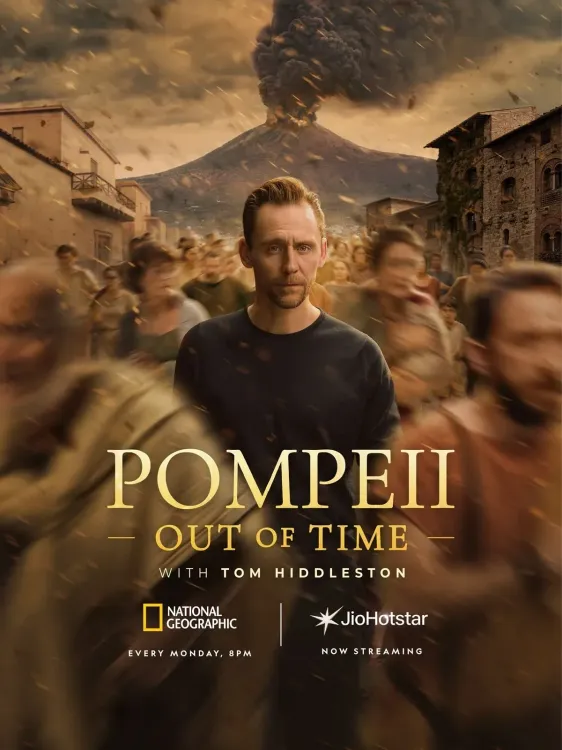
Tom Hiddleston hosts 'Pompeii: Out of Time' , a docu-series blending scripted drama and investigative documentary.
The series challenges long-held assumptions, including evidence that many Pompeii residents could have survived the 79 AD eruption of Mount Vesuvius .
Hiddleston is guided by archaeologists, historians, geologists, and disaster experts throughout the series.
The production is by Plimsoll Productions , with Tom Barbor-Might as showrunner and director.
The series is available on National Geographic Channel and JioHotstar .
British actor Tom Hiddleston has opened up about his deep fascination with the ancient ruins of Pompeii, speaking ahead of his docu-series 'Pompeii: Out of Time with Tom Hiddleston', now streaming on National Geographic Channel and JioHotstar. For Hiddleston, the experience of standing in Pompeii was nothing short of a temporal collapse — the 2,000-year distance between the ancient city and the present day, he said, felt suddenly and viscerally close.
What the Series Uncovers
Guided by a team of archaeologists, historians, geologists, and disaster experts, Hiddleston leads viewers through layers of evidence that challenge long-held assumptions about Pompeii's final hours. Among the most striking revelations is that many of the city's residents, caught in the catastrophic eruption of Mount Vesuvius in 79 AD, may in fact have had the opportunity to escape — a finding that reframes the disaster's human story entirely.
The series blends scripted drama with investigative documentary, transporting audiences back to ancient Rome in the hours immediately before and during the eruption. The format allows the production to move fluidly between forensic reconstruction and emotional storytelling.
Hiddleston in His Own Words
'The ancient world has compelled my imagination and curiosity for as long as I can remember,' Hiddleston said. 'Classical Antiquity is the foundation and cornerstone of Western and European culture. To visit Pompeii is to feel the distance of the 2,000 years between now and then compress. The past becomes the present; the past feels so close. Tangible, honest and real.'
He added: 'Pompeii is often remembered for how its story ended. But by looking closer, we can uncover the details of people's lives, the choices they made, and the moments that came before the city was buried. To revisit the final hours of those ordinary people, caught in an extraordinary moment, and to help bring these remarkable human stories back into the light, is a genuine honor.'
The Eruption That Froze a City
In 79 AD, Mount Vesuvius erupted with devastating force, burying the Roman city of Pompeii under a thick blanket of volcanic ash. The speed and scale of the burial had an unintended consequence: it preserved the city with extraordinary fidelity — its buildings, artworks, and the remains of its people locked in place for nearly two millennia. That preservation is precisely what makes Pompeii such a singular archaeological site, and what gives the docu-series its raw, human weight.
Production and Availability
The series is produced by Plimsoll Productions. Tom Barbor-Might serves as showrunner and director, while Jessica Ruston and Mark Ravenhill are the lead writers, with additional writing by Kevin R. Wright and Tom Barbor-Might. Executive producers are Grant Mansfield, Kevin R. Wright, Helen Flint, and Alan Eyres. 'Pompeii: Out of Time with Tom Hiddleston' is currently available on National Geographic Channel and JioHotstar.
With its blend of scientific rigour and human empathy, the series is positioned as one of the more ambitious historical documentaries of the year — and Hiddleston's evident passion for the subject lends it an authenticity rarely found in the genre.
Point of View
And far more relevant. Hiddleston's casting is also a strategic choice: his credibility as a classically trained actor lends intellectual weight that a conventional celebrity host would not. The real question is whether the series uses its archaeological access to push genuinely new conclusions, or whether the 'new evidence' framing is largely a marketing device. Either way, it arrives at a moment when global appetite for ancient history content — driven partly by streaming competition — is at a sustained high.
NationPress
25 Sept 2026
Frequently Asked Questions
What is 'Pompeii: Out of Time with Tom Hiddleston' about?
It is a docu-series in which Tom Hiddleston, guided by archaeologists, historians, and disaster experts, investigates new evidence about the final hours of Pompeii before and during the 79 AD eruption of Mount Vesuvius. The series blends scripted drama with investigative documentary and is available on National Geographic Channel and JioHotstar.
What new revelations does the Pompeii docu-series make?
The series reportedly uncovers evidence suggesting that many Pompeii residents caught in the Mount Vesuvius eruption had the opportunity to survive — a finding that challenges the widely held assumption that the disaster was unsurvivable for those present. It also focuses on the personal stories and choices of ordinary people in the city's final hours.
Who produced 'Pompeii: Out of Time with Tom Hiddleston'?
The series is produced by Plimsoll Productions. Tom Barbor-Might serves as showrunner and director, with writing by Jessica Ruston, Mark Ravenhill, Kevin R. Wright, and Tom Barbor-Might. Grant Mansfield, Kevin R. Wright, Helen Flint, and Alan Eyres are executive producers.
Where can viewers watch the Pompeii docu-series in India?
'Pompeii: Out of Time with Tom Hiddleston' is available in India on National Geographic Channel and JioHotstar.
Why did Mount Vesuvius's eruption preserve Pompeii so well?
When Mount Vesuvius erupted in 79 AD, it buried Pompeii rapidly under volcanic ash, which effectively sealed and preserved the city's buildings, artwork, and human remains for nearly 2,000 years. This rapid burial is what makes Pompeii one of the world's most intact archaeological sites.