Roman concrete study may crack the mystery of Pyramid of Giza's construction
Synopsis
A July 2026 study in Science Advances found that nearly 2,000-year-old Roman concrete from Hadrian's Villa self-heals via calcite crystal formation — a discovery that could finally explain how cast-concrete pyramid blocks might have survived 4,500 years, breathing new life into a long-contested theory.
Key Takeaways
A study published in Science Advances in July found that nearly 2,000-year-old Roman concrete grows stronger over time through self-healing calcite crystal formation.
The research was led by Zhu Xiaohong of Beijing University of Technology , with collaborators from UC Berkeley , University of Michigan , Lawrence Berkeley National Laboratory , and University of Illinois Urbana-Champaign .
Concrete samples were taken from a communal latrine at Hadrian's Villa in Tivoli, Italy and analysed using high-resolution imaging.
The findings lend new scientific credibility to the theory that the Great Pyramid of Giza 's 2.3 million multi-tonne blocks may have been cast from an early concrete rather than quarried stone.
Modern Portland cement degrades over decades, making ancient concrete's longevity a key focus for sustainable construction research.
A peer-reviewed study on nearly 2,000-year-old Roman concrete has offered a potential materials-science answer to one of archaeology's oldest questions: how the Great Pyramid of Giza — built with 2.3 million multi-tonne stone blocks — could have been constructed from cast concrete and still stand after more than 4,500 years. The research, published in the journal Science Advances in July, reveals that ancient Roman concrete does not merely endure — it actively strengthens itself over centuries.
The self-healing secret of Roman concrete
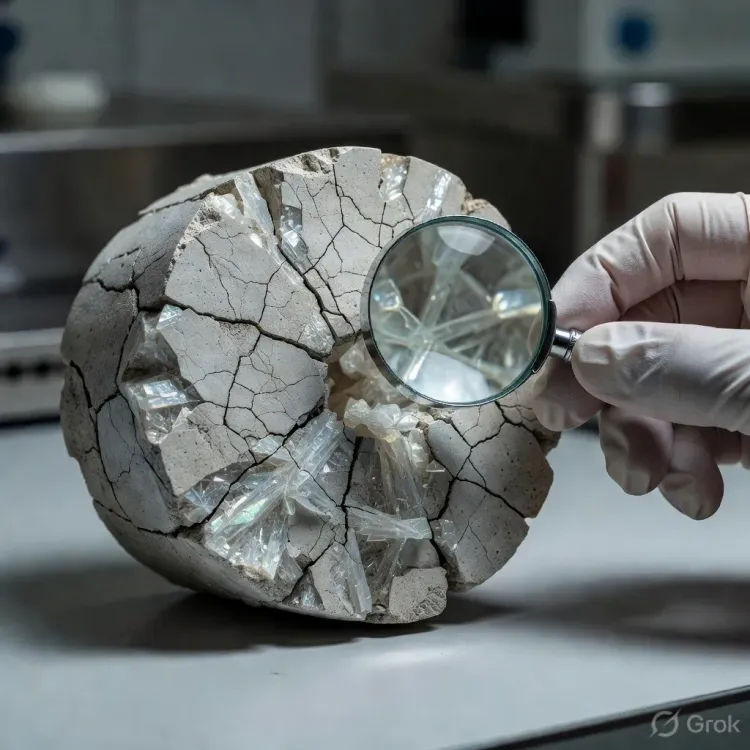
A research team led by Zhu Xiaohong of Beijing University of Technology, in collaboration with scientists from the University of California, Berkeley, the University of Michigan, Lawrence Berkeley National Laboratory, and the University of Illinois Urbana-Champaign, analysed concrete samples extracted from a communal latrine at Hadrian's Villa in Tivoli, Italy. Using high-resolution imaging techniques, the team identified a self-healing mechanism at the material's core: the gradual formation of calcite crystals that progressively fill pores and microcracks, making the structure denser and stronger over time.
Why it matters for Pyramid research
Mainstream archaeology holds that the pyramids were constructed from natural limestone or granite blocks that were precisely cut and hauled into position. An alternative scientific theory, however, proposes that the blocks may have been cast from an early form of concrete — a hypothesis that has long faced a fundamental challenge: how could any artificial material survive for millennia while some modern structures show wear within decades? The Roman concrete findings suggest that the right mineral chemistry can trigger long-term self-repair, lending new credibility to the concrete-cast hypothesis for the pyramids.
The competitive backdrop: ancient materials vs. modern cement
Modern Portland cement, the backbone of contemporary construction, is known to degrade over time, with many structures requiring repair or replacement within a human lifetime. Ancient Roman concrete, by contrast, appears to improve with age — a paradox that materials scientists have been working to decode for years. The Science Advances study adds granular, imaging-backed evidence to explain the mechanism behind this durability, potentially informing next-generation sustainable building materials.
What's next
The research opens a new avenue for applying Roman concrete's self-healing chemistry to the ongoing debate over Pyramid construction methods. If ancient Egyptians used a comparable mineral-binding process, it would reframe not only how the structures were built but also why they have survived largely intact for millennia. Researchers and archaeologists are expected to examine whether similar calcite-crystal formation can be detected in pyramid block samples, a test that could either validate or definitively challenge the concrete hypothesis.
Point of View
Berkeley, and Ann Arbor lending hard imaging data to what was once a fringe hypothesis. The deeper implication runs in two directions simultaneously: it challenges settled Egyptological consensus while also pointing the construction industry toward bio-inspired, self-repairing cement alternatives at a time when infrastructure longevity is a global policy priority. The next critical test — whether pyramid block samples show comparable calcite signatures — could either cement or collapse the theory entirely.
NationPress
20 Oct 2026
Frequently Asked Questions
What did the Roman concrete study published in Science Advances find?
The study found that nearly 2,000-year-old Roman concrete actively self-heals over time through the gradual formation of calcite crystals that fill internal pores and microcracks, making the material denser and stronger with age. Samples were taken from a communal latrine at Hadrian's Villa in Tivoli, Italy.
How does the Roman concrete discovery relate to the Great Pyramid of Giza?
An alternative scientific theory proposes that the Great Pyramid's 2.3 million stone blocks were cast from an early form of concrete rather than quarried and hauled. The Roman concrete study provides a plausible materials-science mechanism — self-healing calcite chemistry — that could explain how such a material might survive for more than 4,500 years.
Who led the Roman concrete research team?
The research was led by Zhu Xiaohong of Beijing University of Technology, with collaborators from the University of California Berkeley, the University of Michigan, Lawrence Berkeley National Laboratory, and the University of Illinois Urbana-Champaign.
Why is ancient Roman concrete stronger than modern Portland cement?
Unlike modern Portland cement, which degrades over decades, ancient Roman concrete develops calcite crystals over centuries that seal internal microcracks and pores, progressively strengthening the structure. This self-healing property is linked to the specific mineral chemistry used in Roman-era construction.
What happens next in the pyramid concrete hypothesis research?
Researchers are expected to investigate whether similar calcite-crystal formation can be detected in actual pyramid block samples. A positive result would significantly validate the concrete-cast theory of pyramid construction, while a negative result would reinforce the mainstream quarried-stone explanation.