When Luxury Breaks Its Promise: How Accor's Unclear Terms Leave Indian Families Embarrassed at the Dining Table
Synopsis
We chose India over Singapore. We chose to invest in our own country's luxury hospitality. Raffles Jaipur made us question that decision.
By Shripal Jain, Founder — NationPress
This Diwali, my family and I traveled to Singapore. It was supposed to be a dream holiday — the kind of international trip you plan months in advance, the kind your kids remember. And it was beautiful in many ways. But it was also a reality check.
The vegetarian food options were limited. There were no bidets in hotel bathrooms — a basic hygiene standard for most Indian families. The experiences, while polished, weren't designed with Indian families in mind. Everything felt like we were guests in someone else's culture, adjusting ourselves to fit in rather than being welcomed as we are.
On the flight back, my wife and I had a conversation that I think many Indian families are having right now. Why are we spending lakhs boosting the economies of other countries when India has world-class luxury destinations of its own? Udaipur, Jaipur, Goa, Kerala — we have palaces, heritage properties, and resorts that rival anything in Southeast Asia or Europe. Why not invest that money at home?
So we made a decision. Our next trip would be in India. Premium. Luxury. No compromises.
We booked Raffles Jaipur.
The Promise
Raffles. The name alone carries weight. Part of the Accor empire, it's positioned as the pinnacle of luxury hospitality — a brand that traces its legacy back to the legendary Raffles Hotel in Singapore. The Jaipur property, nestled against the Aravalli hills, promises Rajasthani royalty reimagined for the modern traveler.
We booked the "World of Wellness" package for two nights — 27 February to 1 March 2026. One night paid, with the second night covered under Accor's Member Stay Plus loyalty benefit. Total: ₹97,940. The booking confirmation, made through Accor's own platform, clearly listed the package inclusions:
- Lifestyle Consultation
- Sensorial Menus for All Meals
- 60-Minute Spa for Two
- 45-Minute Mineral Pool Access
- Morning Yoga with Power Breakfast
- 60-Minute Turkish Hamam for Two
- Raffles Wellness Tisane at Safir
All meals included. Written in the confirmation. Part of what we paid for.
The Welcome
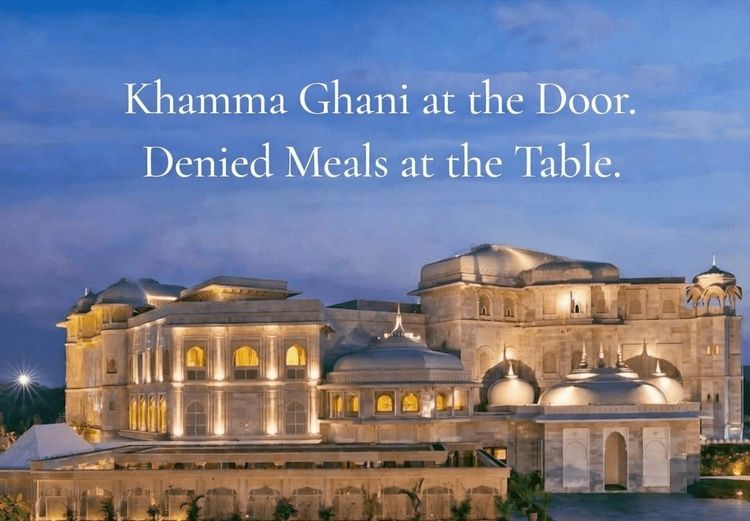
I'll be fair — the arrival started with a "Khamma Ghani," a tika, and a shawl draped over your shoulders. Not the grand welcome you'd imagine at a Raffles, but fine. And to their credit, the room was decorated for our anniversary — cakes, the works. That was a nice touch, and we appreciated it. For a moment, it felt like we'd made the right choice.
But that goodwill didn't last long.
The Reality
The royal treatment dried up faster than the welcome drink.
When my family — my wife, my kids — went down to the restaurant for a meal, the waiter looked at us and said meals are not included in our stay. No checking with the front desk. No calling a manager. Just a flat denial.
Picture this for a moment. You've paid nearly ₹1 lakh. You've chosen this country over another. You've chosen this property over dozens of alternatives. Your children are sitting at the table, hungry and excited. And a waiter is telling you that what's written in your confirmed booking doesn't exist.
The embarrassment isn't just personal. It's the kind that makes you question everything — your decision to travel domestically, your trust in Indian luxury brands, your belief that India's hospitality industry is ready to compete on the world stage.
From Singapore to Jaipur: Same Problem, Different Country
The irony isn't lost on me. We left Singapore because the hospitality wasn't designed for Indian families. We came home expecting better. And what we got was arguably worse — because this time, the failure wasn't cultural unfamiliarity. It was our own country's hospitality industry failing to honor its own promises.
In Singapore, at least the terms were clear. You knew what you were getting. The limitations were honest — a different country, a different culture, a different standard. Fair enough.
At Raffles Jaipur, the terms were written by Accor, confirmed by Accor, charged by Accor — and then denied by Accor's own staff. That's not a cultural gap. That's a breach of trust.
The Fine Print Problem
Accor's booking system is a labyrinth. My confirmation email came loaded with three separate "Special Terms" sections, policies about gala dinners, rules about outside food and hookah, children's policies, loyalty point restrictions, and cancellation clauses. The package inclusions — the actual things I'm paying for — were buried in this avalanche of legalese.
But here's the thing: even if you wade through all of it, the inclusions are unambiguous. "Sensorial Menus for All Meals" doesn't need interpretation. It means all meals are included. There's no asterisk. No "subject to availability." No "only on the paid night."
If Accor's own staff can't decode what Accor's own booking engine confirms, the system is broken.
The Loyalty Betrayal
I'm an Accor loyalty member. The second night of my stay was a Member Stay Plus benefit — a reward earned through consistent spending with the brand. This is Accor's way of saying "thank you for your loyalty." And yet, the property couldn't even ensure my package inclusions were communicated to the restaurant.
What message does this send to loyal members? That your points and benefits look great on the app but mean nothing on the ground? That the "Live Limitless" tagline is limited by the staff's willingness to check a booking?
Indian Families Deserve Better
There's a pattern here that extends well beyond one hotel or one booking. Indian families traveling within India — spending serious money at premium properties — are routinely let down by a hospitality industry that has mastered the art of marketing but not the discipline of delivery.
The welcome ceremonies are perfected. The Instagram moments are curated. The brochures are stunning. But when it comes to the basics — honoring confirmed inclusions, training staff on packages, treating families with children as valued guests rather than inconveniences — the industry falls apart.
We're not asking for special treatment. We're asking for what was promised. What was paid for. What was confirmed in writing.
Indian families are the backbone of domestic luxury tourism. We are the ones choosing Jaipur over Bali, Udaipur over Dubai, Kerala over the Maldives. We are the ones who made a conscious decision to invest in India's hospitality economy. The least we deserve is for that economy to invest in getting our experience right.
A Note to Accor
I founded NationPress to tell stories that matter to India — stories that the mainstream often overlooks. I didn't expect my own family's experience at one of your flagship properties to become one of those stories.
Raffles Jaipur is a beautiful property. The architecture is breathtaking. The potential is immense. But potential means nothing if the execution crumbles at the dining table.
Here's what I'd like to see:
Fix the system. Booking inclusions must automatically sync with every operational department — restaurant, spa, front desk. No guest should ever need to prove what they've already paid for.
Train your people. Every staff member at Raffles Jaipur should know what the "World of Wellness" package includes. A waiter should never deny a confirmed inclusion without first verifying with management.
Simplify your terms. Three "Special Terms" sections and a wall of fine print isn't transparency — it's obfuscation. Make package inclusions clear, prominent, and impossible to miss.
Respect Indian families. We are your market. We are your future. Treat us accordingly.
The Bottom Line
My family and I chose India. We chose to spend our money here, to experience luxury here, to make memories here. We walked into Raffles Jaipur with excitement and walked into the restaurant with our children only to be told that what we paid for doesn't count.
Luxury hospitality isn't about a tika at the entrance or a marble lobby. It's about trust. It's about every single moment of a guest's stay matching the promise that was made at booking.
Raffles Jaipur broke that promise. And until Indian luxury hospitality learns that the experience doesn't end at the welcome — that it lives in every meal, every interaction, every moment a family spends trusting your brand — we will keep losing the argument for why Indian families should travel at home.
A ₹97,940 booking that includes "Sensorial Menus for All Meals" should mean exactly that. No arguments. No denials. No embarrassment.
Just a meal, served with the grace that the Raffles name is supposed to guarantee.