Army Chief flags in Signals mountaineering team that conquered 6 Ladakh peaks
Synopsis
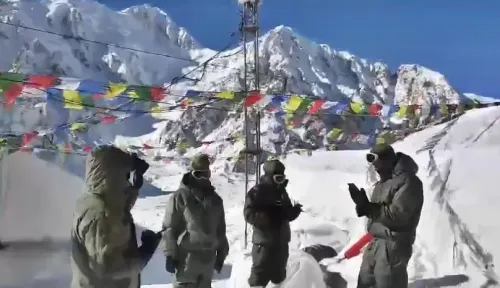
The Indian Army's Corps of Signals team scaled six high-altitude peaks across Ladakh in under three weeks — including the 7,135 m Mount Nun — a feat combining speed, technical difficulty, and operational symbolism. Army Chief General Dhiraj Seth personally flagged in the team, spotlighting the expedition as a statement of military resolve in one of India's most strategically sensitive theatres.
Key Takeaways
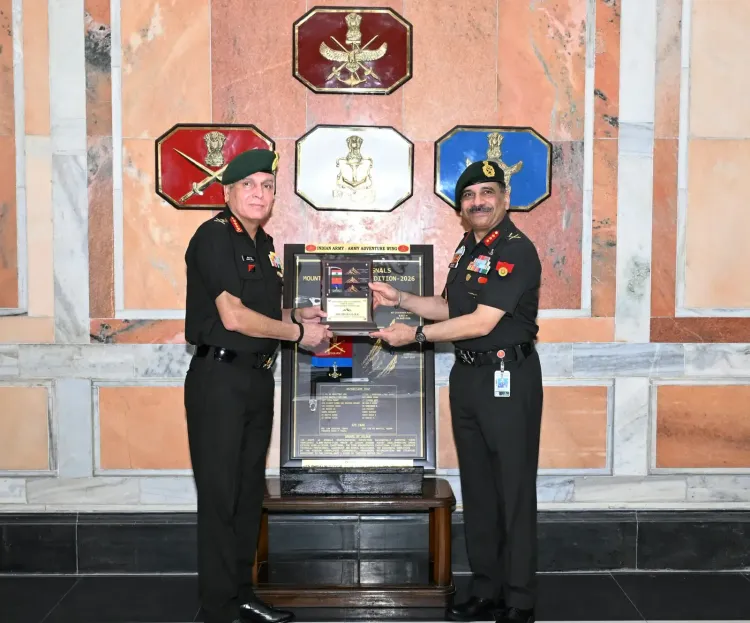
Army Chief General Dhiraj Seth flagged in the Corps of Signals mountaineering team on 11 September 2026 .
The team summited six peaks across Ladakh in under three weeks, including Mt Nun (7,135 m) , the highest.
First campaign: Mt Kiagar Ri (6,100 m) on 13 Aug, Mt Mentok Kangri (6,250 m) on 24 Aug, Mt Chamser Kangri (6,622 m) on 29 Aug.
Second campaign (Nun-Kun range): Mount Kun (7,077 m) on 15 Aug, Mount Delta-41 (5,908 m) on 26 Aug, Mount Nun (7,135 m) on 31 Aug.
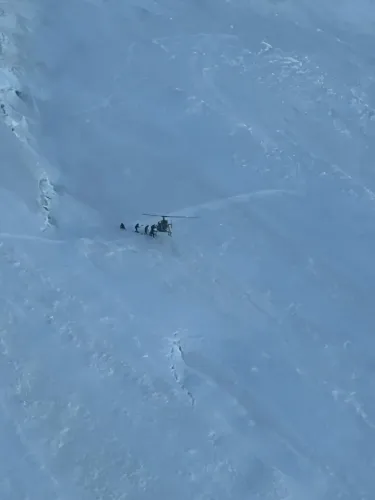
Climbers faced slopes of up to 55 degrees , crevassed glaciers, and a 3-km snow plateau between Nun and Kun.
The expedition reflects the Army's emphasis on high-altitude operational readiness in the Ladakh theatre.
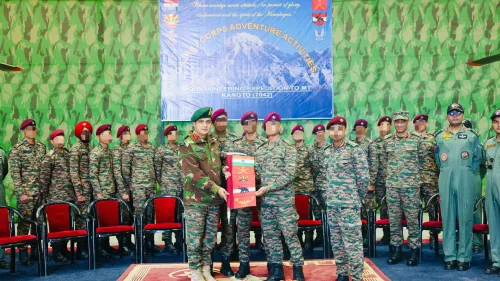
Army Chief General Dhiraj Seth on Thursday, 11 September 2026, flagged in and personally interacted with the Corps of Signals mountaineering team following their extraordinary achievement of summiting six high-altitude peaks across Ladakh in a single expedition. The Indian Army's Additional Directorate General of Public Information announced the ceremony, describing the feat as a reflection of 'unwavering pursuit of excellence and the spirit of adventure in the Indian Army.'
Six Summits, One Mission
The team's expedition was split across two mountaineering campaigns. In the first phase, the Corps of Signals team conquered three peaks in just sixteen days: Mt Kiagar Ri (6,100 m) on 13 August, Mt Mentok Kangri (6,250 m) on 24 August, and Mt Chamser Kangri (6,622 m) on 29 August.
In the second phase, the team took on Ladakh's Nun-Kun mountain range, scaling three more peaks amid severe high-altitude hardships including hostile weather, crevassed glaciers, and steep snow-covered slopes. These summits were Mount Nun (7,135 m) on 31 August, Mount Kun (7,077 m) on 15 August, and Mount Delta-41 (5,908 m) on 26 August.
Technical Challenges on Each Peak
Each summit posed distinct technical demands. Mount Nun, at 7,135 m, is characterised by steep ice walls, heavily crevassed glaciers, and sustained slopes of 45 to 55 degrees on its upper sections. The standard approach follows the West Ridge route, with climbers ascending from the Shafat Glacier base camp at approximately 4,400 m through three progressive high camps at roughly 5,500 m, 6,100 m, and 6,400 m, before a final midnight summit push to manage the effects of extreme altitude.
Mount Kun, while marginally less steep overall, features a technically demanding crux between Camp 1 and Camp 2, where climbers must scale vertical mixed rock, snow, and ice walls at angles of up to 50 degrees, aided by fixed ropes and jumar ascenders. After negotiating this section, climbers must cross a 3-kilometre-wide snow plateau that separates Nun and Kun along the Northeast Ridge, before establishing a final high camp at the base of the summit pyramid.
What This Signals About the Indian Army
The achievement is notable not just for the altitude involved, but for the speed and volume — six peaks across two campaigns in under three weeks, by personnel from the Corps of Signals, a technical branch not primarily associated with high-altitude mountaineering. This comes amid sustained Indian Army focus on building operational readiness and physical resilience in the Ladakh theatre, a region that has remained a priority zone since the 2020 Galwan clash.
Army mountaineering expeditions in Ladakh also serve a dual purpose: they build acclimatisation capability among troops deployed at extreme altitudes, while reinforcing India's physical presence in strategically sensitive terrain. General Seth's personal interaction with the team underscores the institutional importance the Army attaches to such missions.
Recognition and Ceremony
The flag-in ceremony was conducted at the conclusion of the expedition, with General Dhiraj Seth meeting the team members directly. The announcement was made through the Army's official handle, citing the expedition as demonstrating 'infinite resolve' and the relentless pursuit of excellence. The ceremony marks a formal military recognition of the team's accomplishment before the unit returns to regular duties.
Point of View
By a signals unit — not a dedicated mountaineering regiment — is the detail mainstream coverage tends to gloss over. The Corps of Signals is a technical branch; this expedition signals deliberate capability-broadening across arms that operate in Ladakh's extreme terrain. The Army's choice to have the Chief personally flag in the team, rather than delegate the ceremony, is an institutional signal in itself. In the post-Galwan context, every high-altitude achievement in Ladakh carries operational subtext: acclimatisation, presence, and deterrence are inseparable in this theatre.
NationPress
13 Sept 2026
Frequently Asked Questions
Which peaks did the Indian Army Corps of Signals team summit in Ladakh?
The team summited six peaks across two campaigns: Mt Kiagar Ri (6,100 m), Mt Mentok Kangri (6,250 m), and Mt Chamser Kangri (6,622 m) in the first phase, followed by Mount Kun (7,077 m), Mount Delta-41 (5,908 m), and Mount Nun (7,135 m) in the Nun-Kun range. All summits were achieved between 13 August and 31 August 2026.
Who is General Dhiraj Seth and why did he flag in the team?
General Dhiraj Seth is the Chief of Army Staff (COAS) of the Indian Army. He conducted the flag-in ceremony to formally receive and honour the Corps of Signals mountaineering team following their successful multi-peak expedition in Ladakh, a gesture underscoring the institutional importance of the achievement.
What makes the Mount Nun summit particularly difficult?
Mount Nun, at 7,135 m, features steep ice walls, heavily crevassed glaciers, and sustained slopes of 45 to 55 degrees on its upper sections. Climbers ascend via the West Ridge from the Shafat Glacier base camp at 4,400 m, through three high camps, before a final midnight push to manage extreme altitude effects.
Why does the Indian Army conduct mountaineering expeditions in Ladakh?
Army mountaineering expeditions in Ladakh serve a dual purpose: building acclimatisation and physical resilience among troops deployed at extreme altitudes, and reinforcing India's presence in strategically sensitive terrain. The region has been a priority zone for the Indian Army since the 2020 Galwan clash.
How long did it take the team to complete all six summits?
The two campaigns together spanned from 13 August to 31 August 2026, with the first set of three peaks completed in sixteen days. The full six-peak achievement was accomplished in under three weeks.