Safdarjung Hospital performs first robot-assisted knee replacement free under Ayushman Bharat
Synopsis
A 75-year-old patient received India's first robot-assisted Total Knee Replacement at a Central Government hospital — completely free under Ayushman Bharat. Safdarjung's CIO is now one of the few public institutions in the country to operationalise robotic orthopaedic surgery, with the upgradable platform potentially extending to hip and spine procedures next.
Key Takeaways
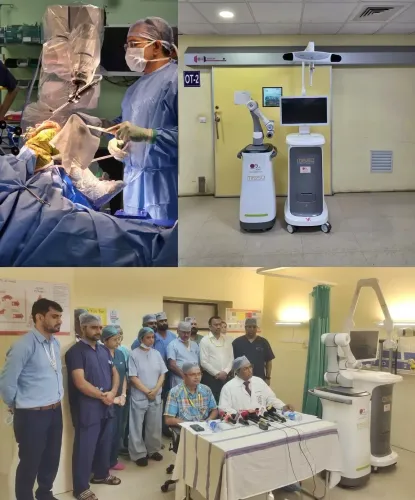
VMMC & Safdarjung Hospital's Central Institute of Orthopaedics completed its first robot-assisted Total Knee Replacement on 22 August .
The surgery was performed on a 75-year-old economically disadvantaged patient at zero cost under the Ayushman Bharat scheme.
The surgical team was led by Dr Bhagwati Prasad Sharma under the clinical guidance of Prof.
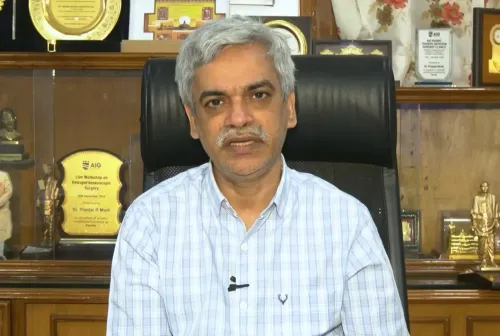
Dr Sumit Sural , Director of CIO.
The robotic platform currently supports Total Knee Replacement , Partial Knee Replacement , and Hip Joint Replacement ; spine surgery support may follow with future upgrades.
The initiative was driven by Dr Kavita Sharma , Director of VMMC & Safdarjung Hospital, as part of a broader push to modernise public orthopaedic care.
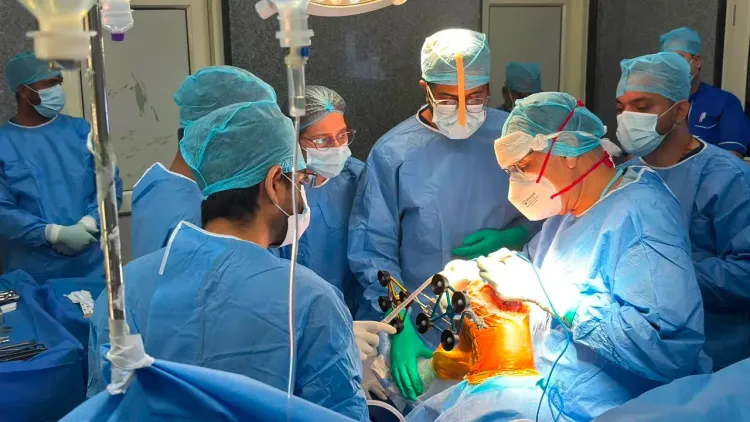
The Central Institute of Orthopaedics (CIO) at VMMC & Safdarjung Hospital in New Delhi scripted a landmark in public healthcare on 22 August, successfully completing its first robot-assisted Total Knee Replacement (TKR) — entirely free of charge under the Ayushman Bharat scheme. The milestone makes Safdarjung one of the few Central Government hospitals to offer robotic orthopaedic surgery to economically weaker patients.
The Procedure and the Patient
The surgery was performed on a 75-year-old economically disadvantaged male patient, who received the advanced procedure at no cost under the Ayushman Bharat framework. The successful outcome demonstrates that high-precision robotic surgery need not be confined to private hospital settings, according to hospital officials.
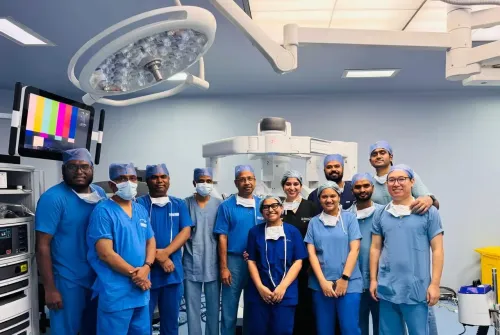
The landmark operation was carried out under the clinical guidance of Prof. Dr Sumit Sural, Director of the Central Institute of Orthopaedics. The surgical team was led by Dr Bhagwati Prasad Sharma, Consultant Professor and Head of Unit, alongside Dr Dhruve Maini and Dr Kartik Yadav. Anaesthesia was managed by Dr Sushil Guria, with operating theatre nursing staff Sister Rekha and Ritika, and technical staff led by Vijender, providing essential support throughout.
Leadership and Institutional Push
The introduction of robot-assisted orthopaedic surgery at CIO has been driven by the leadership of Dr Kavita Sharma, Director of VMMC & Safdarjung Hospital, with the initiative aimed at modernising the hospital's surgical capabilities. The hospital said the move reflects its commitment to making advanced technology accessible to patients from all economic backgrounds.
What the Robotic System Can Do
The newly deployed robotic platform is upgradable by design, currently supporting Total Knee Replacement, Partial Knee Replacement, and Hip Joint Replacement procedures. With future software and technology upgrades, the system may also enable robot-assisted spine surgery, potentially broadening the range of advanced procedures available at the institute.
Robot-assisted surgery allows for detailed pre-operative planning and precise surgical execution — particularly in implant positioning and alignment — areas where marginal errors can significantly affect long-term patient outcomes. This is the first time such a system has been operationalised within this Central Government institution.
Significance for Public Healthcare
The integration of robotic surgical technology into the Ayushman Bharat delivery model carries wider implications. Critics and health policy analysts have long argued that cutting-edge surgical care in India remains inaccessible to those without private insurance or out-of-pocket resources. This procedure, conducted free of cost at a government hospital, challenges that assumption directly.
The hospital has indicated that the platform lays the foundation for CIO to expand its robotic-assisted surgical capabilities and offer a broader range of advanced procedures going forward. With the system now operational, Safdarjung Hospital is positioned to scale up technology-enabled orthopaedic care within the public sector.
Point of View
It changes the equity calculus for advanced surgery in India. The upgradable platform is a sensible investment, but public hospitals have a mixed record of maintaining high-end equipment over time. The real test will come not with the first procedure, but with the hundredth.
NationPress
8 Oct 2026
Frequently Asked Questions
What happened at Safdarjung Hospital on 22 August?
The Central Institute of Orthopaedics at VMMC & Safdarjung Hospital performed its first robot-assisted Total Knee Replacement on 22 August, on a 75-year-old economically disadvantaged patient. The procedure was carried out entirely free of charge under the Ayushman Bharat scheme.
Who performed the robot-assisted knee replacement at Safdarjung?
The surgery was performed under the clinical guidance of Prof. Dr Sumit Sural, Director of CIO, with the surgical team led by Dr Bhagwati Prasad Sharma, Consultant Professor and Head of Unit. Dr Dhruve Maini and Dr Kartik Yadav were also part of the orthopaedic team.
What procedures can the new robotic system at CIO support?
The robotic platform currently supports Total Knee Replacement, Partial Knee Replacement, and Hip Joint Replacement. Future software upgrades may also enable robot-assisted spine surgery, expanding the range of advanced procedures available at the institute.
Why is this significant for public healthcare in India?
This is among the first instances of robot-assisted orthopaedic surgery being performed free of cost at a Central Government hospital under Ayushman Bharat. It signals that advanced robotic surgical care can be made accessible to economically weaker patients within the public health system, not just in private hospitals.
What is the Ayushman Bharat scheme?
Ayushman Bharat is the Indian government's flagship health insurance scheme providing cashless treatment coverage to economically disadvantaged beneficiaries at empanelled government and private hospitals. The Safdarjung TKR procedure was fully covered under this framework at no cost to the patient.