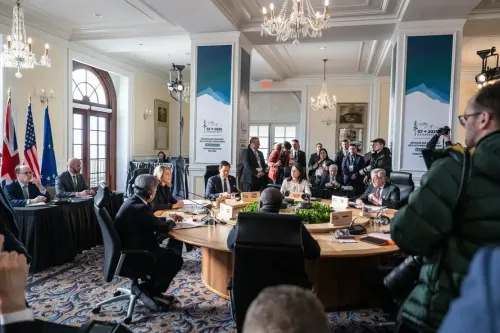
12 nations mark 10 years of South China Sea ruling, back free Indo-Pacific
Synopsis
Ten years after the Permanent Court of Arbitration invalidated China's South China Sea claims, twelve nations — including the US, Japan, Australia, and the Philippines — have jointly declared the ruling 'final and legally binding.' The coordinated statement, timed precisely to the anniversary, is the most expansive multilateral reaffirmation of the 2016 award to date, and a direct counter to Beijing's continued rejection of it.
Key Takeaways
Twelve nations — including the US , Japan , Australia , and the Philippines — issued a joint statement on 12 July 2025 reaffirming a free and open Indo-Pacific .
The statement marks the 10th anniversary of the 2016 Arbitral Tribunal ruling under UNCLOS that rejected China's maritime claims in the South China Sea .
The twelve governments declared the award 'final, legally binding, and definitive' between China and the Philippines .
The statement opposed use of 'coast guard, military, and maritime militia forces' to harass lawful operations at sea — language widely seen as directed at China .
China rejected the original 2016 ruling by the Permanent Court of Arbitration in The Hague and has maintained its position since.
The South China Sea is claimed in whole or in part by China , the Philippines , Vietnam , Malaysia , Brunei , and Taiwan .
Twelve nations, led by the United States, on 12 July 2025 jointly reaffirmed their commitment to a 'free and open Indo-Pacific' and the rules-based international order, marking the 10th anniversary of the landmark 2016 arbitral tribunal ruling that invalidated China's expansive maritime claims in the South China Sea. The joint statement signals a coordinated diplomatic push to keep the decade-old ruling in the international spotlight as tensions in the waterway persist.
The Joint Statement and Its Signatories
The governments of the United States, Australia, Canada, Estonia, Japan, Latvia, Lithuania, New Zealand, the Philippines, Romania, Slovenia, and the United Kingdom signed the statement. Together, they reaffirmed their 'unwavering commitment to maintaining a free and open Indo-Pacific that is peaceful, stable, and rules-based, anchored in international law.'
The statement described the 12 July 2016 decision by the Arbitral Tribunal — constituted under Annex VII of the UN Convention on the Law of the Sea (UNCLOS) — as a 'landmark and unanimous decision' on the South China Sea. The twelve governments declared the award 'final, legally binding, and definitive between China and the Philippines with respect to the maritime entitlements and claims addressed by the Arbitral Tribunal.'
Key Findings Reaffirmed
The signatories reiterated the tribunal's core finding: that 'there is no legal basis for China's expansive maritime claims in the South China Sea, including those based on historic rights.' They also underscored 'the importance of upholding freedom of navigation and overflight, as well as other internationally lawful uses of the sea, as reflected in UNCLOS.'
The statement expressed concern over actions that could undermine regional stability, though it stopped short of citing specific incidents. 'We reiterate our strong opposition to any destabilising or unilateral actions including by force or coercion that threaten peace and stability in the region,' it read.
Opposition to Maritime Coercion
The governments went further, reaffirming 'strong opposition to the use of coast guard, military, and maritime militia forces to harass, obstruct, or intimidate lawful operations by other States at sea or in the air.' The statement noted that such actions 'endanger the safety of personnel and fishermen and seriously degrade regional peace and security' — language widely read as directed at China's conduct in disputed waters.
All parties were urged 'to abide by the 2016 Award and resolve disputes peacefully through dialogue and other lawful mechanisms in accordance with international law.'
Background: The 2016 Ruling and China's Response
On 12 July 2016, the Permanent Court of Arbitration in The Hague ruled overwhelmingly in favour of the Philippines in a case filed under UNCLOS. The tribunal found that China's claims rooted in so-called 'historic rights' had no legal standing under international law. Beijing rejected the ruling outright and has continued to assert its position, even as the US and several allies have consistently called for adherence to the decision.
The South China Sea is one of the world's most heavily trafficked maritime trade routes, claimed in whole or in part by China, the Philippines, Vietnam, Malaysia, Brunei, and Taiwan. Competing claims have triggered repeated confrontations between coast guard and naval vessels, cementing the waterway's status as a major strategic flashpoint in the Indo-Pacific.
ASEAN and the Road Ahead
Reaffirming support for ASEAN's regional vision, the twelve nations said they remained 'steadfast in our support for a free and open Indo-Pacific' and reiterated their shared goal of seeing the South China Sea become 'a sea of peace, stability, cooperation, and prosperity driven by vibrant lawful commerce.' Whether this anniversary statement translates into more coordinated operational posture — or remains a diplomatic signal — will be closely watched in the months ahead.
Point of View
Spanning NATO's eastern flank and the Indo-Pacific, have aligned on a single diplomatic date. But declarations without enforcement remain symbolic. China has spent a decade building facts on the water — artificial islands, coast guard patrols, and maritime militia operations — while the international community has largely responded with statements. The real question is whether this anniversary marks a shift toward coordinated operational pushback, or whether it is, once again, a well-worded communiqué that Beijing will file and ignore. The inclusion of Baltic states like Estonia, Latvia, and Lithuania is notable: it signals that the South China Sea is now framed as a rules-order issue, not merely a regional one — a framing that suits Washington's broader alliance strategy but may dilute the geographic focus that ASEAN members prefer.
NationPress
12 Jul 2026
Frequently Asked Questions
What is the 2016 South China Sea arbitral tribunal ruling?
The 2016 ruling was a decision by the Permanent Court of Arbitration in The Hague, issued on 12 July 2016, in a case brought by the Philippines under UNCLOS. The tribunal found that China's expansive maritime claims — including those based on 'historic rights' — had no legal basis under international law. China rejected the ruling and has not complied with it.
Which 12 countries signed the joint Indo-Pacific statement in 2025?
The twelve signatories are the United States, Australia, Canada, Estonia, Japan, Latvia, Lithuania, New Zealand, the Philippines, Romania, Slovenia, and the United Kingdom. The statement was issued on 12 July 2025, the 10th anniversary of the arbitral tribunal's ruling.
Why does the South China Sea matter strategically?
The South China Sea is one of the world's busiest maritime trade routes and is claimed in whole or in part by China, the Philippines, Vietnam, Malaysia, Brunei, and Taiwan. Competing claims have led to repeated confrontations involving coast guard and naval vessels, making it a major Indo-Pacific flashpoint with global economic implications.
What did the joint statement say about China's maritime behaviour?
Without naming China directly, the statement expressed 'strong opposition to the use of coast guard, military, and maritime militia forces to harass, obstruct, or intimidate lawful operations by other States at sea or in the air.' It also reiterated opposition to 'any destabilising or unilateral actions including by force or coercion.'
Has China responded to the 10th anniversary statement?
The source does not include a response from China to the 2025 anniversary statement. However, Beijing has consistently rejected the original 2016 ruling since it was issued and has maintained its maritime claims in the South China Sea regardless of international pressure.