Yemen Houthis report 300 Saudi airstrikes in a week as Taiz, Lahj battles rage
Synopsis
Saudi warplanes have reportedly carried out 300 airstrikes across nine Yemeni provinces in a single week, while explosions shook Riyadh and air defence alerts were issued in Saudi Arabia — a sharp escalation on both sides of the border that raises the stakes around the strategically critical Bab al-Mandab Strait.
Key Takeaways
Houthi spokesperson Yahya Sarea reported 300 Saudi airstrikes across nine Yemeni provinces in the week ending 19 September 2026 .
26 of those strikes targeted the southwestern province of Taiz in a single 24-hour period, reportedly launched from Khamis Mushait Air Base .
Both F-15 and Typhoon jets were said to have been deployed from Khamis Mushait and King Fahd air bases; Saudi authorities offered no immediate comment.
Heavy ground fighting continued near the Kahbub mountain range in Lahj , close to the Bab al-Mandab Strait , and in oil-rich Marib .
Explosions were heard in Riyadh early Saturday; the Saudi Directorate of Civil Defence later said the danger had passed in Riyadh and Al-Kharj .
Yemen's conflict dates to late 2014 ; the Saudi-led coalition intervened in March 2015 .
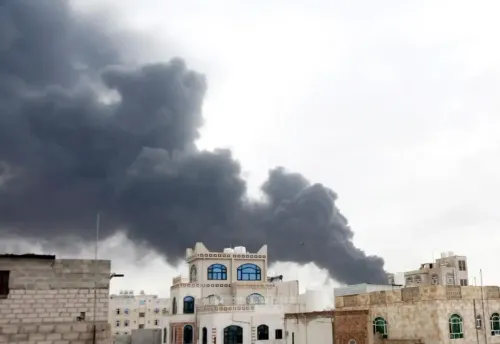
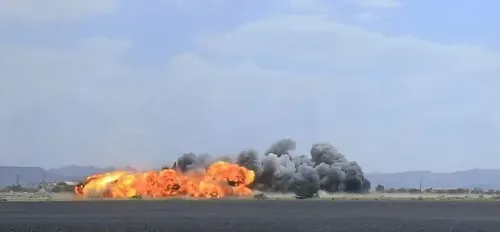
Yemen's Houthi group has reported that Saudi warplanes launched 26 airstrikes on the southwestern province of Taiz in a single 24-hour period, pushing the total number of air strikes across Yemen this week to 300, as air operations intensified alongside fierce ground fighting on multiple fronts. The latest figures were disclosed on Friday, 19 September 2026, according to reports.
Scale of the Air Campaign
Houthi military spokesperson Yahya Sarea said in a statement on social media platform X that Saudi F-15 fighter jets carried out the 26 strikes on Taiz after taking off from Khamis Mushait Air Base in southwestern Saudi Arabia. Sarea further stated that the week's total of 300 airstrikes across nine Yemeni provinces involved both F-15 and Typhoon fighter jets operating from the Khamis Mushait and King Fahd air bases. Saudi authorities had no immediate comment on these claims.
Ground Battles on Multiple Fronts
The reported strikes coincided with heavy fighting on Friday around the Kahbub mountain range in the southern province of Lahj, situated near the strategically vital Bab al-Mandab Strait — a critical chokepoint for global shipping. Clashes also continued across southwestern Taiz and in the oil-rich northeastern province of Marib, underscoring how broadly the conflict has spread. The current escalation follows reported Houthi advances along Yemen's southwestern Red Sea coast earlier this month.
Explosions Heard in Riyadh
In a significant development inside Saudi territory, explosions were heard in the capital Riyadh in the early hours of Saturday, with local residents receiving air defence alerts via mobile applications. The Saudi Directorate of Civil Defence subsequently issued a statement on X confirming that 'the danger has passed in Riyadh and Al-Kharj' and urged residents to continue following official instructions, avoid gathering in groups, and refrain from filming. Earlier, an alert had been issued by the National Early Warning Platform for Emergency Cases specifically for Al-Kharj Governorate.
Background: Over a Decade of Conflict
Yemen's conflict erupted in late 2014 when the Houthis seized the capital Sanaa and much of northern Yemen. A Saudi-led coalition intervened in March 2015 in support of the internationally recognised Yemeni government, setting off one of the region's most protracted and devastating wars. This is the latest episode in a conflict that has drawn in regional and global powers and caused a severe humanitarian crisis, with millions of Yemenis displaced and reliant on aid. Notably, the Houthis have periodically targeted Saudi territory with drones and missiles throughout the war, and the incidents in Riyadh mark a continuation of that pattern.
What to Watch Next
The reported strikes and the Riyadh incidents signal a fresh escalation cycle at a time when diplomatic efforts to stabilise the region remain fragile. Analysts will watch whether Saudi Arabia formally acknowledges the Riyadh incident, whether the Houthis claim responsibility, and whether the fighting around the Bab al-Mandab Strait disrupts commercial shipping lanes — a development that would carry immediate global economic consequences.
Point of View
The Riyadh incidents show the war's feedback loop is intact: Saudi strikes on Yemen, Houthi retaliatory fire on Saudi cities. What mainstream coverage often undersells is the Bab al-Mandab dimension — any sustained Houthi hold along that coastline gives them leverage over one of the world's most critical shipping lanes, which transforms a regional civil war into a global supply-chain risk. Saudi silence on the Riyadh episode is itself a signal worth watching.
NationPress
19 Sept 2026
Frequently Asked Questions
How many Saudi airstrikes on Yemen have been reported this week?
Houthi military spokesperson Yahya Sarea said a total of 300 Saudi airstrikes were carried out across nine Yemeni provinces in the week ending 19 September 2026, including 26 strikes on Taiz in a single 24-hour period.
What happened in Riyadh on Saturday?
Explosions were heard in the Saudi capital Riyadh in the early hours of Saturday, and residents received air defence alerts via mobile applications. The Saudi Directorate of Civil Defence later stated on X that the danger had passed in Riyadh and Al-Kharj, and urged residents to follow official instructions.
Where is the fighting most intense on the ground in Yemen?
Heavy clashes were reported on Friday around the Kahbub mountain range in the southern province of Lahj, near the strategically vital Bab al-Mandab Strait. Fighting also persisted in southwestern Taiz and in the oil-rich northeastern province of Marib.
Why is the Bab al-Mandab Strait significant in this conflict?
The Bab al-Mandab Strait is one of the world's most important maritime chokepoints, connecting the Red Sea to the Gulf of Aden and the Indian Ocean. Houthi control or influence along the nearby coastline gives the group leverage over global shipping lanes, elevating the Yemen conflict beyond a regional dispute.
How did the Yemen conflict begin?
Yemen's conflict erupted in late 2014 when the Houthis seized the capital Sanaa and much of northern Yemen. A Saudi-led coalition intervened in March 2015 to restore the internationally recognised Yemeni government, triggering a prolonged war that has caused a severe humanitarian crisis.