Does Asim Munir’s Ascension as Pakistan’s Chief of Defence Forces Indicate Institutional Decline?
Synopsis
Asim Munir's rise to Chief of Defence Forces has sparked significant debate, with critics arguing that it highlights institutional decay in Pakistan. Shafi Burfat, a prominent Sindhi leader, critiques Munir's lack of military achievements and questions the legitimacy of his claims regarding national unity and divine intervention, calling for a reassessment of Pakistan's role on the global stage.
Key Takeaways
Asim Munir's elevation is criticized for symbolizing institutional decay.
Claims of unity between the army and people are questioned.
Pakistan's reliance on foreign aid is misrepresented as divine support.
Regional discontent and resistance undermine national unity.
Burfat calls for a reevaluation of Pakistan's international role.
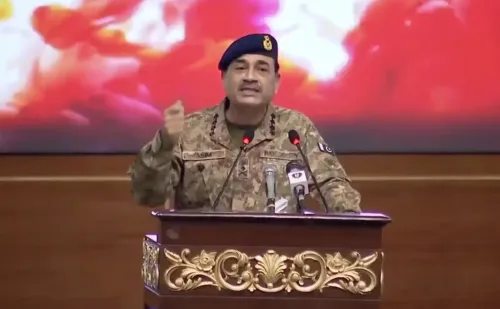
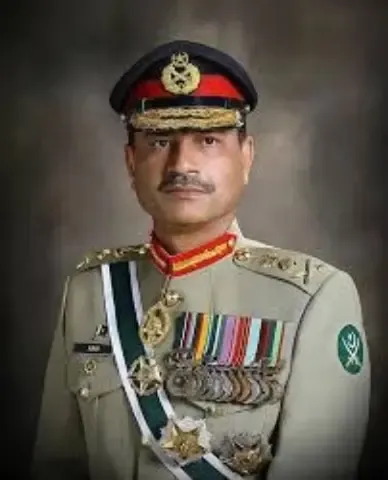
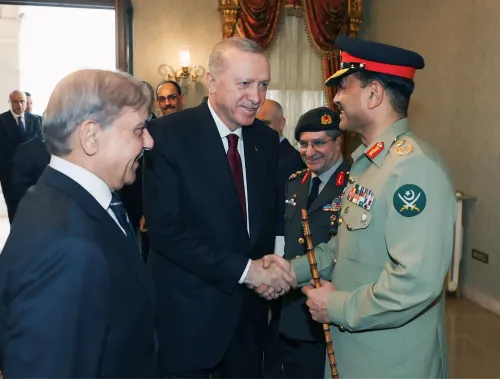
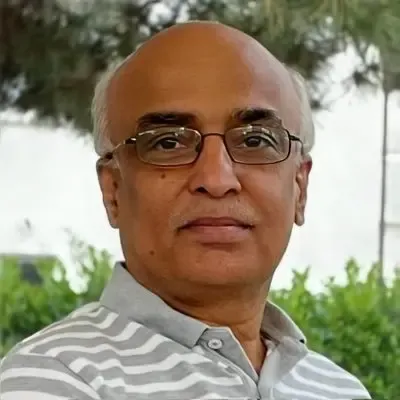
Berlin, Dec 23 (NationPress) Shafi Burfat, the Chairman of the Jeay Sindh Muttahida Mahaz (JSMM), sharply criticized Pakistan’s so-called Field Marshal and Chief of Defence Forces Asim Munir, asserting that he embodies not military prowess but the profound institutional decay of a nation overtaken by its own security apparatus.
The Sindhi leader emphasized that Munir’s rise to the highest ceremonial position—Chief of Defence Forces—despite lacking participation in or victories in any significant international or domestic conflicts, reflects an unchecked militarized authority rather than professional qualifications.
“Titles acquired through coercion instead of competence often expose underlying psychological insecurities. Munir’s preoccupation with grand titles and religious symbols indicates not assurance, but a fragile ego that seeks validation through power. History demonstrates that such individuals rarely contribute to nation-building; they are often the markers of institutional deterioration,” Burfat expressed on X.
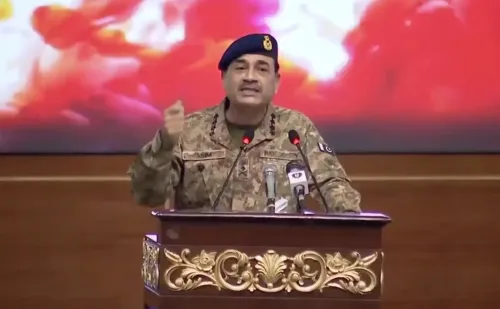
Referring to Munir’s assertion that Hindus and Muslims represent two distinct nations due to differing religious practices, the JSMM Chairman contended that this claim reveals a fundamental misapprehension of political science.
“Nations are not formed on theological grounds but through shared histories, territories, collective memories, economic interests, and political fates. When such statements are made, discerning observers worldwide recognize a perilous intellectual void at the core of Pakistan’s military leadership,” he added.
Highlighting Munir’s remark that during Pakistan’s May crisis, the country “clearly felt Allah’s assistance,” Burfat pointed out that, in truth, Pakistan relied significantly on Chinese military technology, intelligence aid, drone capabilities, and American financial support.
“Reinterpreting geopolitical support as divine intervention is not faith; it is a deliberate misrepresentation. In an age of global transparency, such narratives undermine public intelligence,” he asserted.
Burfat termed Munir’s claim that “the army and the people are united” as perhaps his most “audacious falsehood.”
“Sindhis perceive the Punjabi-dominated military establishment as an occupying force. Balochistan remains in open resistance. Pashtun grievances regarding military operations are well documented. Even inside Punjab, protestors have attacked corps commanders’ residences, an unprecedented indicator of civil-military discord. Speaking of unity under such circumstances is not optimism; it is denial,” he remarked.
The Sindhi leader urged the global community to assess Pakistan with “seriousness and honesty.” He noted that beyond “terrorism, destabilization, and functioning as a hired intermediary for global powers,” Pakistan has little else to contribute to the region or the international system. He described Pakistan’s role as a “subcontractor of violence” instead of a responsible state.
“Asim Munir’s remarks are not strategic insights; they are symptoms of a troubled mindset. His rhetoric masks intellectual barrenness with religious slogans and militaristic bravado. Such discourse neither fosters state-building nor changes historical paths,” the Sindhi leader emphasized.
Point of View
I observe that the critiques of Asim Munir's leadership reflect a broader concern over the health of Pakistan's institutions. While his rise to power is emblematic of military influence, it is essential to consider the complexities of national unity and public sentiment across various regions, as these dynamics play a critical role in shaping the future of the country.
NationPress
30 Sept 2026
Frequently Asked Questions
What led to Shafi Burfat's criticism of Asim Munir?
Burfat criticizes Munir's elevation to Chief of Defence Forces as indicative of institutional decay, pointing out his lack of military achievements.
How does Burfat describe the relationship between the army and the people?
He argues that claims of unity between the army and the people are false, highlighting regional discontent and resistance.
What does Burfat say about Pakistan's reliance on foreign support?
He asserts that Pakistan's reliance on Chinese technology and American financial aid is misrepresented as divine intervention.
What are the implications of Munir's statements according to Burfat?
Burfat believes Munir's rhetoric reflects a disturbed mindset and contributes to a dangerous intellectual vacuum in military leadership.
What does Burfat urge the global community to recognize?
He calls for a serious and honest assessment of Pakistan's role, emphasizing its limited contributions beyond acting as a 'subcontractor of violence.'