Australia-India defence ties must deepen to counter China in Indian Ocean: Report
Synopsis
Australia's 2026 National Defence Strategy has formally named India its most important defence partner in the Indian Ocean — and analysts say the two countries must now move from strategic alignment to concrete defence industry co-production to match the pace of China's military expansion in the region.
Key Takeaways
Australia's 2026 National Defence Strategy designates India as its most 'important defence partner' in the Northeast Indian Ocean .
An annual Australia-India Defence Ministers' Dialogue was established in 2025 ; the second round is scheduled this week in New Delhi .
Australian and Indian maritime patrol aircraft now conduct collaborative anti-submarine warfare activities; an air-to-air refuelling agreement is in progress.
Analysts identify defence industry co-development as the most consequential — and most complex — opportunity, requiring top-down government commitment from both sides.
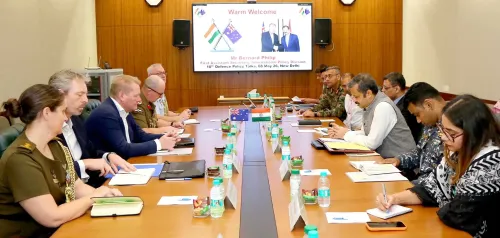
The 10th edition of Defence Policy Talks was held in New Delhi on 8 May , with both sides welcoming increased joint exercise frequency.
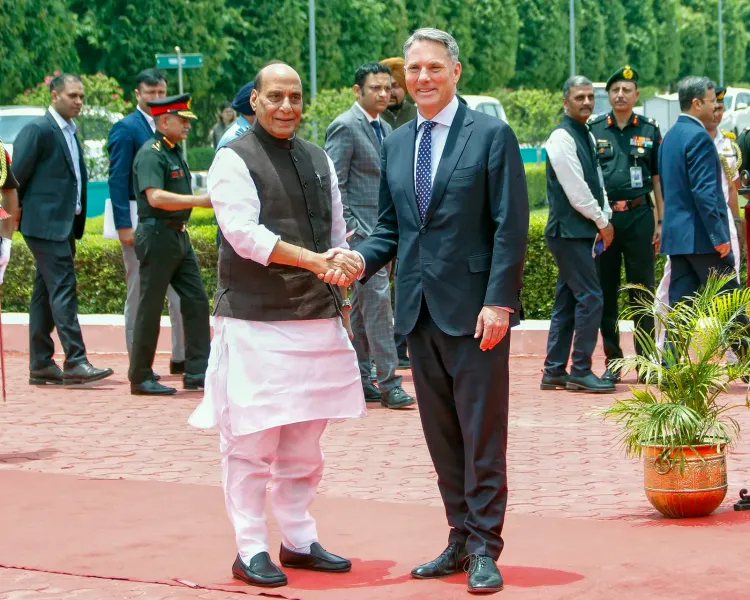
Australia's Deputy PM Richard Marles is travelling to India to meet Defence Minister Rajnath Singh this week.
Australia and India have agreed to hold an annual Defence Ministers' Dialogue, conduct joint exercises across multiple domains, and expand information-sharing cooperation — moves that analysts say are driven by strategic necessity, not diplomatic routine. A new report argues the two nations must now accelerate defence industry collaboration to realise the full potential of their partnership.
Strategic Logic Behind the Push
Australia's 2026 National Defence Strategy, released in April, formally designates the Northeast Indian Ocean as part of Australia's primary area of military interest. The strategy names India as a 'top-tier security partner' and the most 'important defence partner' in that region.
Samuel Bashfield, Research Fellow at the La Trobe Centre for Global Security, and Grace Corcoran, Research Fellow at the Australia India Institute, wrote in The Australian: 'China's military build-up, described in the strategy as the largest in the world today, is increasingly visible in the Indian Ocean. The People's Liberation Army Navy's submarines patrol the region; Chinese research vessels survey its seabed; Beijing's strategic reach extends well beyond the Malacca Strait.'
The authors noted that Australia's trade routes run through these waters and that both countries are resident maritime powers — a shared geography and shared threat that 'creates a set of practical opportunities for deeper co-operation.'
Maritime Security: The Most Developed Front
Maritime cooperation has emerged as the most advanced dimension of the bilateral defence relationship. Australian and Indian maritime patrol aircraft now conduct collaborative anti-submarine warfare activities. The two countries are also progressing an agreement on air-to-air refuelling.
A Joint Maritime Security Collaboration Roadmap, discussed at the October 2025 inaugural Dialogue, points toward sustained cooperation across the region. Bashfield and Corcoran described maritime security as 'the obvious one, and the most developed' area of bilateral defence work.
Defence Industry: High Stakes, High Complexity
The report identifies defence industry as 'the most consequential opportunity, and the most complex.' India's defence-industrial ecosystem — spanning public shipyards, large manufacturers, defence start-ups, and the Make in India policy — prioritises technology transfer, local production, and indigenisation as conditions of market access.
Australian defence industry, by contrast, is small, export-oriented, and typically sells finished capability rather than co-developing it within a partner's industrial framework. Bridging this structural gap, the report argues, will require top-down commitment from both governments.
According to the Australia India Institute, this should be done 'by supporting smaller Australian companies to engage and by the Indian government providing greater clarity on where it perceives the opportunities to lie.' The report also suggests both sides 'may need to demonstrate commitment by procuring defence products made by Australia-India joint ventures.'
Marles Visit and the Second Dialogue
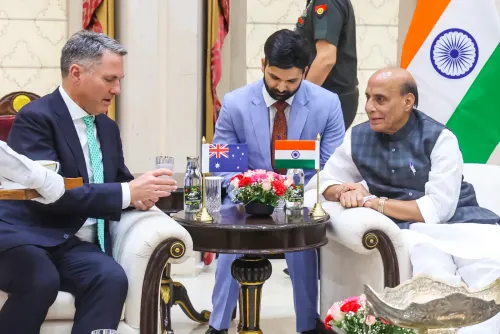
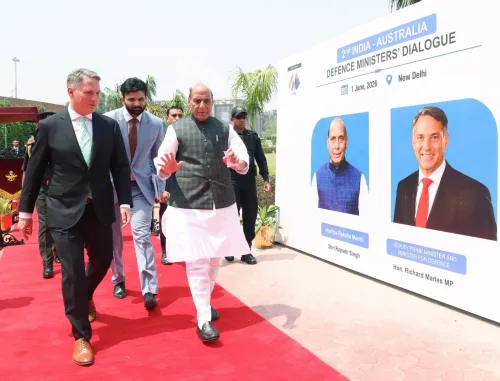
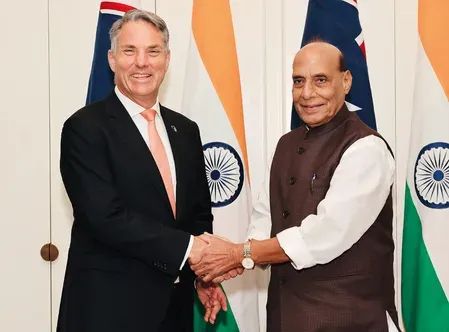
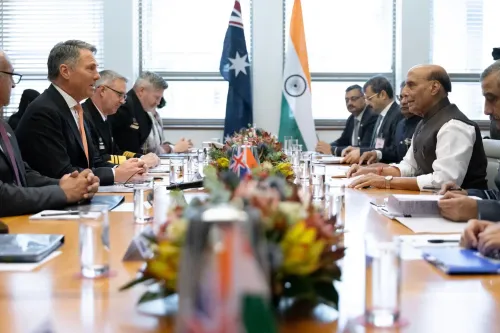
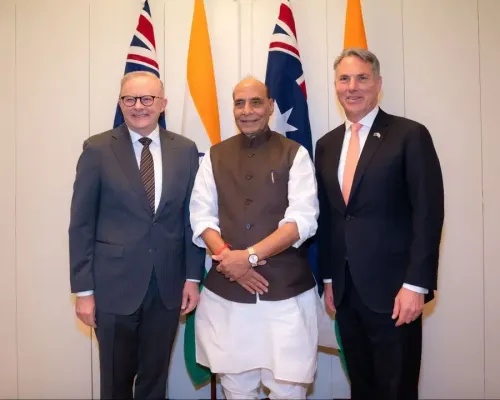
Australia's Deputy Prime Minister and Minister for Defence, Richard Marles, is travelling to India this week for the second Australia-India Defence Ministers' Dialogue. Marles is scheduled to meet Defence Minister Rajnath Singh.
'Australia and India are top-tier security partners. I look forward to meeting with Defence Minister Rajnath Singh to further strengthen our defence partnership following the strong progress we made during his visit to Australia last year,' Marles said in a statement released by the Australian Defence Ministry.
The Australian Defence Ministry noted that the first Dialogue, held in Australia in October 2025, 'showcases unprecedented progress in the bilateral defence partnership and a shared ambition to enhance cooperation.'
Defence Policy Talks and Institutional Momentum
On 8 May, India and Australia held the 10th edition of Defence Policy Talks in New Delhi. Officials from both sides welcomed the increased frequency and complexity of joint exercises.
'The establishment of the annual India-Australia Defence Ministers' Dialogue in 2025 has enhanced consultation and reflected the growing trust between the two countries,' India's Ministry of Defence said in a statement. The Indian delegation was led by Joint Secretary Amitabh Prasad; the Australian side was headed by First Assistant Secretary, International Policy Bernard Philip.
The Ministry of External Affairs (MEA) has noted that ties between the two nations are underpinned by shared democratic values, Commonwealth traditions, expanding economic engagement, and increasing high-level interaction. As the second Dialogue approaches, both capitals appear committed to converting strategic alignment into operational depth.
Point of View
Anti-submarine cooperation, and a refuelling agreement all in rapid succession. But the harder test is defence industry: India's indigenisation-first policy and Australia's finished-capability export model are structurally misaligned, and no amount of ministerial communiqués will bridge that gap without procurement commitments from both sides. The 2026 National Defence Strategy's explicit naming of the Northeast Indian Ocean as a primary interest area is also a significant doctrinal shift for Canberra — one that extends Australia's strategic perimeter well beyond its immediate neighbourhood. Whether Indian strategic planners see Australia as a capable operational partner or a junior one remains the unspoken question that the second Dialogue will not fully answer.
NationPress
23 Sept 2026
Frequently Asked Questions
What is Australia's 2026 National Defence Strategy's position on India?
Australia's 2026 National Defence Strategy designates the Northeast Indian Ocean as part of Australia's primary area of military interest and names India as a 'top-tier security partner' and its most 'important defence partner' in that region. The strategy also describes China's military build-up as the largest in the world today.
What was agreed at the inaugural Australia-India Defence Ministers' Dialogue?
The inaugural Dialogue, held in Australia in October 2025, resulted in an agreement to hold annual Defence Ministers' Dialogues, conduct joint exercises across multiple domains, and deepen information-sharing cooperation. It also produced a Joint Maritime Security Collaboration Roadmap.
Why is defence industry cooperation considered the most complex opportunity?
India's defence sector prioritises technology transfer, local production, and indigenisation as conditions of market access, while Australia's industry is small, export-oriented, and typically sells finished capability. Bridging this structural gap requires top-down government commitment and, according to analysts, procurement of products made by joint ventures.
What is the purpose of Richard Marles' visit to India?
Australian Deputy Prime Minister and Defence Minister Richard Marles is travelling to India this week for the second Australia-India Defence Ministers' Dialogue, where he is scheduled to meet Indian Defence Minister Rajnath Singh to advance the bilateral defence partnership.
What happened at the 10th India-Australia Defence Policy Talks?
The 10th edition of Defence Policy Talks was held in New Delhi on 8 May, with officials from both sides welcoming the increased frequency and complexity of joint exercises and reaffirming commitment to deepening maritime cooperation and regional stability.