Baloch women, minor children forcibly disappeared by Pakistani forces in Quetta
Synopsis
Pakistani security forces allegedly abducted two Baloch women and their minor children — including a 1.5-year-old — from their homes in Quetta, drawing fierce condemnation from rights groups who call it 'collective punishment in its most brutal form.' With no warrants, no official acknowledgement, and all four still missing, the case has become a flashpoint in the long-running debate over enforced disappearances in Balochistan.
Key Takeaways
Umaira Baloch , 27, her daughter Parisa , 8, Najma Baloch , 28, and her son Zakir , 1.5 years old, were allegedly abducted from Gashkori Town, Quetta on 20 August .
Personnel from Pakistan's Counter-Terrorism Department (CTD) and Frontier Corps (FC) are accused of carrying out the abductions, according to rights bodies.
The Baloch Women Forum , Human Rights Council of Balochistan , and Baloch Voice for Justice have all condemned the incident and demanded immediate release.
BYC leader Sabiha Baloch described the abductions as 'collective punishment in its most brutal form' in a post on X.
The HRCB raised concerns under international human rights law and the Convention on the Rights of the Child .
Pakistani authorities have not publicly acknowledged the detentions; all four individuals remain missing as of Thursday.
Pakistani security forces allegedly abducted two Baloch women and their minor children from their homes in Quetta, Balochistan, on Wednesday, 20 August, triggering sharp condemnation from human rights organisations across the region. The four victims — identified as Umaira Baloch, 27, her eight-year-old daughter Parisa, Najma Baloch, 28, and her 1.5-year-old son Zakir — remain missing, with their whereabouts unknown.
According to rights bodies, personnel from Pakistan's Counter-Terrorism Department (CTD) and the Frontier Corps (FC) reportedly carried out the abductions from Gashkori Town in Quetta. No warrants, judicial oversight, or official acknowledgement of the detentions have been reported.
Rights Groups Condemn the Abductions
The Baloch Women Forum (BWF) issued a strong condemnation, calling the abductions a 'grave assault on the basic protections guaranteed by law.' The forum said: 'The disappearance of a 1.5-year-old child is particularly horrifying and exposes the extent to which the practice of enforced disappearance has been normalised in Balochistan, where even women and infants are not spared.'
The BWF further noted that removing minors outside any 'transparent and lawful judicial process' constitutes a serious violation of their fundamental rights and the legal protections ensured to children.
International Law Concerns Raised
The Human Rights Council of Balochistan (HRCB) expressed grave concern, stating that the arbitrary deprivation of liberty of minors raises serious issues under international human rights law and the Convention on the Rights of the Child. The HRCB called for the immediate disclosure of the whereabouts of Umaira, Najma, Parisa, and Zakir, along with guarantees of their safety and their unconditional release.
The council also urged Pakistani authorities to ensure that all four individuals are protected from any form of torture, ill-treatment, or extrajudicial harm, and that families are kept informed of their loved ones' status.
Activists Describe 'Collective Punishment'
The Baloch Voice for Justice (BVJ) alleged that Pakistani forces responsible for such abductions continue to operate with impunity across Balochistan. 'The enforced disappearance of women and children demonstrates the complete absence of accountability and respect for the rule of law,' the organisation said.
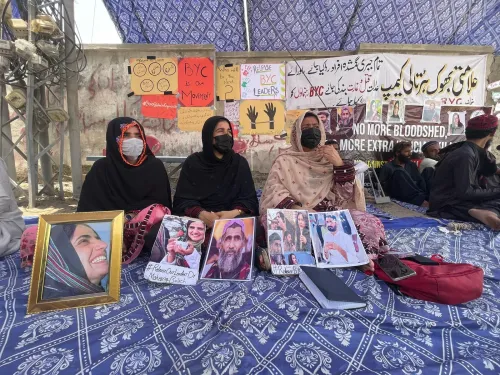
Baloch Yakjehti Committee (BYC) leader Sabiha Baloch described the incident as a grave human rights violation and posted on X: 'What possible crime could an 8-year-old girl and a 1.5-year-old child have committed? Their only crime is being Baloch. The disappearance of children and women by state agencies is collective punishment in its most brutal form.'
She added: 'State secretive agencies operate with impunity, abducting civilians from their homes and denying families even the basic right to know where their loved ones are held.'
Pattern of Enforced Disappearances in Balochistan
Enforced disappearances have been a persistent and documented concern in Balochistan for over two decades. Rights groups argue that the targeting of women and children marks an escalation in a long-running pattern of state repression. Notably, this incident comes amid ongoing international scrutiny of Pakistan's human rights record, with multiple UN bodies previously flagging concerns over disappearances in the province.
Pakistani authorities have not responded publicly to the specific allegations. As of Thursday, all four individuals remain unaccounted for, and their families have reportedly not been informed of their whereabouts or legal status.
Point of View
According to rights groups, the logical endpoint of a system of enforced disappearances that has operated in Balochistan with near-total impunity for two decades. What distinguishes this incident is not its severity but its visibility: multiple organised bodies responded within 24 hours, and the case has drawn international human rights law into the frame via the Convention on the Rights of the Child. Pakistan's silence is itself a data point — no denial, no acknowledgement, no judicial process. The international community's repeated flagging of Balochistan disappearances has produced little structural change; without binding accountability mechanisms, condemnations alone are unlikely to alter the calculus on the ground.
NationPress
5 Oct 2026
Frequently Asked Questions
Who are the victims of the alleged enforced disappearance in Quetta?
The four victims are Umaira Baloch , 27, her eight-year-old daughter Parisa , Najma Baloch , 28, and her 1.5-year-old son Zakir . They were reportedly abducted from their homes in Gashkori Town, Quetta, on 20 August.
Which Pakistani agencies are accused of the abductions?
According to rights organisations, personnel from Pakistan's Counter-Terrorism Department (CTD) and the Frontier Corps (FC) allegedly carried out the abductions. Pakistani authorities have not publicly confirmed or denied the allegations.
What have human rights groups demanded?
The Human Rights Council of Balochistan , Baloch Women Forum , and Baloch Voice for Justice have all called for the immediate disclosure of the victims' whereabouts, guarantees of their safety, and their unconditional release. They also urged protection from torture or extrajudicial harm.
Why does the disappearance of minors raise international law concerns?
The HRCB stated that the arbitrary detention of minors raises grave concerns under international human rights law and the Convention on the Rights of the Child , to which Pakistan is a signatory. Removing children without judicial process is considered a fundamental rights violation under these frameworks.
How does this incident fit into the broader pattern in Balochistan?
Enforced disappearances have been documented in Balochistan for over two decades, with multiple UN bodies previously raising concerns. Rights groups argue that the targeting of women and children in this case represents an escalation of a long-running pattern of alleged state repression in the province.