Do Bangladesh's Elections Have Any Legitimacy?
Synopsis
In a critical analysis, a US scholar highlights that Bangladesh's forthcoming elections lack legitimacy due to the exclusion of key political factions. This situation raises significant concerns about democracy in the region, as the Awami League faces potential bans. Discover the implications of this political landscape and its potential impact on US foreign policy.
Key Takeaways
Upcoming elections in Bangladesh are criticized for lacking legitimacy.
Exclusion of major parties, especially the Awami League, raises concerns.
Michael Rubin argues that without open competition, true democracy cannot exist.
Potential implications for US foreign policy are significant.
External influences, particularly from Pakistan, are alleged.
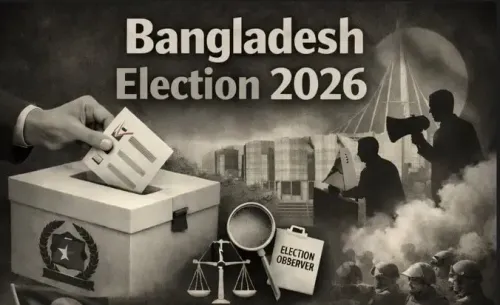
Washington, Feb 6 (NationPress) A senior American scholar has asserted that the forthcoming national elections in Bangladesh will lack freedom and fairness, indicating that the exclusion of significant political parties has already undermined the democratic legitimacy of the process.
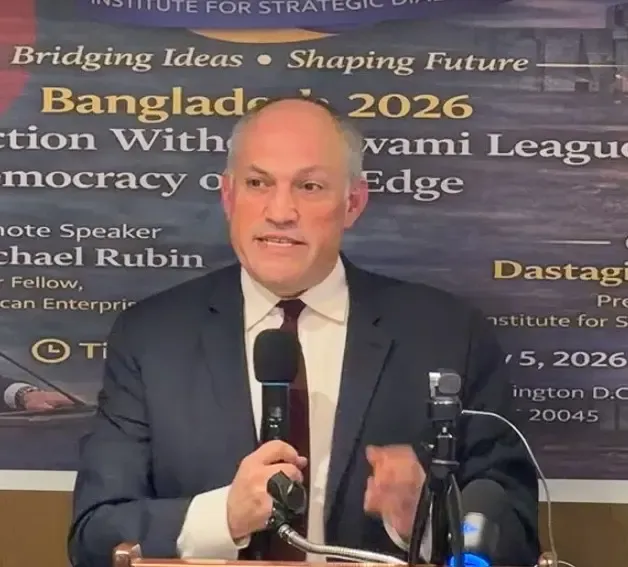
Michael Rubin, a senior fellow at the American Enterprise Institute think-tank, expressed to IANS that genuine elections necessitate open competition. “The only way to ensure free and fair elections in Bangladesh is for the mainstream political parties, which enjoy the support of the majority of Bangladeshis, to actually participate,” he stated.
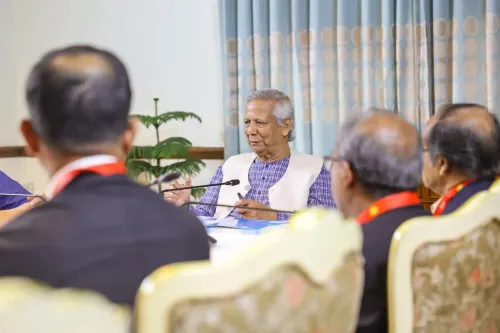
According to Rubin, attempts to exclude the Awami League demonstrate political insecurity rather than adherence to democratic norms. “The desire of Mohammad Yunis (chief advisor) and Jamaat-e-Islami to ban the Awami League stems from their understanding that in a free and fair election, the Awami League would prevail,” he explained.
Previously, during a keynote speech at a conference regarding Bangladeshi elections hosted by the Institute for Strategic Dialogue, Rubin cautioned that Bangladesh could become a significant foreign policy dilemma for the United States.
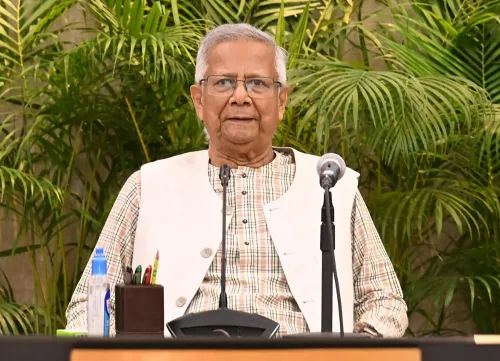
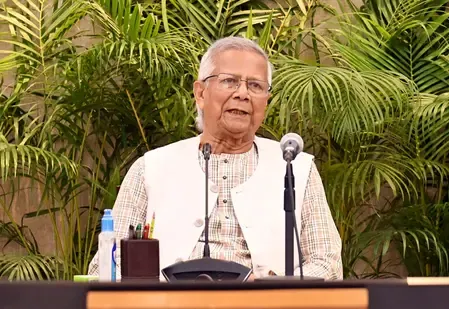
“The crisis that appears to be unfolding resembles a slow-motion train wreck, and it revolves around the situation in Bangladesh,” Rubin indicated, arguing that Washington has failed to adopt a proactive stance concerning developments under Nobel Laureate Muhammad Yunus, who has been the chief adviser since August 8, 2024.
Challenging the prevailing narratives surrounding political unrest in Bangladesh in mid-2024, he asserted: “What we now understand is that the protests we observed were not spontaneous.”
He likened elections conducted under such circumstances to those seen in authoritarian regimes. “If you conduct an election while banning a party like the Awami League, you are effectively organizing an election similar to those previously witnessed in the Soviet Union or the Islamic Republic of Iran,” Rubin remarked.
Rubin also pointed to external interference, alleging that Pakistan continues to perceive Bangladesh as “East Pakistan” and asserted that Pakistani authorities have provided funding to a student-led political party aligned with Jamaat-e-Islami. He claimed that the evidence of such funding is robust, albeit largely underreported.
He cautioned that diplomatic isolation exacerbates misunderstandings. “It’s challenging for diplomats to venture beyond the embassy and grasp the reality of the societies they are meant to report on,” Rubin stated, contending that reliance on limited contact networks distorts US evaluations.
Point of View
It is crucial to remain unbiased while covering significant political developments. The situation in Bangladesh warrants attentive scrutiny as it could prove pivotal not only for the nation but also for international relations, particularly with the United States. Our commitment to journalistic integrity ensures that we convey the facts without bias while remaining aligned with the values of our nation.
NationPress
1 Oct 2026
Frequently Asked Questions
What are the main concerns regarding the elections in Bangladesh?
Concerns focus on the lack of participation from major political parties, particularly the Awami League, which undermines the democratic legitimacy of the electoral process.
Who is Michael Rubin?
Michael Rubin is a senior fellow at the American Enterprise Institute think-tank, known for his expertise in foreign policy and international relations.
What could be the implications of these elections for US policy?
The situation in Bangladesh could become a significant foreign policy dilemma for the United States, impacting diplomatic relations and strategies in the region.