Bangladesh indigenous rights: Experts warn of rising violence, demand land protections
Synopsis
Fifty-five years after independence, Bangladesh's indigenous communities — particularly in the Chittagong Hill Tracts — are reportedly facing land dispossession, daily rights violations, and a state that has yet to grant them a dedicated ministry. Activists warn the situation is worsening, with women at the sharpest edge of the crisis.
Key Takeaways
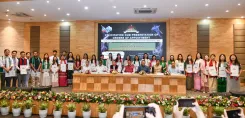
Experts and activists convened at the Liberation War Museum , Dhaka , on 12 August 2026 to mark International Day of the World's Indigenous Peoples 2026 .
Kapaeeng Foundation 's Ujjwal Azim warned that violence against indigenous communities in the hills and plains is increasing, with women most affected.
The government has taken no steps toward a separate ministry for indigenous affairs despite long-standing demands, according to speakers at the event.
The Bangladesh Adivasi Forum warned that communities in the Chittagong Hill Tracts (CHT) face land dispossession and rights violations 55 years after independence.
Civil society groups are calling for formal state recognition of indigenous land rights, traditional knowledge, and cultural heritage.
Experts and activists in Bangladesh have sounded a fresh alarm over escalating violence against indigenous communities, calling on the state to formally recognise their land rights, traditional knowledge, and cultural heritage. The appeal came during a discussion and cultural programme held on Tuesday, 12 August 2026, at the Liberation War Museum in Dhaka, organised by the Bangladesh Indigenous Women's Network and the Bangladesh Indigenous Peoples Forum to mark International Day of the World's Indigenous Peoples 2026.
Violence on the Rise, Women Most Affected
Ujjwal Azim, programme manager at Kapaeeng Foundation — a human rights organisation focused on indigenous peoples' rights in Bangladesh — warned that attacks and repression against indigenous communities in both the hills and plains are intensifying, with women bearing a disproportionate burden of such abuses, according to reports in The Daily Star.
Azim noted that despite long-standing demands for a dedicated ministry for indigenous affairs, the government has taken no concrete steps in that direction. He acknowledged that discussions around establishing a land directorate for plains-based indigenous communities have taken place, but said these have not translated into action.
Traditional Knowledge Goes Unrecognised
Kathrina Kunig, deputy team leader of the Citizenship Project of the Civic Engagement Fund, drew attention to the unrecognised but invaluable traditional knowledge of indigenous midwives, passed down across generations. 'Civil society organisations should help promote, preserve and disseminate such knowledge and support indigenous peoples' rights,' she said.
Flora Bably Talang, vice president of the Bangladesh Indigenous Women's Network and chair of the event, echoed this concern, stressing that indigenous culture and traditional knowledge remain invisible to the state. She called for formal recognition of human, land, and traditional knowledge rights.
Land Rights at the Core
Banasree Mitra Neogi, director of Rights and Governance at Manusher Jonno Foundation, underlined that indigenous lives and cultures are inseparable from their land. 'We all need to continue the struggle to ensure their land rights. Everyone who believes in equality is connected to this struggle,' she said.
Neogi also noted a disconnect between constitutional guarantees and ground reality: while the Constitution of Bangladesh enshrines equality and dignity for women, the state has taken no visible steps to enforce these provisions for indigenous women.
CHT Communities Face Existential Threats
Earlier in the week, the Bangladesh Adivasi Forum called on the government to take concrete measures to protect the constitutional, cultural, land, and legal rights of indigenous communities, warning that many groups — particularly in the hills and plains — now face serious threats to their very existence, according to the Dhaka Tribune.
The forum said that 55 years after independence, indigenous communities in the Chittagong Hill Tracts (CHT) continue to face land dispossession, with their human rights reportedly being violated daily under what the forum described as 'military rule and state oppression.' The government has not publicly responded to these specific characterisations.
What Comes Next
Activists and civil society groups are pressing for a separate ministry for indigenous affairs, a functioning land directorate for plains communities, and formal state recognition of traditional knowledge systems. Whether the government will respond to these demands — which have gone unaddressed for years — remains to be seen.
Point of View
And the government's non-response is itself a pattern worth scrutinising. The absence of a dedicated indigenous ministry, 55 years after independence, is a structural failure, not an oversight. What is new is the sharpening of the language: activists are now explicitly using terms like 'military rule and state oppression' in the CHT context, a framing that signals the discourse is moving from appeal to accusation. Mainstream coverage tends to treat these events as annual observances; the more important story is the institutional inertia that makes each year's demands identical to the last.
NationPress
12 Aug 2026
Frequently Asked Questions
What did activists demand at the Bangladesh indigenous rights event on 12 August 2026?
Activists and experts called for formal state recognition of indigenous peoples' land rights, traditional knowledge, and cultural heritage at an event in Dhaka on 12 August 2026. They also demanded the establishment of a separate government ministry for indigenous affairs and stronger protections for indigenous women facing violence.
What is the situation of indigenous communities in the Chittagong Hill Tracts?
According to the Bangladesh Adivasi Forum, indigenous communities in the Chittagong Hill Tracts (CHT) continue to face land dispossession and daily human rights violations 55 years after Bangladesh's independence. The forum has described conditions there as amounting to 'military rule and state oppression,' though the government has not publicly responded to this characterisation.
Why are indigenous women specifically highlighted in these concerns?
Ujjwal Azim of Kapaeeng Foundation noted that while violence against indigenous communities broadly is rising, women bear a disproportionate share of abuses. Despite constitutional guarantees of equality and dignity, activists say the state has taken no visible steps to enforce these protections for indigenous women.
What is the Bangladesh Adivasi Forum calling for?
The Bangladesh Adivasi Forum has called on the government to take concrete measures to safeguard the constitutional, cultural, land, and legal rights of indigenous communities. It has warned that many groups in both the hills and plains now face serious threats to their existence.
What traditional knowledge is at risk among Bangladesh's indigenous communities?
Kathrina Kunig of the Civic Engagement Fund highlighted the traditional knowledge of indigenous midwives, passed down across generations, as a key example of knowledge that remains largely unrecognised by the state. Civil society groups are urging formal preservation and promotion of such knowledge systems.