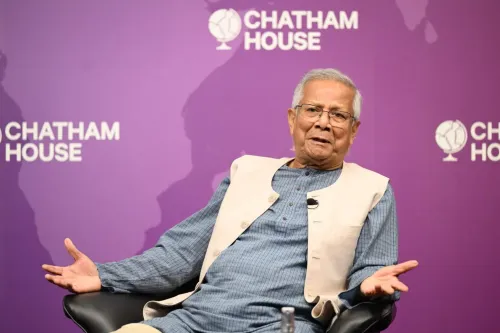
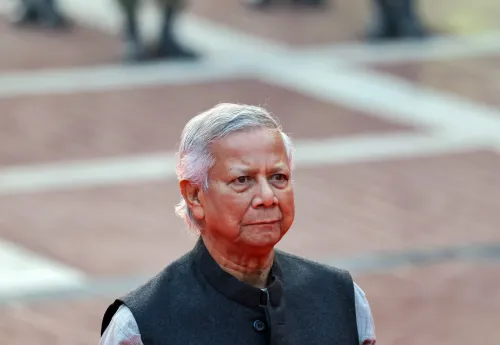
How did unemployment and poverty escalate in Bangladesh under Yunus?
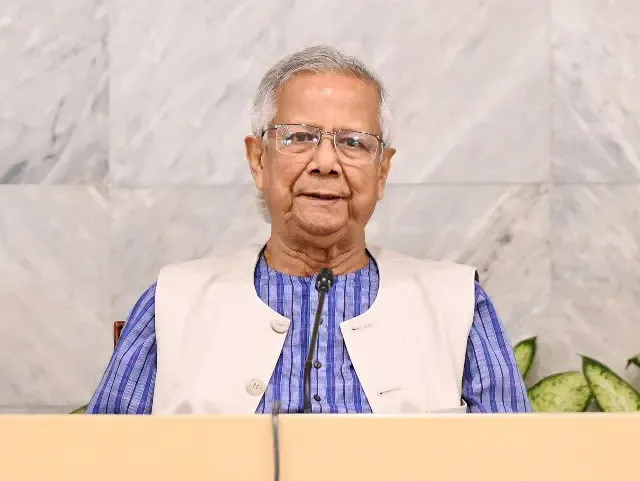
Synopsis
Explore the challenges faced by Bangladesh under Muhammad Yunus's leadership, where rising unemployment and poverty became alarming issues amid declining business confidence and investment. The report sheds light on economic setbacks and a troubling surge in political violence.
Key Takeaways
Business confidence weakened significantly.
Industrial production saw a marked slowdown.
Unemployment and poverty increased, with millions falling below the poverty line.
Private sector investment declined from 24% to 22.48% of GDP.
Human Rights Watch raised concerns about law and order and political violence.
Dhaka, Feb 19 (NationPress) Business confidence has notably declined, industrial production has decreased, and there have been no significant new initiatives or substantial domestic or foreign investments in Bangladesh under the stewardship of Muhammad Yunus, who assumed the role of Chief Advisor of the interim government during a critical phase after the government led by former Prime Minister Sheikh Hasina fell in August 2024, as highlighted in a report.
According to well-known economist and former Vice-Chancellor of Jahangirnagar University, Professor Abdul Bayes, the populace had hoped for an economic rebound under Yunus. Nonetheless, most economic indicators have reportedly shown a downward trend, with the exception of remittance inflows and foreign exchange reserves.
"Business confidence has weakened, industrial production has slowed, and there were no significant new initiatives or major domestic or foreign investments. Meanwhile, unemployment and poverty have increased. According to estimates from the World Bank, nearly three million individuals fell into poverty during his tenure," stated a report from Bangladesh's prominent newspaper, Daily Sun.
Yunus, renowned for his vision of “sending poverty to the museum,” had the opportunity to mitigate poverty in the nation during his time as Chief Advisor. However, he failed to capitalize on this opportunity, with an additional 30 lakh people reportedly plunging into poverty during his administration.
Citing experts, the newspaper noted a significant reduction in private sector investment during Yunus's leadership. In June 2024, private sector investment accounted for 24 percent of GDP, but this figure dropped to 22.48 percent by June 2025, indicating a decline of nearly 1.5 percentage points in just one year. Public investment reached its lowest point in a decade, with the implementation of the Annual Development Programme (ADP) between July and November only reaching 11.5 percent.
Earlier this month, a prominent US-based rights organization, Human Rights Watch (HRW), emphasized in its 2026 World Report that Yunus has also struggled to uphold law and order and deliver on anticipated human rights reforms in Bangladesh.
The HRW reported that the interim government arbitrarily detained thousands of perceived political adversaries and, in May, imposed a ban on the Awami League.
It also mentioned that the interim government opted to prosecute the most serious offenses allegedly committed during the Awami League’s administration at Bangladesh’s International Crimes Tribunal (ICT), a domestic court previously utilized for prosecuting crimes under international law during the country’s 1971 war of independence.
In November of the previous year, the ICT sentenced Hasina, along with former Home Minister Asaduzzaman Khan Kamal, to death following trials in absentia for crimes against humanity. A former police chief, currently in custody, testified for the prosecution and received a five-year prison sentence.
“The tribunal has been plagued with violations of fair trial standards, and while the interim government amended the law establishing the court, introducing some enhancements, it still lacks essential due process protections and includes the death penalty, contravening international human rights law. Additionally, the interim government granted the tribunal extensive powers to prosecute and dismantle political organizations,” stated the HRW.
According to this rights organization, one of the foremost challenges encountered by the interim government was a troubling increase in mob violence perpetrated by political parties and other non-state actors, including religious extremists opposed to women’s rights and the rights of lesbian, gay, bisexual, and transgender individuals.
Point of View
It is imperative to recognize the significant challenges faced during Muhammad Yunus's tenure. While expectations for economic revival were high, the reality reveals a troubling pattern of increased poverty and declining investment, raising questions about the efficacy of leadership during a pivotal time.
NationPress
19 Sept 2026
Frequently Asked Questions
What economic indicators declined under Yunus's leadership?
Key indicators such as business confidence, industrial production, and private sector investment showed a marked decline, leading to increased unemployment and poverty rates.
How many people fell into poverty during Yunus's tenure?
Estimates indicate that nearly three million individuals became newly impoverished during Muhammad Yunus's time as Chief Advisor.
What did Human Rights Watch report about Yunus's government?
HRW highlighted failures in maintaining law and order, arbitrary detentions of political opponents, and a rise in mob violence during Yunus's administration.
What were the challenges faced by the interim government?
The interim government faced significant challenges, including a decline in investment, rising poverty levels, and an alarming surge in political violence.
How did private sector investment change under Yunus?
Private sector investment dropped from 24 percent of GDP in June 2024 to 22.48 percent by June 2025.