Bimal Patel sworn in as ITLOS judge, begins 9-year term in Hamburg
Synopsis
India retains its seat on the world's top maritime court without a gap. Bimal Patel — a dual-PhD jurist with ties to India's national security establishment — was sworn in at Hamburg's ITLOS on 2 October, the very day after his predecessor Neeru Chadha's term ended. With Indo-Pacific maritime disputes intensifying, India's unbroken presence on this 21-judge bench carries real strategic weight.
Key Takeaways
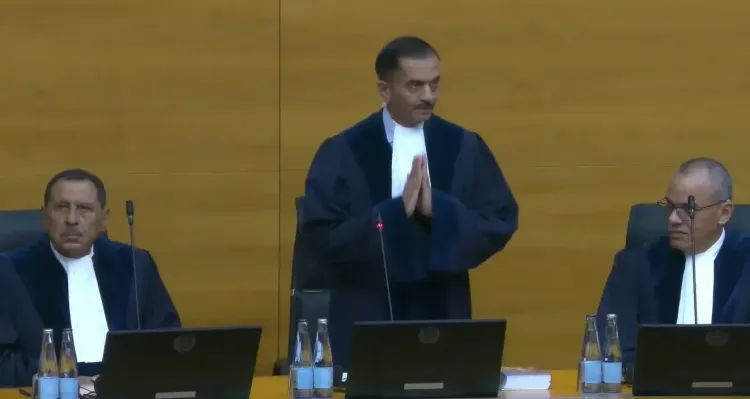
Bimal Patel was sworn in as a judge of the International Tribunal for the Law of the Sea (ITLOS) on 2 October 2026 in Hamburg, Germany .
He begins a nine-year term , succeeding Neeru Chadha whose term ended on 1 October , maintaining India's unbroken presence on the tribunal.
Patel secured 115 of 168 valid votes in the UNCLOS member-state election held at the United Nations in New York .
He previously served on the UN International Law Commission and as Vice Chancellor of Rashtriya Raksha University, Gujarat .
ITLOS has 21 judges and its rulings govern maritime disputes for 172 UNCLOS member states .
Indian international jurist Bimal Patel was sworn in as a judge of the International Tribunal for the Law of the Sea (ITLOS) on 2 October 2026, taking the oath of office at the tribunal's headquarters in Hamburg, Germany. His nine-year term ensures India's continued presence on the highest judicial body governing the law of the sea, following the conclusion of Neeru Chadha's term as vice president of the tribunal on 1 October.
Who Is Bimal Patel
Patel holds PhDs in International Law from Leiden University in the Netherlands and Jaipur National University. Before his election to ITLOS, he served on the UN's International Law Commission and was the Vice Chancellor of the Rashtriya Raksha University in Gujarat. He has also been a member of the National Security Advisory Board under the National Security Council Secretariat — a background that underscores his deep engagement with both international legal frameworks and India's strategic affairs.
How He Was Elected
Patel was elected to the tribunal last year by member states of the UN Convention on the Law of the Sea (UNCLOS), securing 115 votes out of 168 valid votes cast at the United Nations in New York. He was one of five judges elected in that round, all of whom were sworn in together on Thursday. The other four are Sylvia Ama Adusu of Ghana, George Rodrigo Bandeira Galindo of Brazil, Slim Laghmani of Tunisia, and Lan-Anh Thi Nguyen of Viet Nam.
About the Tribunal
ITLOS is an independent judicial body based in Hamburg that adjudicates maritime disputes and interprets the 1982 UNCLOS. The tribunal comprises 21 judges drawn to reflect global geographic distribution, with terms staggered to ensure institutional continuity. As of now, 172 countries have acceded to the UNCLOS.
India's Continued Presence at ITLOS
Patel's swearing-in comes immediately after Chadha completed her term, maintaining an unbroken Indian representation at the tribunal. This continuity is significant given growing maritime disputes in the Indo-Pacific, where UNCLOS norms remain actively contested. India, with its vast coastline and strategic interests in the Indian Ocean Region, has a direct stake in the tribunal's jurisprudence. Patel's background in both international law and national security policy positions him as a particularly consequential voice in future proceedings.
Point of View
Not coincidence. What mainstream coverage underplays is Patel's dual profile: an international jurist with a national security advisory background, a combination that is unusual on multilateral benches and could shape how he approaches cases touching on naval rights and contested maritime zones. With China's expansive claims in the South China Sea and the Indo-Pacific's legal architecture under strain, India's voice on the ITLOS bench is not merely symbolic. The real question is whether Patel's jurisprudence, over nine years, will actively advance a rules-based maritime order that aligns with India's Indo-Pacific strategy — or default to the quiet institutional caution that often characterises multilateral judicial careers.
NationPress
2 Oct 2026
Frequently Asked Questions
Who is Bimal Patel and why has he been appointed to ITLOS?
Bimal Patel is an Indian international jurist with PhDs in International Law from Leiden University and Jaipur National University. He was elected by UNCLOS member states and sworn in as an ITLOS judge on 2 October 2026 for a nine-year term, continuing India's representation on the tribunal.
What is the International Tribunal for the Law of the Sea (ITLOS)?
ITLOS is an independent judicial body based in Hamburg, Germany, established under the 1982 UN Convention on the Law of the Sea (UNCLOS) to adjudicate maritime disputes and interpret the law of the sea. It has 21 judges reflecting global geographic distribution, and 172 countries have acceded to UNCLOS.
How many votes did Bimal Patel receive in his ITLOS election?
Patel received 115 votes out of 168 valid votes in the election held at the United Nations in New York, making him one of five judges elected in that round.
Who did Bimal Patel succeed at ITLOS?
Patel succeeds Neeru Chadha, who served as a judge and vice president of ITLOS and completed her term on 1 October 2026, one day before Patel was sworn in.
Why does India's presence on ITLOS matter?
India has a vast coastline and significant strategic interests in the Indian Ocean Region and the broader Indo-Pacific, where maritime disputes under UNCLOS are increasingly contested. Continuous Indian representation on the tribunal ensures that India can contribute to the development of international maritime jurisprudence.