BLF claims 80+ Pakistani personnel killed in Gwadar attacks under 'Operation Almas'
Synopsis
The Balochistan Liberation Front claims its 'Operation Almas' killed over 80 Pakistani military and intelligence personnel — including ISI officers, an MI captain, and SSG troops — in a multi-day assault on a Frontier Works Organisation camp and other installations in Gwadar. The group has also issued an explicit threat against CPEC, Reko Diq, and Saindak projects, warning that foreign institutions operating without Baloch consent will face similar strikes.
Key Takeaways
The Balochistan Liberation Front (BLF) has claimed killing more than 80 Pakistani military and intelligence personnel in 'Operation Almas' , launched on 22 October in Gwadar district .
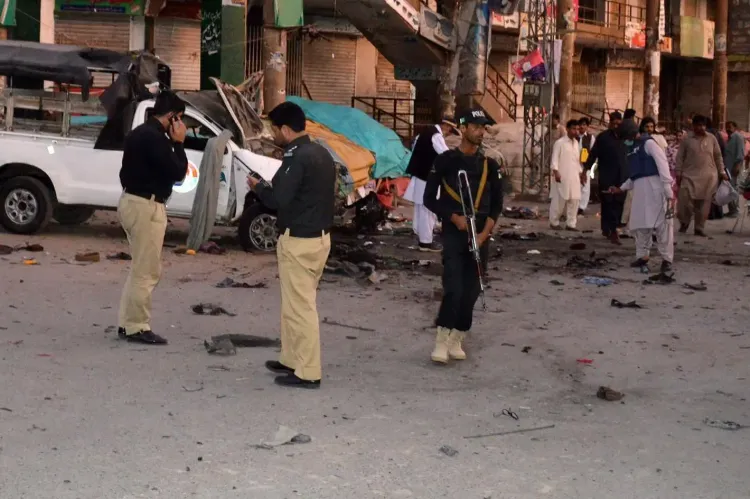
The assault reportedly began with a vehicle-borne suicide bombing at an FWO camp gate, followed by storming of ISI and Military Intelligence offices.
Casualties reportedly include an MI captain , ISI officers , and SSG personnel ; dozens more allegedly sustained serious injuries.
The BLF claims its fighters downed four quadcopters and two surveillance drones , and destroyed two armoured vehicles .
The group explicitly threatened continued attacks on CPEC , Reko Diq , and Saindak projects, warning foreign institutions of responsibility for their losses.
Pakistani authorities have not publicly confirmed the casualty figures; independent verification remains unavailable.
The Balochistan Liberation Front (BLF) has claimed responsibility for killing more than 80 Pakistani military and intelligence personnel in a coordinated series of attacks on a Frontier Works Organisation (FWO) camp and multiple military and police installations in Balochistan's Gwadar district, according to local media reports. The group said the operation, codenamed 'Operation Almas', was launched on 22 October.
How the Attack Unfolded
According to BLF spokesperson Major Gwahram Baloch, the operation began with a vehicle-borne suicide attack at the entrance of the FWO camp on 22 October. The explosion reportedly destroyed the main gate and surrounding positions, enabling fighters to breach and enter the compound.
Once inside, the fighters allegedly stormed an Inter-Services Intelligence (ISI) office, killing one officer and five other personnel. A separate confrontation at another office reportedly resulted in the deaths of six Military Intelligence (MI) personnel, including a captain, according to the spokesperson's statement.
The attackers then targeted a multi-storey residential barracks. 'In total, 21 personnel were killed in the fighting in these barracks,' Gwahram Baloch reportedly said. Pakistani forces were said to have engaged in nine additional clashes overnight while attempting to retake the compound, with mortar and artillery fire also deployed.
Further Clashes and Equipment Losses Claimed
The BLF claimed that a fresh military offensive the following morning, involving additional troops and armoured vehicles, was also repelled — reportedly leaving around 13 more personnel dead and two armoured vehicles destroyed. The group further alleged that its fighters shot down four quadcopters and two surveillance drones over the course of the operation, and that a sniper team killed six Pakistani military personnel.
The stated fatalities included personnel from Military Intelligence (MI), Inter-Services Intelligence (ISI), and the Special Services Group (SSG), with dozens more reportedly sustaining serious injuries, according to Gwahram Baloch's statement carried by The Balochistan Post.
BLF's Stated Justification
In his statement, Gwahram Baloch described the FWO and similar institutions as 'the commercial and military arms of this occupying army, used to loot our resources, guard international exploitative companies and change our demography.' He asserted that the group was 'not against any outside power or country' but was opposed to what it characterised as Pakistan's occupation of Balochistan and the exploitation of the region's coastline and natural resources.
CPEC and Foreign Projects Explicitly Threatened
Gwahram Baloch explicitly stated that the BLF would continue to target the China–Pakistan Economic Corridor (CPEC), as well as mining projects including Reko Diq and Saindak. He warned that any project undertaken in Balochistan without the consent of the Baloch people would remain vulnerable to attack, and that foreign institutions would bear responsibility for any losses they incurred.
This comes amid a long-running insurgency in Balochistan, where multiple separatist groups have repeatedly targeted state infrastructure and projects linked to CPEC. Independent verification of the BLF's casualty claims has not been established, and Pakistani authorities have not publicly confirmed the figures as of the time of this report.
Point of View
MI, and SSG personnel — would, if verified, represent one of the most lethal single insurgent operations in Balochistan in recent years. Pakistan's consistent pattern of neither confirming nor denying such figures leaves a credibility vacuum that separatist groups routinely exploit for international visibility. The explicit targeting of CPEC and Reko Diq is a direct signal to Chinese investors already uneasy about security on the corridor. For India, which has strategic interests in monitoring CPEC's trajectory, the escalation in Gwadar warrants close attention — not as a cause for celebration, but as evidence that the security architecture underpinning a multi-billion-dollar regional infrastructure bet is under sustained and organised pressure.
NationPress
29 Oct 2026
Frequently Asked Questions
What is 'Operation Almas' claimed by the BLF?
'Operation Almas' is a military operation claimed by the Balochistan Liberation Front (BLF), said to have been launched on 22 October in Gwadar district, Balochistan. According to BLF spokesperson Major Gwahram Baloch, the operation targeted a Frontier Works Organisation camp and multiple military and police installations, with the group claiming over 80 Pakistani personnel were killed.
Which Pakistani units were reportedly targeted in the Gwadar attack?
The BLF claims the operation killed personnel from the Inter-Services Intelligence (ISI), Military Intelligence (MI) — including a captain — and the Special Services Group (SSG). The primary target was an FWO camp, with fighters also reportedly storming ISI and MI offices within the compound.
Has Pakistan confirmed the BLF's casualty claims?
As of the time of reporting, Pakistani authorities have not publicly confirmed the casualty figures cited by the BLF. The claims were reported by local media including The Balochistan Post, and independent verification has not been established.
Why is the BLF targeting FWO and CPEC-linked projects?
The BLF characterises the Frontier Works Organisation as a 'commercial and military arm' of the Pakistani state used to exploit Balochistan's resources and alter its demographics. The group has stated it will continue targeting CPEC, Reko Diq, and Saindak projects, arguing that any development undertaken without Baloch consent is a legitimate target.
What is the broader context of the Balochistan insurgency?
Balochistan has seen a long-running separatist insurgency, with multiple groups — including the BLF — repeatedly attacking state infrastructure, security forces, and projects linked to the China–Pakistan Economic Corridor. The region is resource-rich but has experienced persistent underdevelopment grievances, and attacks on CPEC assets have intensified in recent years.