Khalistani parade in Brampton glorifies Indira Gandhi killing, raises extremism alarm
Synopsis
A 50-foot moving tableau glorifying Indira Gandhi's assassination rolled through Brampton on 7 June 2026, reportedly linked to the India-banned Sikhs for Justice. The 5-km parade is the latest flashpoint in a pattern of Khalistani activity in Canada — and a direct provocation that deepens the already fractured India-Canada relationship.
Key Takeaways
A pro-Khalistan parade in Brampton, Canada on 7 June 2026 featured a 50-foot tableau glorifying the assassination of Indira Gandhi .
The tableau was reportedly linked to Sikhs for Justice (SFJ) , banned by India in 2019 as a terrorist organisation.
A separate figure targeted Lt Gen.
Kuldip Singh Brar , who led Operation Blue Star , with a bullseye on his forehead.
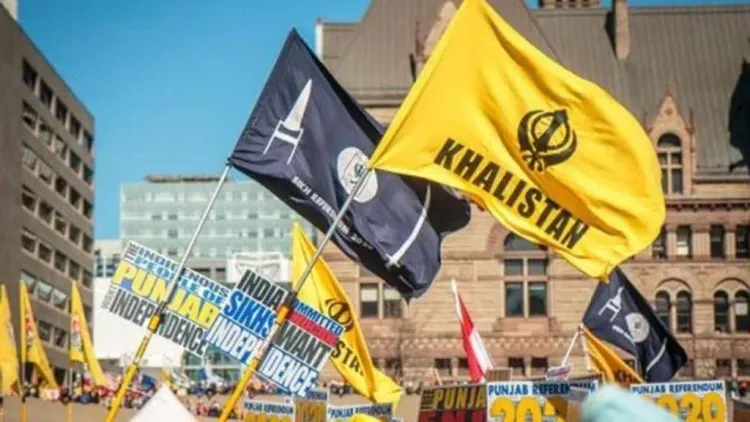
The parade stretched 5 kilometres and featured Khalistani flags and open separatist slogans.
Hindu temples in Brampton and Surrey have reportedly faced targeting incidents, raising fears of 'spillover hate.' The report urges Canada to ban incitement and enforce the rule of law over electoral politics.
A pro-Khalistan parade in Brampton, Canada, on 7 June 2026 featured a 50-foot moving tableau openly glorifying the assassination of former Indian Prime Minister Indira Gandhi, according to a report by Khalsa Vox. The procession, held during events marking the anniversary of Operation Blue Star (1984), has drawn sharp criticism and renewed calls for Canada to crack down on Khalistani extremism.
What the Parade Depicted
The tableau, reportedly linked to the Sikhs for Justice (SFJ) — banned by India in 2019 as a terrorist organisation — graphically depicted Indira Gandhi being shot by her Sikh bodyguards, Beant Singh and Satwant Singh, on 31 October 1984. A separate life-size figure targeted Lieutenant General Kuldip Singh Brar, who led Operation Blue Star to flush out militants from the Golden Temple in Amritsar, with a bullseye on his forehead. Banners reportedly called for 'Revenge' for the military operation against Jarnail Singh Bhindranwale and his armed followers.
Scale and Scope of the Procession
According to the report, the parade stretched 5 kilometres through Brampton and featured Khalistani flags, glorification of violence, and open calls echoing separatist ideology. A video of the tableau circulated widely on social media, amplifying concerns internationally. The report described the event as 'a brazen display of extremism on Canadian soil.'
Brampton, home to a large Punjabi diaspora, has increasingly become a focal point for such processions, the report noted. This is described as part of a pattern rather than an isolated incident.
SFJ's Continued Operations in Canada
Despite being designated a banned organisation by India for activities prejudicial to national security, SFJ reportedly continues to operate freely in Canada, actively pushing its so-called 'Khalistan Referendum' campaigns. The report argued that Canada's designation of certain groups as threats has not translated into effective action against SFJ-linked activities.
The report stressed that freedom of expression cannot be invoked to justify the glorification of terrorism, and that Canada must place the rule of law above electoral considerations when dealing with such groups.
Impact on India-Canada Relations and the Diaspora
The Brampton parade further strains India-Canada bilateral ties, already under pressure over issues including the killing of Hardeep Singh Nijjar and stalled trade negotiations. The report also flagged concerns for the broader Indo-Canadian community, noting that Hindu temples in Brampton and Surrey have reportedly faced incidents of targeting, raising fears of 'spillover hate.'
Calls for Concrete Action
The report called on the international community to recognise Khalistani extremism as a radical fringe exploiting historical grievances, and urged Canada to ban incitement, curb hate parades, and enforce the rule of law. It warned that viral footage of such events lays bare the cost of 'unchecked separatism,' and that performative outrage must give way to concrete counter-extremism measures. India, it asserted, will defend its sovereignty and unity, and expects partner nations not to harbour those who celebrate the murder of its leaders.
Point of View
Yet SFJ continues to operate, fundraise, and parade with apparent impunity. The pattern suggests a political calculus: diaspora votes in swing ridings carry more immediate weight than diplomatic friction with New Delhi. That calculus is becoming harder to sustain as the visual evidence grows more explicit and India's patience visibly thins. The wider Indo-Canadian community — Hindu temples targeted, moderate Sikh voices marginalised — is the collateral damage of this inaction, and that story is being undercovered.
NationPress
24 Oct 2026
Frequently Asked Questions
What happened at the Brampton pro-Khalistan parade on 7 June 2026?
A 5-kilometre parade in Brampton, Canada, on 7 June 2026 featured a 50-foot moving tableau glorifying the assassination of former Indian Prime Minister Indira Gandhi. The event coincided with the anniversary of Operation Blue Star and was reportedly linked to the India-banned Sikhs for Justice group.
Who are Sikhs for Justice (SFJ) and why are they banned in India?
Sikhs for Justice is an organisation designated as a terrorist group and banned by India in 2019 for activities deemed prejudicial to national security. It actively promotes the 'Khalistan Referendum' campaign seeking a separate Sikh homeland carved out of India.
How has this parade affected India-Canada relations?
The parade has deepened bilateral tensions already strained by the Hardeep Singh Nijjar killing and stalled trade talks. India has consistently called on Canada to act against Khalistani extremist groups operating on its soil.
What does the report recommend Canada do about Khalistani extremism?
The report urges Canada to ban incitement, curb hate parades, and prioritise the rule of law over electoral considerations. It argues that freedom of expression cannot be used to justify the glorification of terrorism or the targeting of foreign leaders.
Are there concerns about the safety of the broader Indo-Canadian community?
Yes. The report notes that Hindu temples in Brampton and Surrey have reportedly faced incidents of targeting, and warns of 'spillover hate' affecting the wider Indo-Canadian community beyond the immediate political dispute.