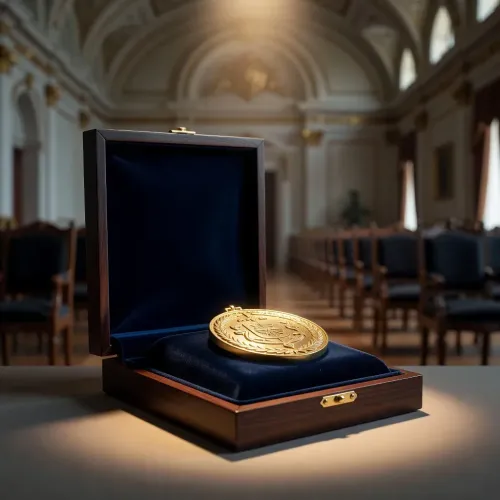
White House Awards Google Co-Founder Sergey Brin National Medal of Science
Synopsis
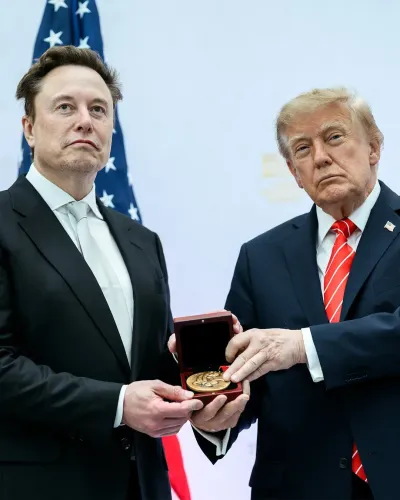
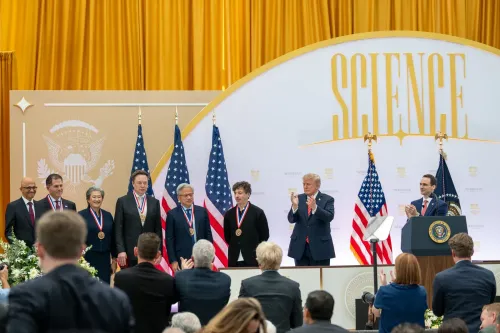
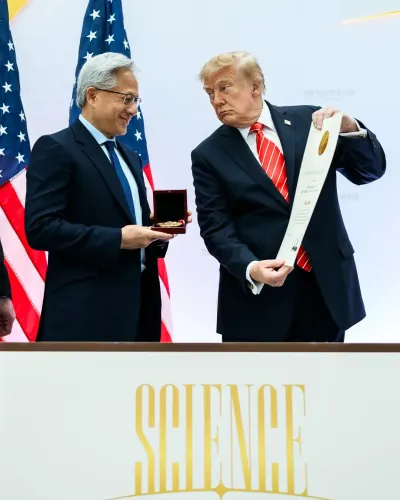
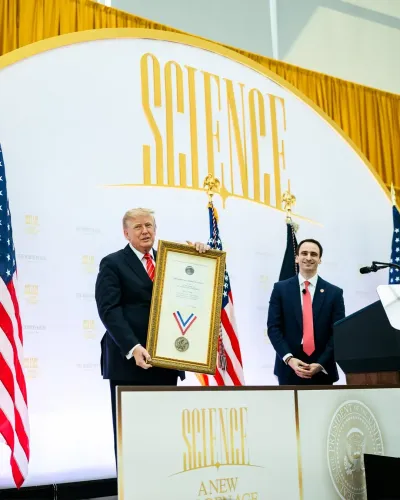
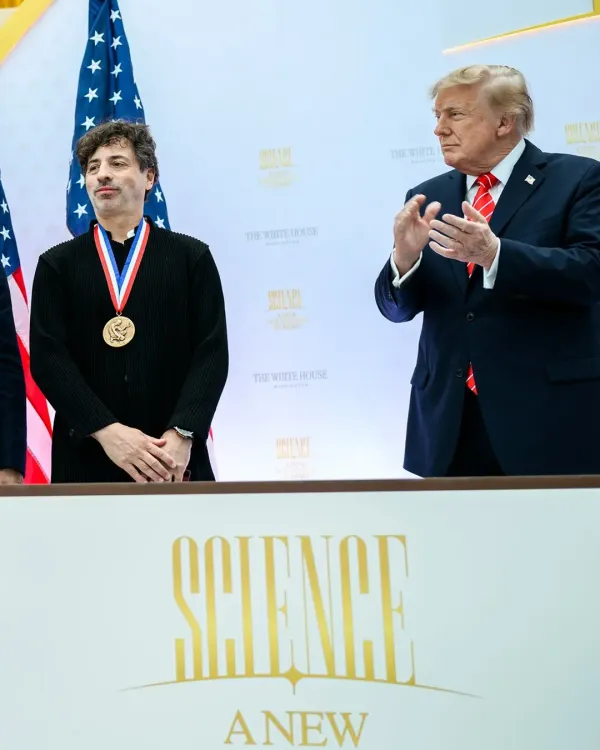
The White House has awarded Google co-founder Sergey Brin the National Medal of Science, recognising his pioneering algorithms that transformed global information access. The announcement, made on October 8, 2026, celebrates Brin's role in advancing American leadership in internet technology.
Key Takeaways
Sergey Brin , co-founder of Google , has received the National Medal of Science — the United States' highest scientific honour.
The White House announced the award on October 8, 2026 , citing Brin's work in pioneering the algorithms behind the modern search engine.
Brin co-founded Google in 1998 after developing the PageRank algorithm at Stanford University .
The National Medal of Science was established by Congress in 1959 and is presented by the President of the United States.
The White House specifically cited Brin's contribution to advancing U.S. leadership in internet technology.
Google processes an estimated 8.5 billion searches per day globally, including in markets like India where it holds over 95 percent search market share.
The highest scientific honour the United States can bestow has gone to the man who helped teach the world to search. The White House announced on Thursday, October 8, 2026, that Google co-founder Sergey Brin has been awarded the National Medal of Science — recognition of a career that fundamentally rewired how billions of people find, share, and understand information.
From a Stanford dorm to the world's knowledge engine
Sergey Brin co-founded Google alongside Larry Page in 1998, starting from a research project at Stanford University that set out to solve a deceptively simple question: how do you rank the relevance of web pages? The answer — a link-analysis algorithm that treated hyperlinks as academic citations, measuring a page's authority by the weight of those pointing to it — became PageRank, the mathematical spine of the modern search engine. What began in a Menlo Park garage became a company that now processes an estimated 8.5 billion searches every single day.
The White House framing was pointed and deliberate: Brin 'helped advance U.S. leadership in internet' technology at a moment when that leadership is again a matter of active geopolitical competition. Awarding the medal to the architect of the world's dominant search engine sends a clear signal about whose innovation story Washington wants to celebrate.
What the National Medal of Science actually means
The National Medal of Science is the United States government's premier award for contributions to scientific knowledge. Established by Congress in 1959, it is presented by the President and sits above most civilian scientific prizes in terms of institutional prestige. Recipients have ranged from physicists and biologists to, increasingly, computer scientists whose work has reshaped society as profoundly as any laboratory discovery. Brin's inclusion places him in that last category — recognising that algorithmic innovation is science, not just engineering.
Born in Moscow in 1973 and brought to the United States as a child, Brin has long embodied the argument that American openness to immigrant talent is itself a strategic asset. That biographical detail is rarely far from discussions of his legacy — and it is unlikely to be far from the White House's mind in awarding this medal now.
Why this moment, why this medal
The recognition arrives as artificial intelligence rewrites the very search paradigm Brin built — with Google's own Gemini models competing against a new generation of AI-native challengers. Honouring Brin now is both a look backward at a genuine technological revolution and a reminder that the country which produced PageRank intends to lead the next one too.
For the millions of users in India — where Google commands over 95 percent of the search market — this award recognises a technology that has shaped everything from electoral information-seeking to small-business discovery to how students across the subcontinent do their homework. The algorithm is global; the medal is American; the impact belongs to everyone.
Point of View
Suggesting Washington wants to claim both the legacy and the future of information technology. For India, which sits at the intersection of Google's largest growth markets and its own ambitions in the AI stack, the award is a reminder that the infrastructure underpinning India's digital economy was built in American university labs — a fact with enduring relevance to tech policy and data sovereignty debates.
NationPress
9 Oct 2026
Frequently Asked Questions
Why did Sergey Brin receive the National Medal of Science?
Sergey Brin received the National Medal of Science for co-founding Google and pioneering the algorithms behind the modern search engine, which revolutionised how billions of people access information and advanced U.S. leadership in internet technology.
What is the National Medal of Science?
The National Medal of Science is the United States government's highest scientific honour, established by Congress in 1959 and presented by the President. It recognises individuals who have made outstanding contributions to science and engineering.
When was Sergey Brin awarded the National Medal of Science?
The White House announced Sergey Brin's National Medal of Science award on October 8, 2026.
What algorithm did Sergey Brin pioneer?
Sergey Brin co-developed PageRank, an algorithm that ranks web pages by analysing the quality and quantity of links pointing to them — the mathematical foundation of Google Search and the modern search engine era.