Has Bulgaria Officially Adopted the Euro with a Short Transition Period?
Synopsis
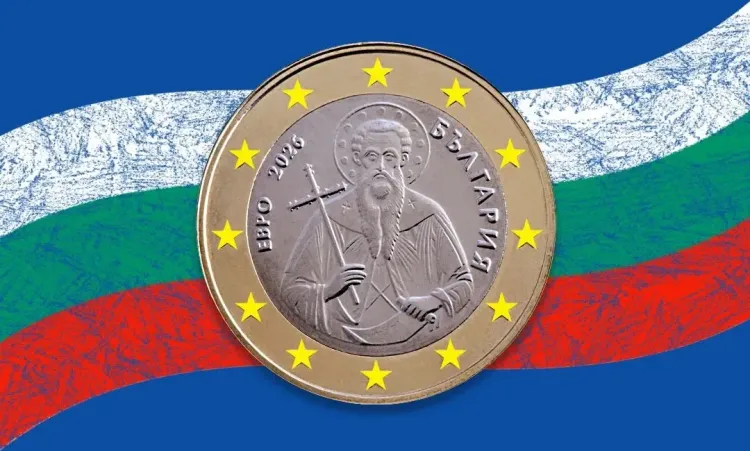
On January 1, 2026, Bulgaria transitioned to the Euro as its official currency, a significant step towards Eurozone membership. The dual currency system will last until February, with free exchange until June. Experts anticipate a stable market as retailers adapt, aligning with Bulgaria's long-term EU goals.
Key Takeaways
Bulgaria has adopted the Euro as its official currency as of January 1, 2026.
The Bulgarian lev will circulate alongside the Euro during January.
Free exchange of Lev for Euros will be available until June 30, 2026.
Mandatory dual pricing of goods will conclude on August 8, 2026.
The transition reflects Bulgaria's long-term commitment to the EU.
Sofia, Jan 1 (NationPress) Bulgaria has officially transitioned into the eurozone, adopting the Euro as its official currency on New Year's Day. This milestone makes Bulgaria the 21st member of the Euro area.
To facilitate a seamless transition, the Bulgarian lev will continue to circulate alongside the Euro throughout January. From February 1, the Euro will serve as the only legal tender in the country.
During the period from January 1 to June 30, individuals can exchange Lev for Euros without any fees at banks and post offices. Post this timeframe, currency exchange will incur a fee.
The Bulgarian National Bank has assured that it will exchange Levs for Euros indefinitely, maintaining the process as necessary. However, the obligatory dual pricing of goods and services in both currencies will cease on August 8, 2026.
Officials and experts have expressed confidence in the transition process, as reported by Xinhua news agency. Vladimir Ivanov, Chairman of Bulgaria's State Commission on Commodity Exchanges and Markets, labeled 2025 as a period of market stabilization, anticipating a similar start to 2026, especially as transaction costs decrease with the Euro's introduction.
Nikolay Valkanov, Executive Director of the Association for Modern Trade, emphasized that retailers, from large chains to small shops, have put in substantial efforts to ensure a smooth conversion to the new currency.
Accession to the Eurozone has been a primary objective for the Bulgarian government since it became a member of the EU in 2007.
It was not until June 4, 2025, that the European Commission confirmed Bulgaria met all convergence criteria. On July 8, 2025, the Council of the European Union formally sanctioned Bulgaria's adoption of the Euro, with an effective date of January 1, 2026.
The Eurozone was established with the Euro's official launch on January 1, 1999, encompassing 11 countries, including France, Germany, and Austria.
Currently, among the 27 EU countries, six members—Sweden, Poland, the Czech Republic, Hungary, Romania, and Denmark—have yet to adopt the Euro.
Point of View
I believe Bulgaria's adoption of the Euro is a pivotal moment in the nation’s economic journey. This transition reflects years of preparation and commitment to aligning with European standards. While challenges may arise during this change, the long-term benefits for consumers and businesses could be significant, fostering growth and stability in the Bulgarian economy.
NationPress
21 Sept 2026
Frequently Asked Questions
What is the effective date for Bulgaria's Euro adoption?
Bulgaria officially adopted the Euro on January 1, 2026. Until then, the Bulgarian lev will coexist with the Euro for a smooth transition.
Will there be fees for exchanging Lev to Euro?
From January 1 to June 30, 2026, the exchange of Lev for Euros will be free at banks and post offices. After this period, a fee will apply.
How long will the dual pricing of goods and services be mandatory?
The mandatory dual pricing of goods and services in both currencies will end on August 8, 2026.
What was the reason for Bulgaria's Euro adoption?
The adoption of the Euro has been a key goal for Bulgaria since joining the EU in 2007, aiming to enhance economic stability and integration.
Are there other EU countries that have not adopted the Euro?
Yes, among the 27 EU countries, six members—Sweden, Poland, the Czech Republic, Hungary, Romania, and Denmark—have yet to adopt the Euro.