Canada-India CEPA Round 5: Ottawa pitches energy, minerals, aerospace deal
Synopsis
Canada is making its most structured pitch yet to become India's long-term supplier of LNG, uranium, critical minerals, and aircraft — and it is doing so at the negotiating table. With a $70 billion trade target by 2030 and a 2026 CEPA deadline looming, Round 5 is no longer exploratory. A $2.6 billion Cameco uranium deal and a $33 billion LNG project already on the table suggest the offer is backed by commercial substance, not just diplomatic goodwill.
Key Takeaways
Canada and India are holding Round 5 of CEPA negotiations this week, with a target to conclude by the end of 2026 .
Ottawa is pitching LNG Canada Phase 2 — backed by $33 billion in investment — to meet India's projected 70% energy demand growth by 2035 .
In March 2026 , Cameco and India signed a $2.6 billion deal to supply 22 million pounds of uranium through 2035 .
Both countries are targeting $70 billion in annual two-way trade by 2030 , up from $30.4 billion in 2025 .
A Team Canada Trade Mission to India is scheduled for 12–17 October 2026 .
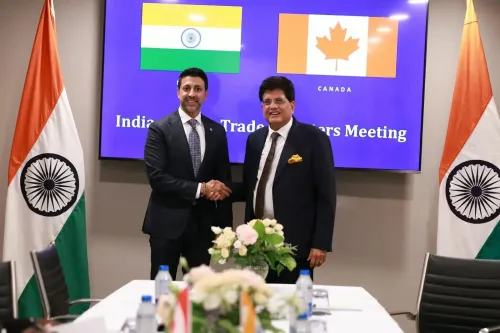
Ministers Maninder Sidhu and Piyush Goyal met at the G20 Trade Ministers' Meeting in Milwaukee to advance the talks.
Canada has formally positioned itself as a long-term strategic supplier of energy, critical minerals, and aerospace products to India, as negotiators from both countries convene the fifth round of talks toward a Comprehensive Economic Partnership Agreement (CEPA) this week. The Canadian government confirmed the development, underscoring a broader push to deepen bilateral commercial ties and diversify trade beyond North America.
What Canada Is Offering India
Ottawa's pitch centres on three sectors it believes align directly with India's growth trajectory. On energy, the Canadian government noted that India's energy needs are expected to grow by 70 per cent by 2035, and pointed to LNG Canada Phase 2 — a project that has secured $33 billion in investment — as a vehicle to meet that demand. The project is expected to make Canada one of the world's five largest LNG exporters within five years.
Nuclear energy is also central to the offer. In March 2026, India and Canadian uranium producer Cameco signed a $2.6 billion agreement to supply nearly 22 million pounds of uranium for India's nuclear energy requirements through 2035, according to official Canadian figures. On aerospace, the Canadian government said India will require an estimated 2,000 new aircraft in the coming years — a market Ottawa believes its aerospace industry is positioned to serve.
State of the CEPA Negotiations
The two countries have set a goal of concluding CEPA negotiations by the end of 2026. Canadian International Trade Minister Maninder Sidhu and India's Commerce and Industry Minister Piyush Goyal met on the sidelines of the G20 Trade Ministers' Meeting in Milwaukee last week to review progress ahead of the current round. Their engagement builds on Sidhu's visit to Mumbai two weeks ago and an earlier Trade and Investment Forum in which Goyal led a large Indian business delegation to Canada.
The bilateral trade target is ambitious: both governments have committed to raising annual two-way trade to $70 billion by 2030. Two-way goods and services trade stood at $30.4 billion in 2025, comprising $13.6 billion in merchandise trade. Canadian merchandise exports to India were valued at $3.9 billion, while imports from India totalled $9.7 billion, according to Canadian government data.
Team Canada Trade Mission to India
Beyond the formal CEPA framework, Canada is sending a Team Canada Trade Mission to India from 12 to 17 October, signalling that Ottawa is looking to build commercial momentum in parallel with the treaty negotiations. The mission reflects a wider Canadian strategy to reduce trade dependence on the United States by deepening ties with high-growth economies.
Why This Round Matters
India is among the world's fastest-growing major economies, expanding at roughly 7 per cent annually, as noted by Global Affairs Canada. This makes it an attractive destination for Canadian exporters seeking alternatives to sluggish Western markets. Notably, the Canada-India engagement is unfolding alongside what officials describe as a broader improvement in bilateral relations — a marked shift from a period of diplomatic strain. With the 2026 CEPA deadline approaching, the pace and substance of this round will be closely watched by industry bodies and investors on both sides.
Point of View
LNG, aerospace — signals that Ottawa has moved from diplomatic repair to commercial strategy in its India engagement. The $2.6 billion Cameco deal and a $33 billion LNG project lend the pitch credibility, but closing a CEPA by end-2026 remains a steep ask given how slowly bilateral frameworks typically move. The $70 billion trade target by 2030 requires more than doubling current volumes in five years — achievable in theory, but only if regulatory and tariff barriers on both sides are resolved at speed. What mainstream coverage underplays is Canada's underlying motive: reducing structural dependence on US trade, with India as the most viable alternative anchor.
NationPress
8 Oct 2026
Frequently Asked Questions
What is the Canada-India CEPA and where do negotiations stand?
The Comprehensive Economic Partnership Agreement (CEPA) is a proposed free trade deal between Canada and India aimed at significantly expanding bilateral commerce. Negotiators are currently in Round 5 of talks, with both governments targeting a conclusion by the end of 2026.
What is Canada offering India in these trade talks?
Canada is pitching itself as a long-term supplier of LNG energy via LNG Canada Phase 2, uranium through the $2.6 billion Cameco deal, critical minerals, and aerospace products to meet India's projected demand for 2,000 new aircraft. The offer is designed to align with India's infrastructure and energy growth outlook through 2035.
What is the Cameco uranium deal with India?
In March 2026, India and Canadian uranium producer Cameco signed a $2.6 billion agreement to supply nearly 22 million pounds of uranium for India's nuclear energy requirements through 2035, according to Canadian government figures.
What is the Canada-India bilateral trade target?
Both countries have set a target of raising annual two-way trade to $70 billion by 2030. Two-way goods and services trade stood at $30.4 billion in 2025, with Canadian merchandise exports to India at $3.9 billion and imports from India at $9.7 billion.
What is the Team Canada Trade Mission to India?
Canada is sending a Team Canada Trade Mission to India from 12 to 17 October 2026, aimed at expanding commercial ties and diversifying Canadian trade beyond the United States. The mission runs alongside the formal CEPA negotiation process.