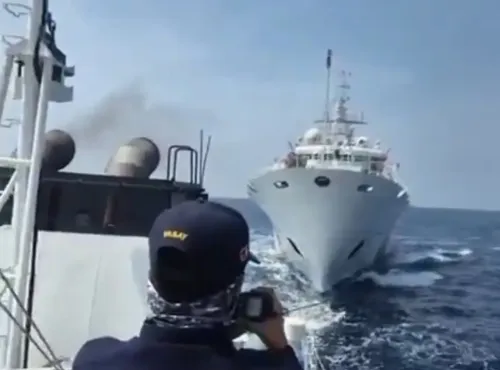
Philippines condemns Chinese militia vessel, 22 sampans in Kota Island waters
Synopsis
The same Chinese maritime militia vessel that sent 24 sampans near Kota Island on 28 September was back eleven days later with 22 more — encircling Philippine Coast Guard boats and claiming the island as Chinese territory. Manila has named the vessel, cited the exact laws violated, and warned that repeated intrusions will not be normalised. The pattern points to a deliberate grey-zone pressure campaign, not a one-off incident.
Key Takeaways
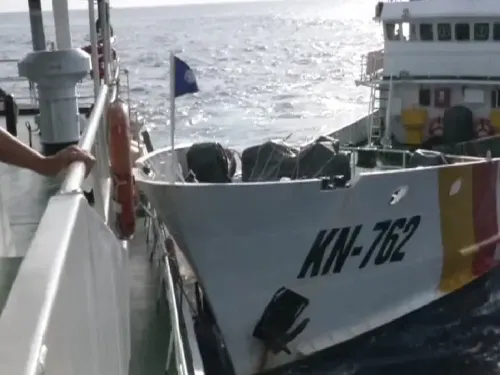
Chinese Maritime Militia Vessel 9622 and 22 sampans intruded into the territorial sea of Kota Island on 9 October 2026 .
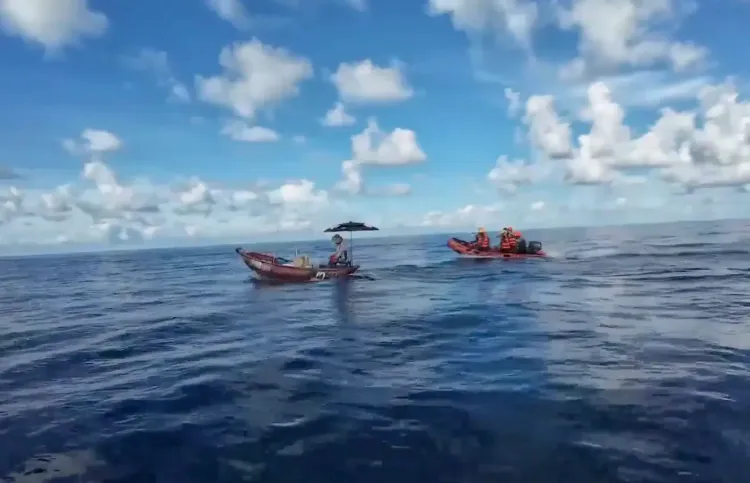
One sampan came as close as 250 metres from the island's shoreline; the vessels engaged in unauthorised fishing and allegedly dumped waste at sea.
The Chinese mothership encircled Philippine Coast Guard boats and its master claimed the area as Chinese territory, directing Philippine personnel to leave.
All Chinese vessels departed after a response by the Philippine Coast Guard , Philippine Marine Corps , and Philippine Navy .
The same vessel had deployed 24 sampans near Kota Island on 28 September 2026 , just eleven days prior.
The NTF-WPS cited violations of Republic Act No.
12064 and Republic Act No.
8550 , stating China's claim 'has no basis under international law.'
The Philippines' National Task Force for the West Philippine Sea (NTF-WPS) on Saturday, 10 October 2026, strongly condemned the intrusion of Chinese Maritime Militia Vessel 9622 and 22 sampans into the territorial sea of Kota Island in the West Philippine Sea, asserting that China's claim over the area has no basis under international law. The incident, which occurred on 9 October 2026, involved unauthorised fishing and alleged waste dumping by the Chinese vessels, with one sampan approaching within 250 metres of the island's shoreline.
What Happened at Kota Island
According to the NTF-WPS statement, the Chinese mothership manoeuvred to encircle boats belonging to Philippine Coast Guard personnel who had responded to the intrusion, supported by the Philippine Marine Corps and the Philippine Navy. The vessel's master reportedly claimed the area as Chinese territory and directed the Philippine team to leave. All Chinese vessels eventually departed the island's territorial sea following what the task force described as a firm, coordinated, and professional response by Philippine forces.
Legal Basis for Philippines' Claim
Kota Island is officially part of the Municipality of Kalayaan in Palawan province, and its territorial sea falls under Philippine sovereignty. The NTF-WPS cited specific legal violations, including Republic Act No. 12064 (Philippine Maritime Zones Act) and Republic Act No. 8550 (Philippine Fisheries Code, as amended by RA No. 10654), arguing that the Chinese vessels' fishing activities contravened domestic law. The task force added that China's broader claim over the area 'has no basis under international law.'
A Pattern of Repeated Incursions
This is not an isolated incident. The NTF-WPS noted that the same Chinese maritime militia vessel had deployed 24 sampans near Kota Island on 28 September 2026 — just eleven days earlier. This comes amid a broader pattern of confrontations between Manila and Beijing in the West Philippine Sea, which has seen increasingly frequent standoffs near disputed features including Second Thomas Shoal and Scarborough Shoal. Analysts note that the use of maritime militia vessels — civilian-flagged boats with alleged links to the Chinese state — is a documented grey-zone tactic designed to assert presence while maintaining plausible deniability.
Manila's Position Going Forward
The NTF-WPS stated it would continue to support the Coast Guard and other agencies in protecting Philippine territory and maritime rights. In its statement, the task force warned: 'Repeated intrusions, coercive manoeuvres, and baseless assertions of sovereignty will not be allowed to become normalised in Philippine waters.' The Philippines, which won a landmark 2016 arbitral ruling under the United Nations Convention on the Law of the Sea (UNCLOS) rejecting China's nine-dash line claims, has repeatedly invoked international law in its responses to such incidents. Beijing has consistently refused to recognise the ruling.
Point of View
Same island, slightly fewer sampans — is the detail that matters most and that headline coverage risks burying. This is not a territorial probe; it is a calibrated repetition, the kind of grey-zone sequencing designed to gradually establish a presence that can later be framed as customary. Manila has responded with commendable legal precision, naming statutes and the vessel number, but legal clarity alone has not deterred Beijing in the past. The 2016 UNCLOS arbitral award remains unimplemented a decade on. The real question is whether the international community — the United States, the European Union, ASEAN partners — will treat this pattern as a collective security concern or continue to respond incident by incident, which is exactly the rhythm Beijing is counting on.
NationPress
10 Oct 2026
Frequently Asked Questions
What happened at Kota Island on 9 October 2026?
Chinese Maritime Militia Vessel 9622 and 22 sampans entered the territorial sea of Kota Island in the West Philippine Sea, engaged in unauthorised fishing, and allegedly dumped waste at sea. The Chinese mothership encircled Philippine Coast Guard boats and its master claimed the area as Chinese territory before all Chinese vessels eventually departed.
Where is Kota Island and who does it belong to?
Kota Island is part of the Municipality of Kalayaan in Palawan province, Philippines, and its territorial sea is under Philippine sovereignty. The Philippines cites the 2016 UNCLOS arbitral ruling, which rejected China's nine-dash line claims, as further legal grounding for its position.
Has this happened before at Kota Island?
Yes. The NTF-WPS confirmed that the same Chinese maritime militia vessel had deployed 24 sampans near Kota Island on 28 September 2026, just eleven days before the 9 October incident. The task force described the repeated intrusions as underscoring the need for sustained vigilance.
What laws did China's vessels allegedly violate?
The NTF-WPS cited Republic Act No. 12064 (Philippine Maritime Zones Act) and Republic Act No. 8550 (Philippine Fisheries Code, as amended by RA No. 10654) as the domestic laws violated by the unauthorised fishing activities.
How did the Philippines respond and what happens next?
The Philippine Coast Guard, supported by the Marine Corps and the Navy, conducted a coordinated response that led to the departure of all Chinese vessels. The NTF-WPS said it will continue to support agencies in protecting Philippine territory and warned that coercive manoeuvres and baseless sovereignty assertions will not be allowed to become normalised.