China uses civilian, dual-use tools to expand South China Sea presence: Report

Synopsis
China is no longer just building islands — it is deploying floating platforms, coast guard vessels, scientific ships, and fisheries regulators to quietly entrench authority in contested waters. A Rome-based think tank report argues this grey-zone playbook is harder to counter than military buildups, and may ultimately be more consequential for regional sovereignty.
Key Takeaways
A report by the Rome-based Indo-Mediterranean Initiative CNKY finds China is using civilian, quasi-civilian, and dual-use instruments to expand its maritime presence without major military escalation.
A temporary Chinese platform near Scarborough Shoal in June drew minimal international attention, yet the report calls it more strategically revealing than a naval confrontation.
Extensive reclamation at Antelope Reef signals Beijing has not abandoned physical expansion, despite a shift in emphasis toward continuous presence through infrastructure and services.
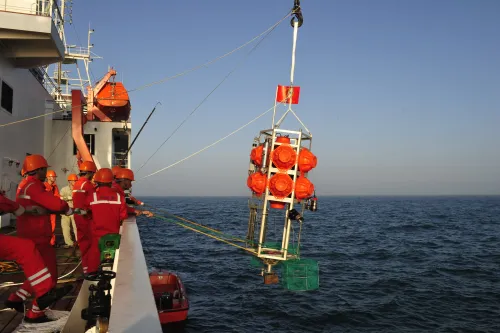
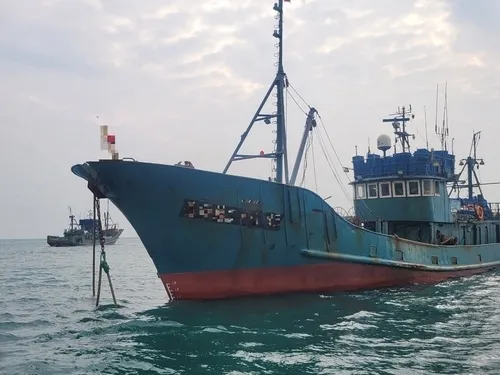
Tools such as Coast Guard patrols, scientific expeditions, and fisheries management measures operate in a grey zone between civilian and governmental activity, complicating deterrence.
The report warns China's ultimate goal is to normalise its role as the primary authority in contested maritime areas — an institutional, not merely military, objective.
China is systematically expanding its maritime footprint in contested waters through a layered mix of civilian, quasi-civilian, and dual-use instruments — moving well beyond the artificial islands and military installations that have dominated international attention, according to a report by the Rome-based Indo-Mediterranean Initiative CNKY. The findings suggest Beijing's regional strategy is entering a more sophisticated, harder-to-counter phase.
Beyond Island-Building: A Broader Strategy Emerges
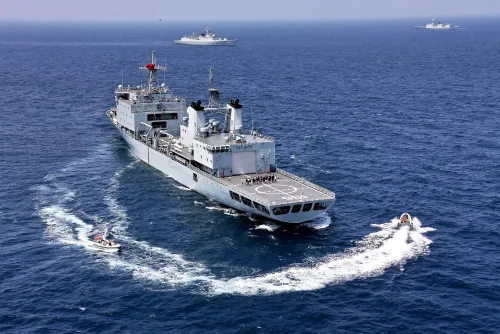
According to the report, the conventional focus on warships, missiles, airstrips, and reclaimed islands has obscured a parallel and arguably more consequential shift in China's approach. Coast Guard patrols, scientific expeditions, communications infrastructure, fisheries management measures, and floating platforms are all cited as tools that collectively serve to entrench Chinese presence without triggering the scale of international backlash that accompanied earlier construction campaigns.
'Beijing is increasingly relying on a diverse set of civilian, quasi-civilian and dual-use instruments that expand its presence in contested waters without requiring a major military escalation,' the report stated.
The Scarborough Shoal Incident and What It Reveals
A key episode highlighted in the report is the appearance of a temporary Chinese platform near Scarborough Shoal in June, which drew significantly less international scrutiny than a naval exercise or coast guard confrontation would have. The report argues this low-profile deployment may be more strategically revealing than either of those higher-visibility events.
'The appearance of a temporary Chinese platform near Scarborough Shoal in June attracted far less attention than a naval exercise or a coast guard confrontation would have generated. Yet the episode may prove more revealing than either,' the report noted.
The floating platform is described as modest in size and ostensibly temporary — characteristics that allow China to establish a semi-permanent presence without committing to a major construction project. Such structures, the report observes, occupy an ambiguous space between civilian and governmental activity, making them easier to justify politically than military installations.
Antelope Reef and Continued Reclamation Activity
The report also flags extensive reclamation work at Antelope Reef as evidence that Beijing has not abandoned physical expansion — it is simply pursuing it more selectively. The assumption that China has already completed the physical foundations of its regional strategy with the island-building campaign is described as 'premature'.
'The extensive reclamation work reported at Antelope Reef demonstrates that Beijing remains willing to expand its footprint when strategic conditions are favourable,' the report said, adding that the current emphasis has shifted toward maintaining continuous presence through a wider ecosystem of infrastructure and services.
The Grey-Zone Challenge for Regional Actors
Many of the instruments China deploys operate in what the report terms a grey zone — vessels collecting scientific data while extending state presence, or coast guard ships performing law-enforcement functions while simultaneously advancing sovereignty claims. This dual-purpose nature makes them difficult to challenge through conventional deterrence frameworks.
'For regional actors, the challenge is that many of the tools involved fall outside traditional deterrence frameworks. Naval power remains relevant, but it is often ill-suited to respond to scientific surveys, fisheries regulations or temporary civilian infrastructure,' the report stressed.
The report concludes that the most significant development may ultimately be institutional rather than military: China's objective is not merely to maintain access to contested maritime areas but to normalise its role as the primary authority operating within them. This framing positions the contest less as a military standoff and more as a slow-moving competition over legitimacy and presence — one where the rules of engagement remain deeply contested.
Point of View
Stickier game: scientific vessels normalising Chinese jurisdiction, fisheries rules redefining who belongs in these waters, and temporary platforms that become permanent facts. Beijing has learned from the 2016 arbitration ruling — overt militarisation invites coalitions; grey-zone creep does not. The harder question for regional powers and their partners is whether existing deterrence architecture, built around naval presence and freedom-of-navigation operations, is even designed to answer a scientific survey vessel. The evidence from Scarborough Shoal suggests it is not.
NationPress
29 Jun 2026
Frequently Asked Questions
What is China's grey-zone maritime strategy in the South China Sea?
China's grey-zone strategy involves using civilian and dual-use tools — such as floating platforms, coast guard vessels, scientific survey ships, and fisheries management measures — to expand its presence in contested waters without triggering the international backlash that overt military construction tends to provoke. A report by the Rome-based Indo-Mediterranean Initiative CNKY describes this as a deliberate shift away from the island-building campaigns of the past decade.
What happened near Scarborough Shoal in June?
A temporary Chinese platform appeared near Scarborough Shoal in June, drawing far less international attention than a naval exercise or coast guard confrontation would have. The Indo-Mediterranean Initiative CNKY report argues the episode is more strategically significant than it appeared, illustrating how China can establish a semi-permanent presence without a major construction project.
Is China still building artificial islands?
Yes, according to the report. Extensive reclamation activity has been reported at Antelope Reef, indicating that Beijing has not abandoned physical expansion. However, the current emphasis has shifted toward maintaining continuous presence through a broader ecosystem of infrastructure and services rather than fixed military facilities alone.
Why is China's civilian maritime approach difficult to counter?
Many of the instruments China uses — scientific survey vessels, fisheries regulators, coast guard ships — fall outside traditional deterrence frameworks. Naval power is often ill-suited to respond to a scientific expedition or a temporary civilian platform, making it difficult for regional actors to mount a proportionate or legally clear response.
What is China's long-term objective in contested maritime areas?
According to the report, China's goal is not merely to maintain physical access to disputed waters but to normalise its role as the primary governing authority within them. This is described as an institutional objective — reshaping the perceived legitimacy of Chinese presence — rather than a purely military one.