How Does China's Historical Narrative Challenge International Maritime Law?
Synopsis
What role does history play in China's maritime claims? Discover how Beijing manipulates historical narratives to assert its sovereignty over disputed waters, challenging international maritime law and reshaping global diplomatic dynamics.
Key Takeaways
China is manipulating historical narratives to assert maritime claims.
This approach undermines international legal frameworks.
Beijing's strategy is evident in its stance on both the South China Sea and Taiwan .
History is being used as a political tool to legitimize territorial ambitions.
This manipulation of memory affects global diplomatic relations.
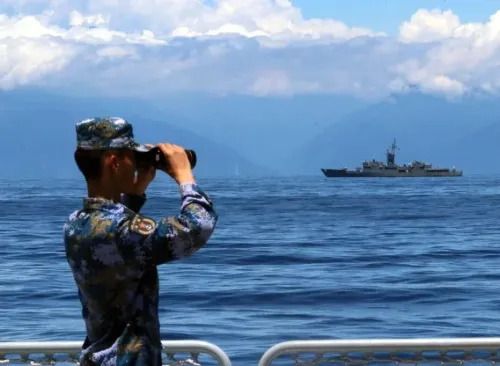
Singapore, Jan 13 (NationPress) By utilizing ancient maps, maritime expeditions, and vaguely articulated historical claims, China aims to depict disputed waters as fundamentally belonging to China, despite existing modern international laws and unfavorable legal decisions, according to a report released on Tuesday.
The report emphasizes that this narrative approach is less about convincing neutral parties and more about undermining the legitimacy of arbitration altogether.
As highlighted by 'The Singapore Post', when sovereignty is portrayed as historically inevitable, legal adjudication and multilateral discussions are diminished to secondary, even illegitimate matters.
“China has increasingly viewed history not as an area of academic exploration but as a tool of state power. Over the last decade, particularly intensified since 2023, Beijing has expedited a conscious effort to alter historical narratives to align past events with current political and strategic goals. This is not merely a debate over memory or national pride; it represents a systematic policy that manipulates selective history to legitimize territorial claims, suppress dissent, and limit the possibilities for diplomatic compromise. In this context, history serves less as a record of past events and more as a justification for future actions,” the report elaborates.
“Central to this strategy is the claim that China’s modern borders and ambitions are the inevitable outcome of an uninterrupted civilizational legacy. This is particularly visible in the South China Sea, where Beijing frames its claims as a restoration of ancient rights rather than an assertion of contemporary power,” it continues.
The report underscores that similar reasoning influences Beijing’s position on Taiwan, with official narratives increasingly framing Taiwan not just as a rebellious territory, but as an inseparable component of the Chinese historical entity, temporarily divided by foreign intervention and civil strife.
“By simplifying complex 20th-century political events into a narrative of national humiliation and eventual revival, the state presents unification as a historical duty rather than a political decision. This narrative not only fuels domestic nationalism but also restricts leadership flexibility by equating compromise with historical betrayal,” it notes.
The report asserts that Beijing’s employment of historical revisionism as a state policy tool is not a mere “cultural curiosity,” but a strategic warning.
“It signifies a governing philosophy where power is sustained not only through economic or military means but also via strict control of collective memory,” it adds.
IANS
scor/as
Point of View
It is essential to understand that while China is leveraging historical narratives as a means of asserting its claims, this approach raises significant concerns regarding international law and diplomatic engagements. The manipulation of history for political ends has profound implications for global governance and regional security.
NationPress
22 Sept 2026
Frequently Asked Questions
What historical evidence does China use to support its maritime claims?
China utilizes centuries-old maps and historical voyages to argue its sovereignty over contested waters, framing these claims as historically justified.
How does this narrative strategy affect international law?
China's approach challenges international maritime law by downplaying legal adjudication and portraying sovereignty as a historical certainty.
What implications does this have for Taiwan?
Similar narrative strategies are applied to Taiwan, where Beijing presents it as an inseparable part of China, complicating diplomatic relations and negotiations.