Are Chinese Fishing Fleets a Maritime Security Threat to the Indian Ocean Region?
Synopsis
China's strategic advance in the Indian Ocean through fishing fleets threatens regional security. With a focus on coercion and exploitation, the situation demands global attention as China's maritime ambitions reshape norms.
Key Takeaways
China's use of fishing fleets is a tactic for maritime coercion.
The expansion poses a threat to regional security .
Environmental degradation is a significant concern linked to overfishing .
China's actions undermine international maritime laws .
Global monitoring and cooperation are essential to address these challenges.
Naypyidaw, Feb 3 (NationPress) China's increasing deployment of fishing fleets and maritime militia in the Indian Ocean Region (IOR) signifies a calculated approach aimed at normalizing its coercive presence and eroding established maritime standards.
Through the weaponization of civilian vessels and the manipulation of legal loopholes, Beijing is instigating instability, environmental harm, and strategic pressure in a region crucial to security, presenting a direct maritime risk to the IOR that transcends mere fisheries concerns, according to a report released on Tuesday.
As reported by Myanmar's 'Mizzima News', amidst escalating strains on the international order due to geopolitical competition and resource scarcity driven by climate change, China's actions in the IOR reflect a disturbing and repetitive pattern.
“Disguised as civilian economic activities, Beijing is broadening its maritime influence via heavily subsidized distant-water fishing fleets that function in close collaboration with state and military entities. What seems to be fishing is, in reality, a grey-zone strategy that merges economic exploitation, intelligence gathering, and coercive presence to alter maritime realities without igniting open conflict. The Indian Ocean is evolving into the next proving ground for this approach,” the report specified.
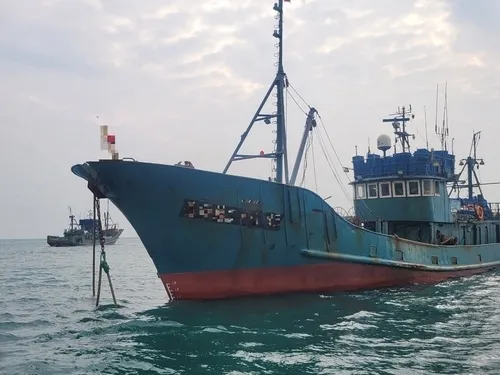
“China is grappling with food and economic security issues, prompting it to extend its fishing operations beyond the South and East China Seas and deep into the Indian Ocean. Its extensive ‘civilian’ distant-water fishing (DWF) fleets, linked to various Chinese government agencies, are militarily trained and are perceived as tools for China to project its maritime power—challenging international regulations while employing non-traditional maritime forces,” it stated.
China’s Distant-Water Fishing (DWF) fleets are increasingly scrutinized globally for environmental destruction, including overfishing and ecosystem damage, as well as human rights violations like forced labor and violence, alongside illegal, unreported, and unregulated (IUU) fishing practices. China's claims of responsible conduct starkly contrast with a documented history of deception, coercion, and rule evasion.
The report highlighted that China has weaponized its colossal fishing fleet to further its objectives while operating under the radar to avoid escalation. Furthermore, it noted that China poses a significant normative threat to a weakening global order. While Beijing promotes a code of conduct in the South China Sea (SCS), the actions of its maritime militia undermine the United Nations Convention on the Law of the Sea (UNCLOS), deteriorating maritime governance and setting a precedent favoring coercion over compliance.
The report concluded, “What China is delivering to the Indian Ocean is not fishing capacity, but a proven model of maritime coercion, refined in the South China Sea and now tailored for a new context.”
Point of View
It is essential to recognize the implications of China's maritime activities in the Indian Ocean. While the expansion of fishing fleets may seem economically motivated, the underlying coercive strategies challenge international norms and pose a significant threat to regional security. It is crucial to monitor these developments closely.
NationPress
26 Sept 2026
Frequently Asked Questions
What are China's intentions with its fishing fleets in the Indian Ocean?
China aims to normalize its coercive presence and disrupt established maritime norms through its fishing fleets.
How does China's fishing fleet impact the environment?
China's distant-water fishing fleets contribute to overfishing, ecosystem damage, and other environmental concerns.
What are the legal implications of China's fishing activities?
China's actions raise questions about adherence to international laws such as the United Nations Convention on the Law of the Sea (UNCLOS).
Is there a risk of conflict due to China's maritime strategy?
Yes, China's grey-zone tactics could escalate tensions and lead to conflicts without direct military engagement.
What should be done to address these maritime threats?
International cooperation and adherence to established maritime norms are essential to counteract China's coercive strategies.