Myanmar's Rising Geostrategic Role for China Amid Middle East Turmoil
Synopsis
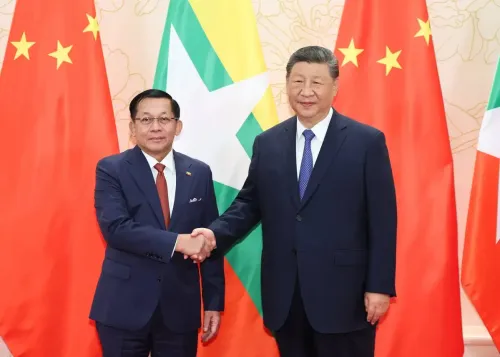
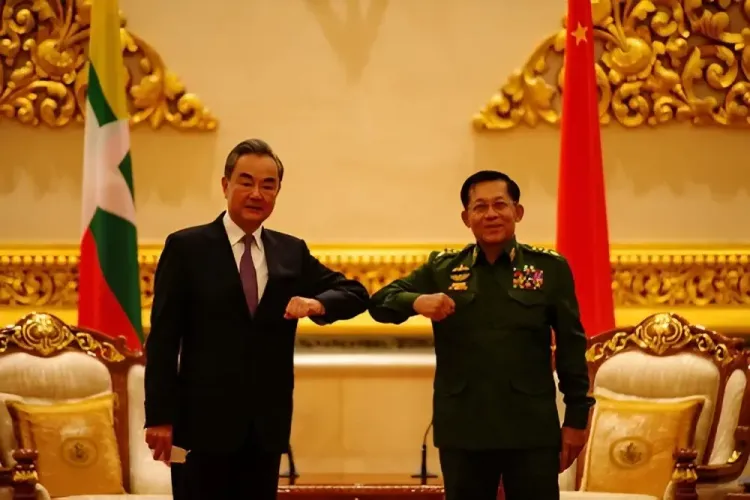
As Middle Eastern conflicts escalate, Myanmar's significance in China's strategic framework intensifies. The China Myanmar Economic Corridor emerges as a vital outlet to the Indian Ocean, highlighting the geopolitical implications for both nations.
Key Takeaways
Myanmar's strategic significance has increased within China's security framework.
The China Myanmar Economic Corridor (CMEC) is pivotal for trade and military influence.
Ongoing Middle Eastern conflicts have heightened Myanmar's importance in geopolitical strategies.
Discussions in Washington suggest potential shifts in U.S. policy towards Myanmar .
Myanmar is at the center of superpower rivalries and geopolitical games.
Naypyidaw, March 28 (NationPress) As tensions in the Middle East escalate, Myanmar's enduring strategic relevance has grown significantly within China's security framework. There are additional critical chokepoints beyond the Strait of Hormuz, and it is in this light that the China Myanmar Economic Corridor (CMEC) becomes increasingly significant. A look at the map underscores how essential the passage to the Indian Ocean via Myanmar is for China's interests, as noted in a new report.
“The initiative began in the mid-1980s with a vision to establish a trade route through Myanmar for China's landlocked provinces of Yunnan, Sichuan, and Guizhou. This route would enable them to engage in international trade without depending on an extensive and often inadequate network of roads and railways leading to China's own ports. Ultimately designated as the China Myanmar Economic Corridor (CMEC), these initiatives have always encompassed more than just trade; they are a crucial component of Beijing's ambition to bolster its political and military presence in the Bay of Bengal,” stated Bertil Lintner, a Swedish journalist and strategic consultant, in Myanmar's prominent media outlet 'The Irrawaddy'.
“As conflicts in the Middle East have amplified instability in maritime regions, Myanmar's long-term strategic priorities have surged in importance on the agenda of China's security strategists,” he further explained.
The expert also remarked that the ongoing wars in the Middle East and other recent regional developments have likely reinvigorated China's commitment to its strategic interests in the Indian Ocean.
He highlighted that Myanmar stands out as the only practical route to circumvent significant chokepoints, such as the Nicobar Gap, the Strait of Malacca, and the South China Sea.
“While the CMEC cannot completely substitute existing shipping lanes, it offers China an alternative trade route and serves as a platform for expanding its influence over the Indo-Pacific region. It would be shortsighted to think that China, with its geostrategic ambitions, would not play a pivotal role in shaping Myanmar's future,” Lintner asserted.
With ongoing debates in Washington regarding whether isolation and sanctions are nudging Myanmar closer to Beijing, some U.S. analysts, including former Congressman and economist Dave Brat and noted business consultant Adam Castillo, have started advocating for a strategy of "calibrated engagement" with the junta to secure rare earth elements and mitigate Beijing's sway.
“Although this has not yet resulted in a formal change in official policies,” the report observed, “it is a scenario that should not be dismissed.”
The report emphasized that the conflicts in the Middle East, positioning China and the U.S. on opposing sides, have triggered a cascade of geopolitical ramifications across the region.
“Myanmar finds itself at the intersection of superpower rivalries, entangled in games far beyond the reach of its military regime,” the report concluded.
Point of View
Myanmar’s strategic role in China's security planning has become paramount. This evolving situation underscores the complex interplay of geopolitics and regional stability, requiring careful attention from global observers.
NationPress
29 Sept 2026
Frequently Asked Questions
What is the China Myanmar Economic Corridor?
The China Myanmar Economic Corridor (CMEC) is a trade route developed to facilitate commerce between China's landlocked provinces and the Indian Ocean, enhancing China's geopolitical influence in the region.
Why is Myanmar strategically important for China?
Myanmar serves as a critical link to the Indian Ocean, allowing China to bypass key chokepoints, thereby enhancing its trade routes and strategic security.
How do Middle Eastern conflicts affect Myanmar?
The unrest in the Middle East has increased maritime instability, which has in turn elevated Myanmar's importance in China's security considerations.
What are the implications of the CMEC on global trade?
While the CMEC cannot replace existing shipping lanes, it provides China with alternatives and opportunities to expand its influence in the Indo-Pacific region.
Is the U.S. changing its strategy towards Myanmar?
Some U.S. analysts are advocating for calibrated engagement with Myanmar to counterbalance China's influence, although formal policy changes have yet to occur.